AI detectors make big promises, and Winston AI makes some of the biggest. The platform claims to be THE ONLY AI detector with 99.87% accuracy! Such a claim is worth testing rather than just trusting it.
So, I tested it! And now you are reading a detailed review that covers what happened when I signed up, scanned three very different texts, checked the pricing page, and read what other testers and users reported.
By the end of this article, you’ll know:
- How Winston AI’s interface feels;
- What the free trial covers;
- What Winston AI pricing looks like after verification;
- How the detector handled my AI detection tests;
- Whether it fits your workflow.
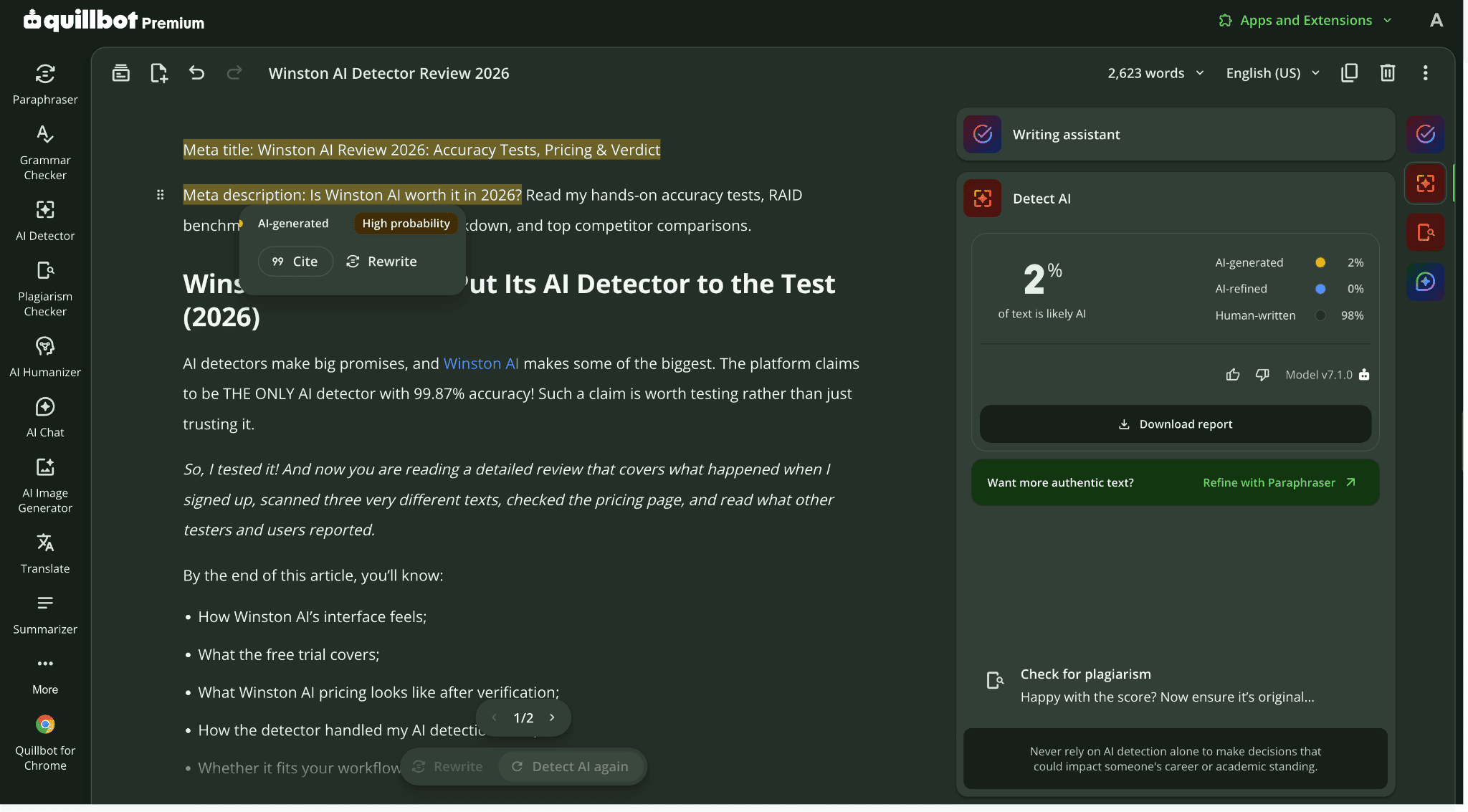
📢 A note on conflict of interest before we start: GetSolved runs its own AI checker, which makes Winston AI a competitor to a tool I write alongside. That said, I evaluated Winston strictly on observed results, with no preconceptions about its quality.
What Is Winston AI?
Winston AI is a content-integrity platform from a Montreal-based company, built around an AI content detector that estimates whether a text was written by a human or by generative AI. Around that core sit a plagiarism checker, an essay grader, an AI image and deepfake detector, writing feedback, a fact checker, and shareable PDF reports.
The audience is wide. Teachers review student work with it, publishers and SEO teams screen freelance drafts, and any content creator can check a piece before it goes live. That mix explains why Winston keeps appearing in comparisons of the best AI detector tools.
Many AI detectors now compete for the same buyers while AI writing tools keep improving. It means the best AI content detector this month may not hold the title for long. Anyone who has used such tools for a while knows that rankings shift with every model update.
First Impressions: Interface and Free Trial
The interface is comfortable from the first second. The homepage places a large text window at the top, so you can paste your text for AI detection before reading a single menu label. Nothing needs explaining, which is rare for a tool with this many features.
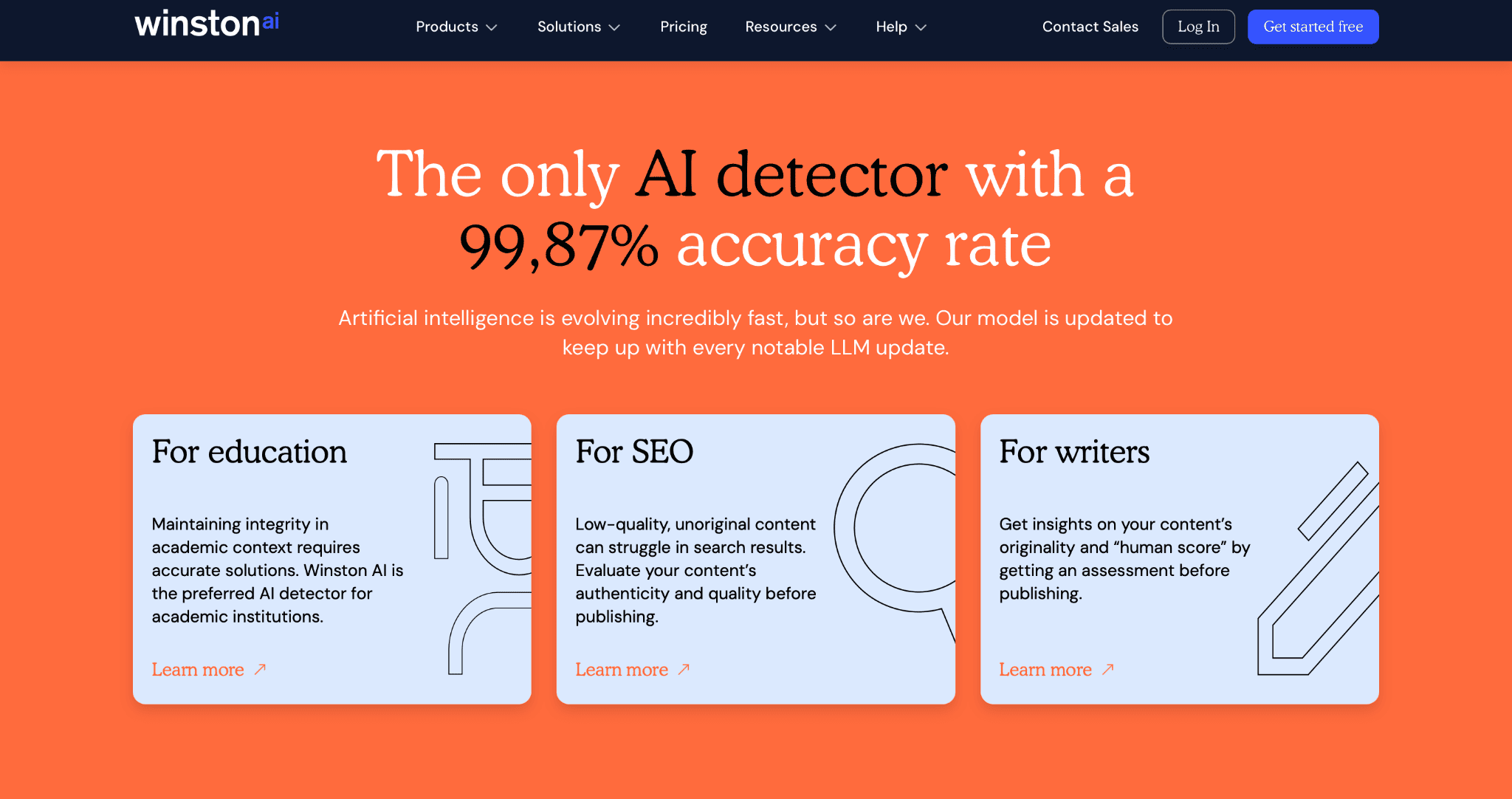
There is one catch: the page invites you to start for free, but a scan still requires you to create an account. No credit card is required, though.
The free trial includes 2,000 credits valid for 14 days. In practice, that covers roughly two 1,000-word texts, enough for a few real checks. Compared with similar tools, it is a generous start, though I wouldn’t call it a free plan in the usual sense: once the 14 days or credits run out, scanning stops until you pay.
Winston AI Features
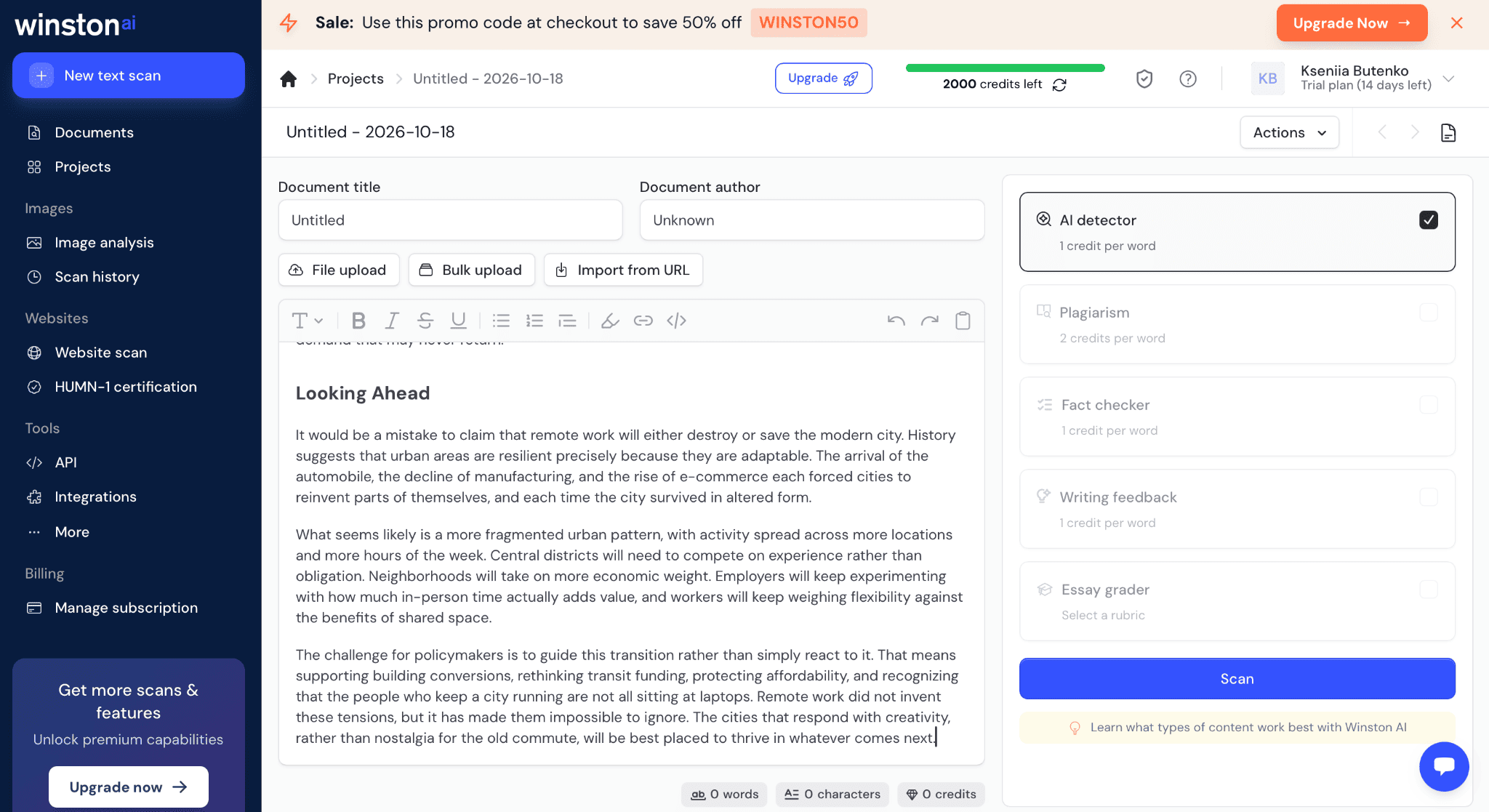
What’s good about Winston AI is its broad feature set. The AI Prediction Map sits at the center of the experience. Instead of a single number, Winston highlights the sentences it reads as likely AI next to those it reads as human, along with an overall human score.
To see why that matters, it helps to know how AI detection works: detectors measure how predictable the wording is, so sentence-level highlighting shows which passages drove the result.
Beyond the map, Winston AI offers a long list of extras:
- AI model coverage: detection of ChatGPT, Gemini, Claude, and other AI models, plus paraphrased content detection.
- Multi-language checks: English, Spanish, Simplified Chinese, German, Polish, Portuguese, Italian, Ukrainian, and Dutch.
- Shareable authenticity reports: results export as a link or PDF, handy when a teacher or agency needs to show the evidence.
- Plagiarism detection: advanced plagiarism checking with highlighted sources, so one scan covers both content and plagiarism.
- AI image and deepfake detection: images for AI detection from Midjourney, DALL-E, Stable Diffusion, and more.
- Extras: writing feedback, OCR for pictures and handwriting, and a fact checker for fact-checking claims inside a draft.
That breadth sets Winston apart from single-purpose checkers. A text detector, a plagiarism checker, and an image scanner in one account mean fewer tabs and fewer subscriptions.
The multilingual support deserves a second look if you write in languages other than English. Winston lists Italian, Ukrainian, and Polish alongside the major languages, though the accuracy figures I found are for English documents. Hence, a non-English result is worth confirming with a second reader.
The same caution applies to the AI image detector: I did not test it, so I can only refer to what the pricing page lists rather than vouch for its performance.
Does Winston AI Match Its Accuracy Claims?
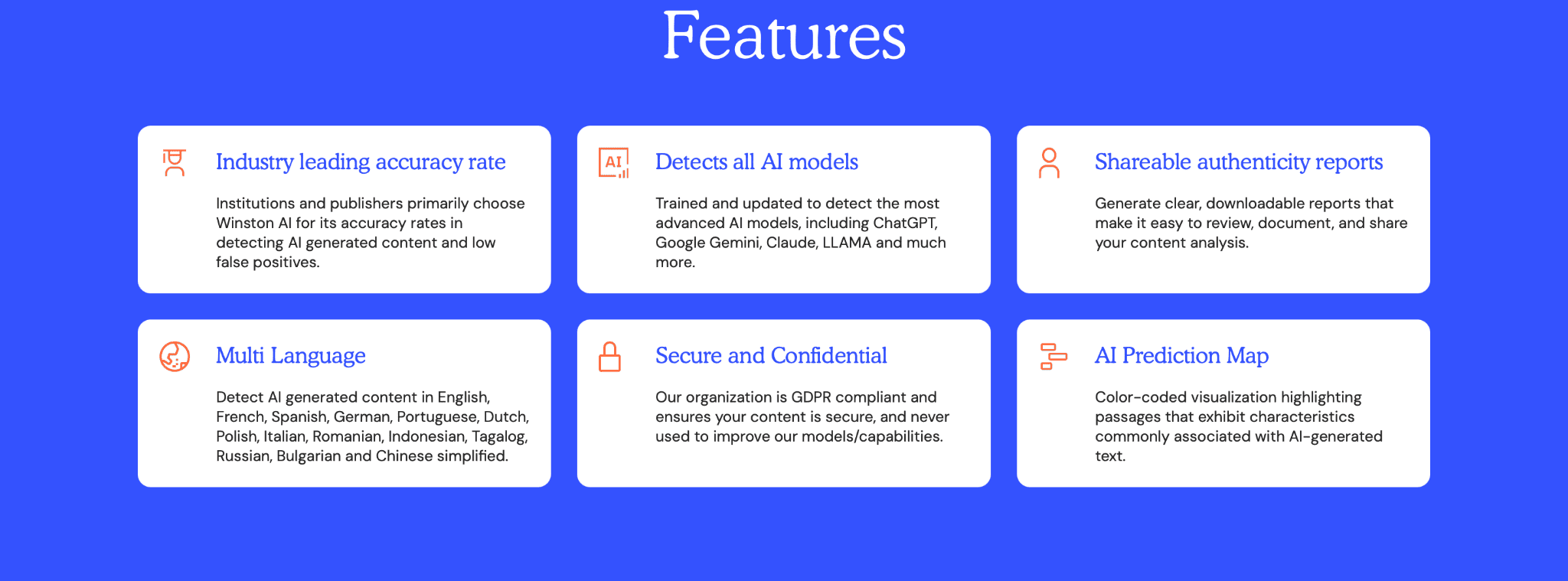
The 99.87% figure comes from the vendor, so I treated it as a claim to check.
- The Winston 5.0 announcement ties the number to an in-house test of 12,000 English documents: 11,984 classified correctly, 16 errors. The sample is large, but Winston built and ran the test itself.
- Another stronger piece of evidence comes from RAID, a public benchmark introduced at ACL 2024 that compares detectors at a fixed false-positive rate. At a 1% false-positive rate, with adversarial attacks included, Winston reports catching 99.89% of AI writing.
- The same snapshot, dated October 5, 2026, lists Grammarly at 98.21%, QuillBot at 98.10%, and GPTZero at 92.93%. Those comparison figures appear in Winston’s own write-up, but the public RAID leaderboard lets you verify them.
Winston says it leads that leaderboard, and a first-place finish on RAID would be an impressive result.
Outside Winston’s own testing, the picture is more mixed. A University of Florida study, summarized by Originality.ai, reported Winston’s mean GPT-prediction scores as 75.9% and 82% on two academic datasets, compared with 97.5% and 95.5% for Originality.ai. Detectors update often, and that research predates Winston 5.0, so the numbers describe an older model.
Still, the gap shows why the accuracy of AI detectors deserves hands-on testing, not just headline percentages. AI detection accuracy changes with text length, topic, and editing, and inaccurate AI detection hurts most when a human writer pays the price.
My Three AI Detection Tests
I ran three texts through the Winston AI detector and took a screenshot of every result: one fully AI-generated text, one passage from Harry Potter, and one New York Times article. Together, they show how the tool treats AI-generated and human-written text, which is the minimum a reader needs before trusting any detection tool.
Each test follows the same pattern of setup, result, and observation.
Test 1: Fully AI-Written Text
Setup: I generated a 1160-word text with AI (the kind of raw draft a writer might paste in) and ran it through Winston without edits to see how the detector handles the easiest case.
Result: Winston AI scored the text as 100% AI.
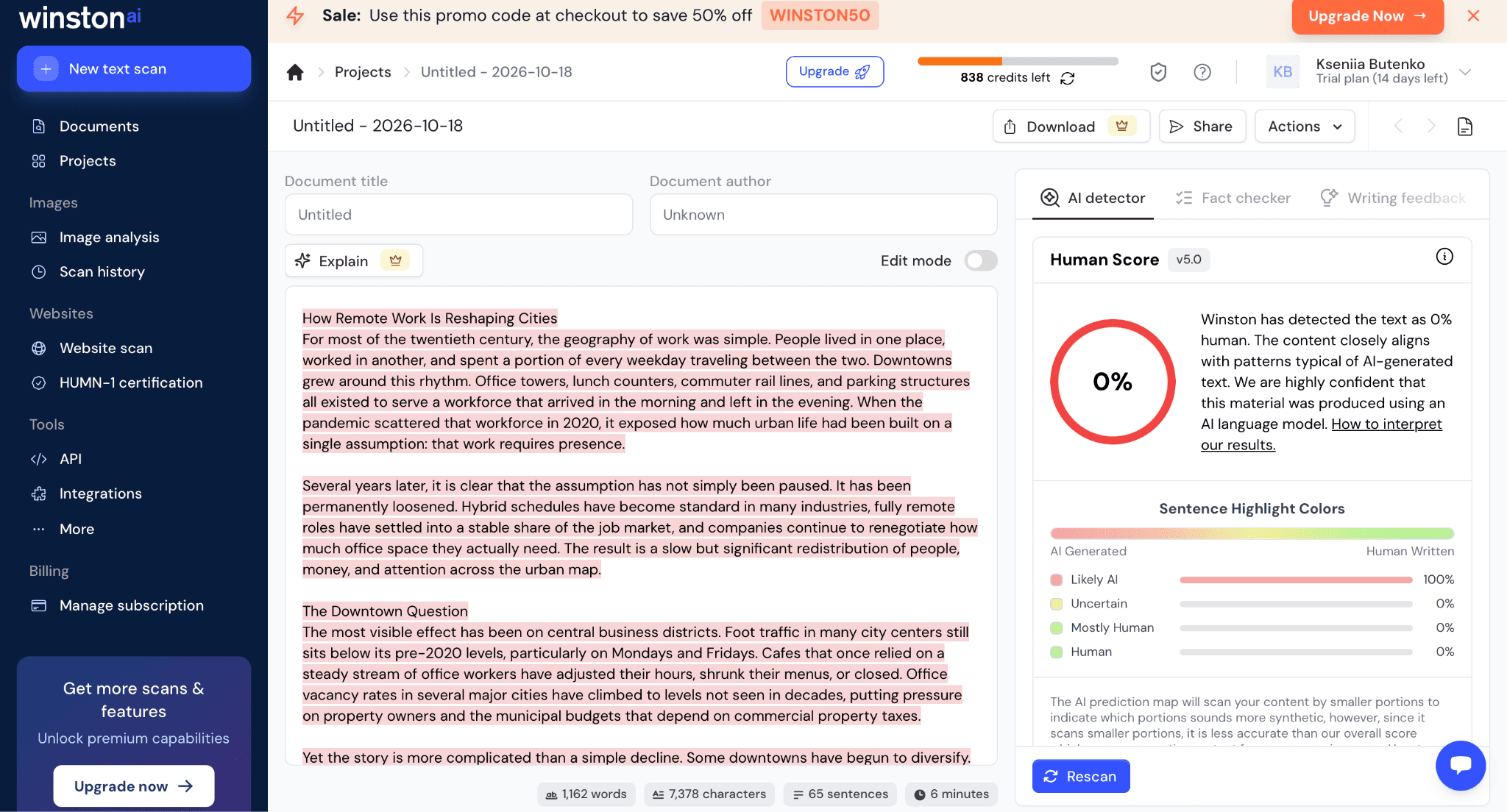
Observation: Raw machine writing was flagged exactly as it should be, and the AI-detected score left no room for doubt. Unedited output is the baseline every AI text detector is expected to pass, confirming the basics rather than proving anything advanced. If you suspect a freelancer pasted raw ChatGPT output, Winston is most dependable here — the score is unambiguous, and the highlighted sentences give you concrete proof to show them.
Test 2: A Harry Potter Passage
Setup: The second sample was a 220-word passage from a Harry Potter novel, published long before generative AI existed. A reliable detector must leave it alone.
Result: Winston AI scored the passage as 100% human.
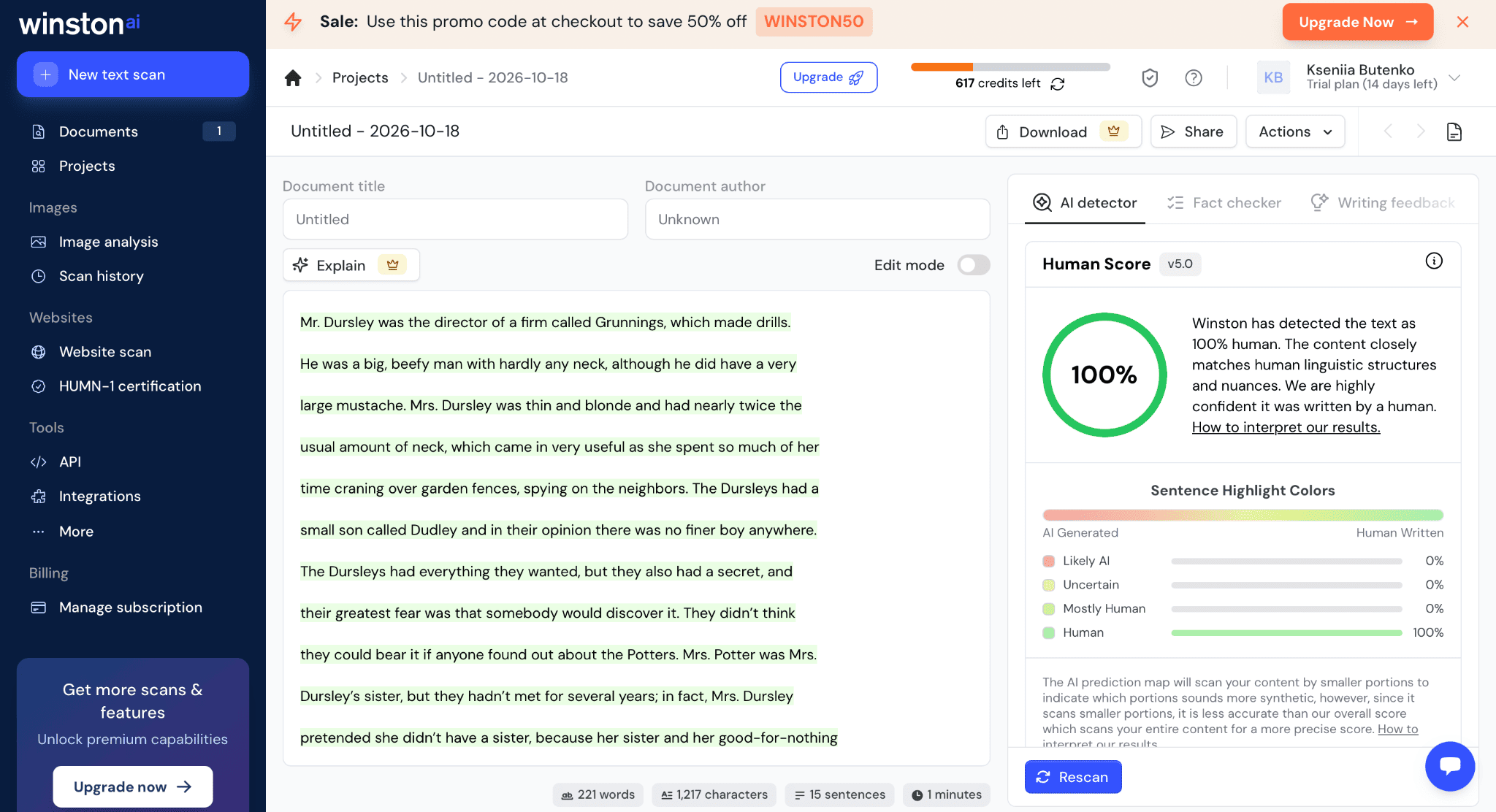
Observation: No false positives on narrative fiction. Clean, well-edited prose is the kind of writing AI detectors sometimes flag by mistake, so a clean pass counts in the tool’s favor. In practice, carefully edited writing passed here without a false alarm, though a single passage is only one data point.
Test 3: A New York Times Article
Setup: For the third test, I used a 245-word excerpt from a New York Times article by Rebecca Chao: professionally edited journalism with a formal structure, a style that other testers report as a false-positive trigger.
Result: Winston AI scored the article as 100% human.
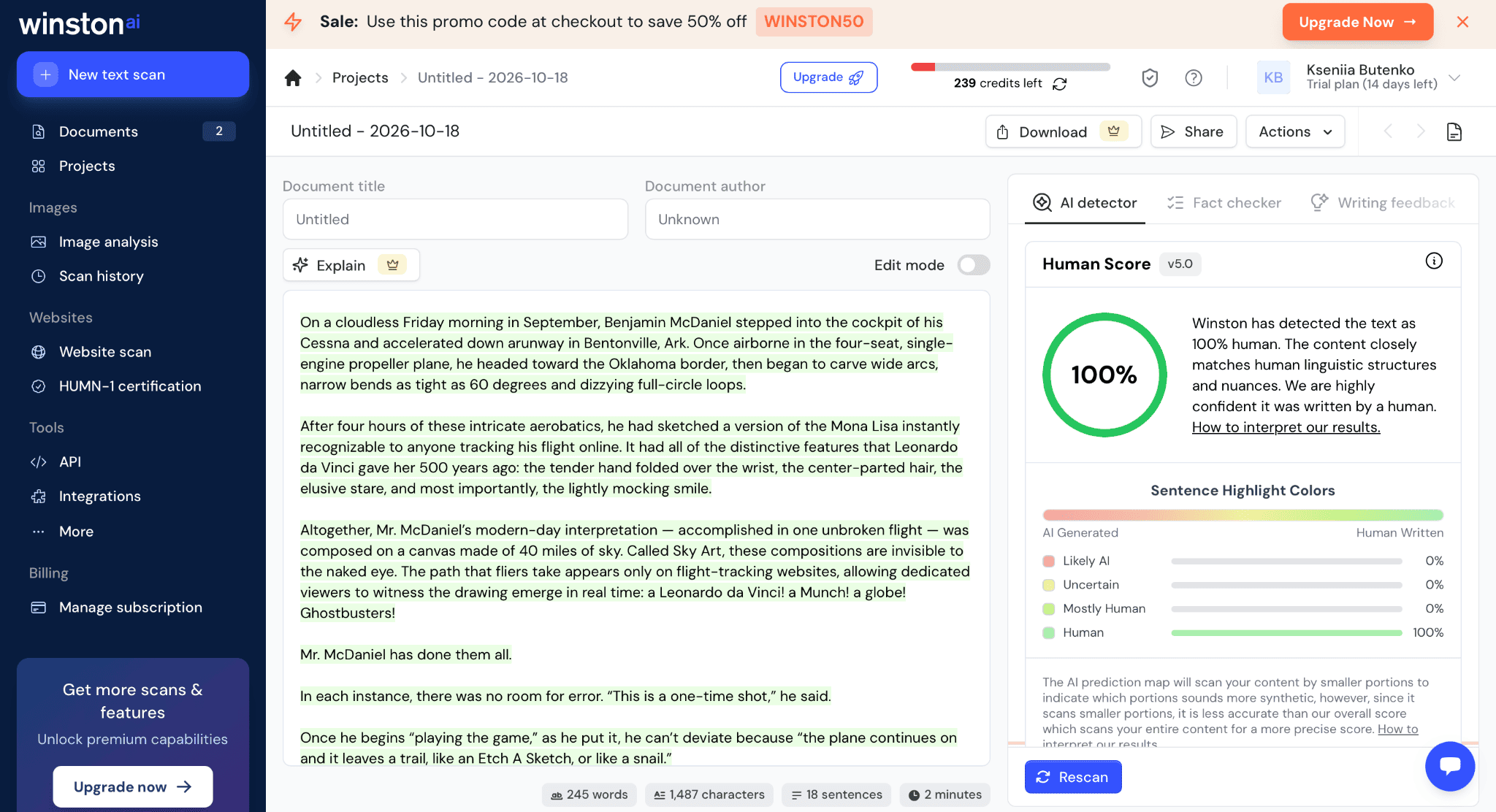
Observation: The detector flags polished, structured reporting as human-written content, which matters when checking editorial or academic work. Students and teachers worry most about this scenario because a false accusation costs far more than a missed detection, and a tool that stays calm on structured, formal prose is easier to trust.
To detect AI-generated content by hand, or to back up a score, there are signs you can use to tell if content is AI-generated without any software.
What these tests don’t cover: all three samples were unedited. I didn’t scan mixed human-and-AI drafts, humanized text, or short snippets, and three scans can’t measure a false-positive rate. Read my results as a sanity check: accuracy was high on clean cases, and the hard ones remain untested.
What Other Testers and Users Report
Because my tests skipped the hard cases, I checked what others found when they put Winston and other AI tools in the same category through harder inputs.
🟣 Originality.ai ran three ChatGPT-5 samples through Winston in October 2025. The blog post scored 100% AI, the promotional email 87%, and the ebook extract only 3%. Winston 5.0 arrived in September 2026, so a rerun is overdue, but the inconsistency in format is worth knowing. Originality also sells a competing product, so weigh its tests accordingly.
🟣 EssayDone, a humanizer vendor, reported other weak spots in October 2025: a 454-word text that was 41% human scored 3% human, and AI text passed through QuillBot’s humanizer scored 100% human. DecEptioner, another humanizer vendor, said several blogs written before 2018 were flagged as AI in its February 2026 test.
🟣 Users describe a split on Trustpilot. One reviewer uses Winston to spot work that feels too polished for their students’ level, while another says it flagged historical speeches as AI-generated.
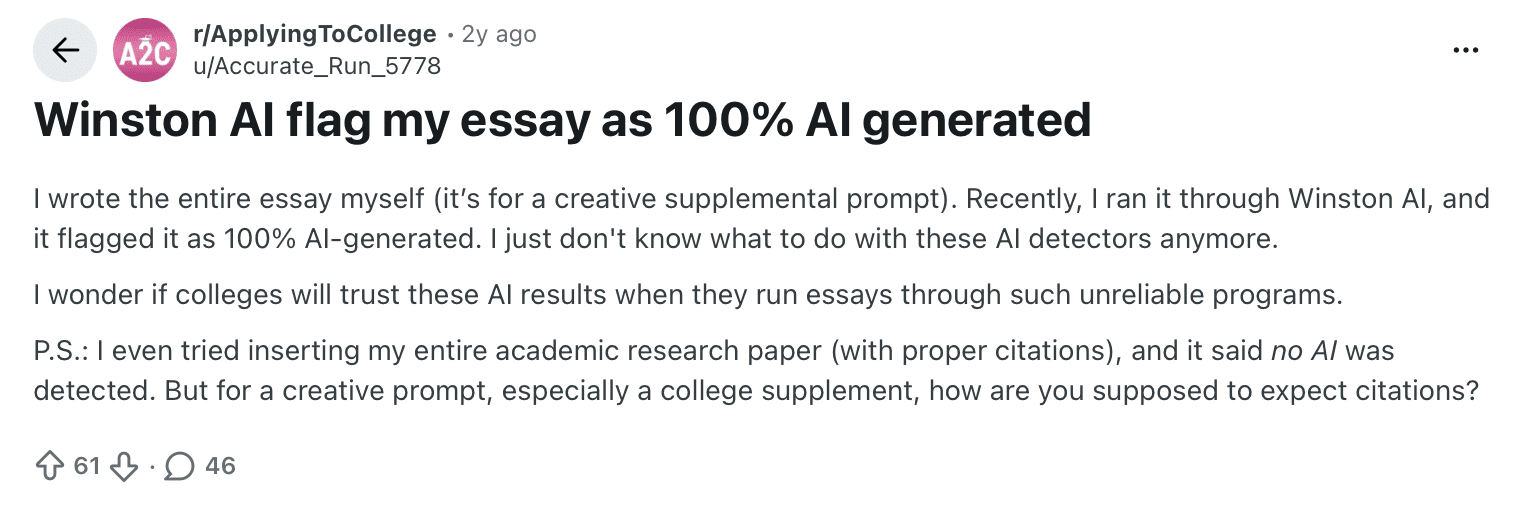
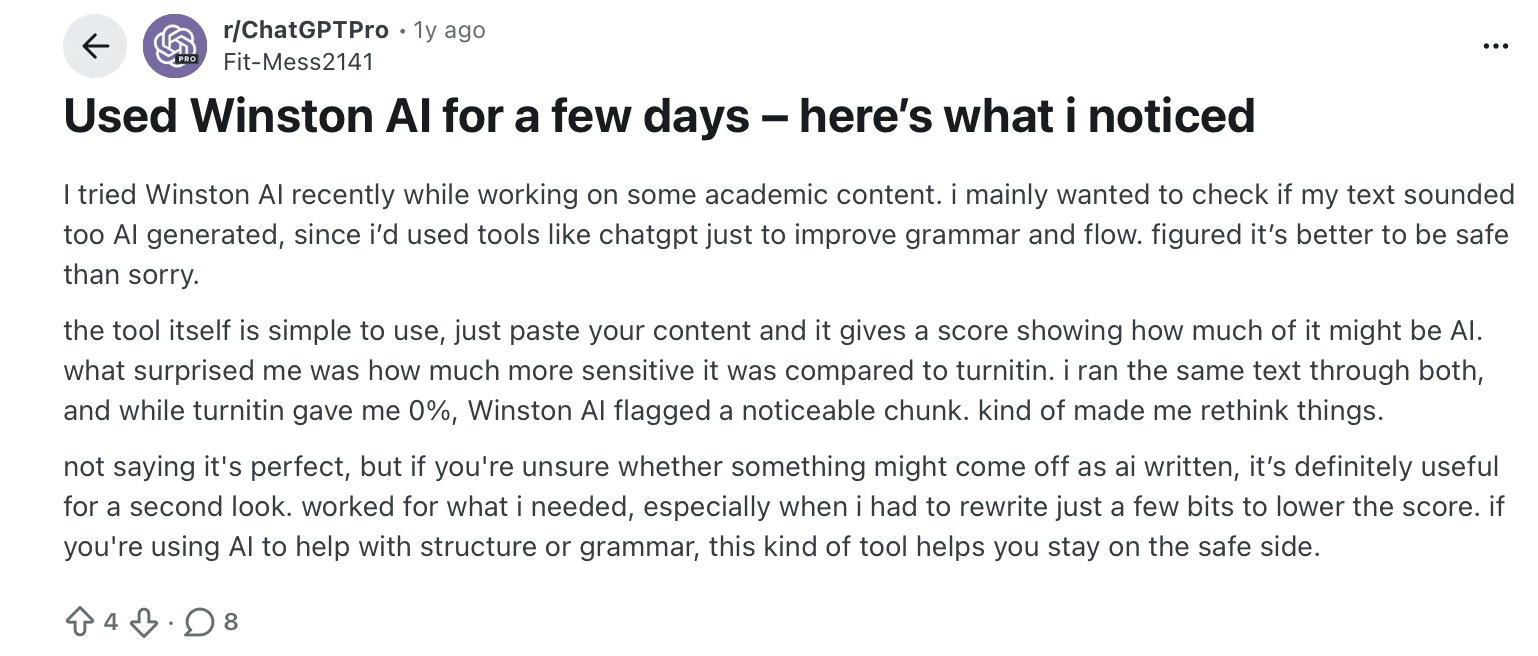
🟣 Additionally, users on Reddit report different results too. A tool built to detect AI can misjudge a human-AI blend as easily as a pure draft. The pattern matches my results. Winston handles clean cases well, while formal prose and heavily edited text are where AI detectors flag too much or too little.
Winston AI Pricing
Winston offers a free plan only as a trial, so the paid tiers below are what you will actually use.
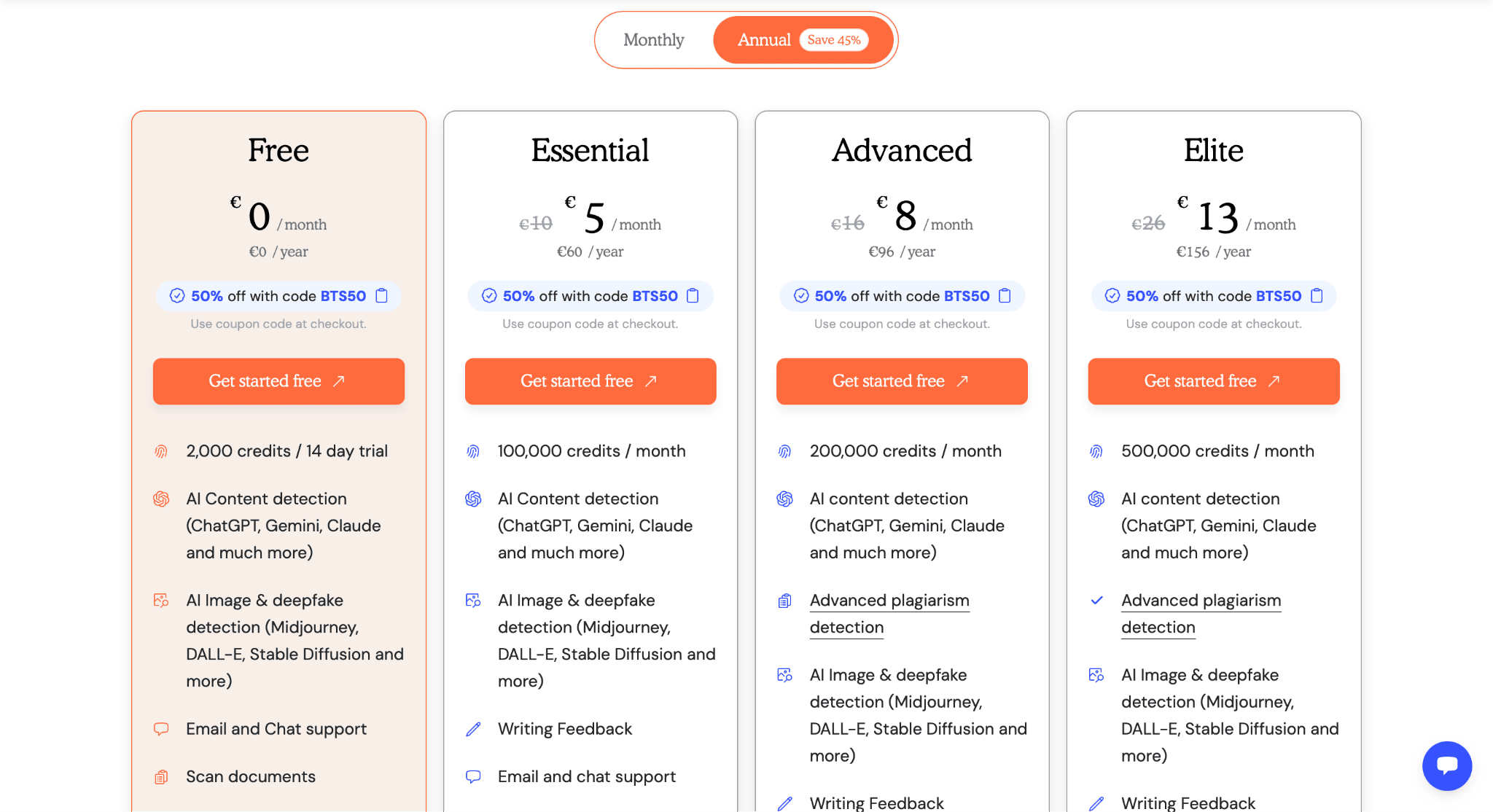
Pricing verified on October 18, 2026.
- Free trial: $0 for 14 days, with 2,000 credits, AI content detection, image and deepfake scans, OCR and PDF reports.
- Essential: Standard $18/month (or $12/month billed annually). With the active 50% promo code (BTS50), pricing drops to 5/month (billed monthly; 60/year). Includes 100,000 credits a month, writing feedback, and plagiarism detection.
- Advanced: Standard $29/month (or $19/month billed annually). With the BTS50 promo code, pricing drops to 8/month(96/year). Includes 200,000 credits, up to 5 team members, and HUMN-1+ website certification.
- Elite: Standard $49/month (or $29/month billed annually). With the BTS50 promo code, pricing drops to 13/month(156/year). Includes 500,000 credits and unlimited team members.
Monthly plans can be canceled at any time, with the change taking effect at the end of the paid term. Annual plans cannot be canceled during the term. Winston AI also bundles AI text, images, and plagiarism checks into one plan, so the list price is reasonable, but check the credit allowance before you commit if you scan long documents daily.
What’s interesting is that Winston AI also proposes custom plans, which may be more comfortable for institutions.

Winston AI vs Originality.ai, GPTZero, and Other Detectors
Originality.ai vs. Winston AI is the matchup most readers ask about, and Originality.ai’s AI side of that debate leans heavily on academic studies.
- Originality points to a University of Wisconsin-Madison study in which it scored an F1 of 0.92 against Winston’s 0.83. Winston answers with its RAID results.
Both sides publish benchmarks that flatter them, so the fair takeaway is that neither dominates across all datasets.
GPTZero is another name that comes up constantly.
- On RAID at a 1% false-positive rate, Winston reports 99.89% against 92.93% for GPTZero, yet GPTZero’s own re-run of the Chicago Booth benchmark shows 99.3% AI recall with a 0.05% false-positive rate.
Strong numbers on both sides again make a hands-on test the deciding factor.
- Grammarly sits close behind on RAID at 98.21%, and the review of Grammarly’s AI detector shows how that tool behaves on real text.
Whichever tool you choose, run the same text through a second detector before acting on a score.
Winston’s Strengths and Weaknesses
Pros
- Clean results on human text: 100% human on both the Harry Potter and New York Times samples.
- Strong independent benchmark: 99.89% on RAID at a 1% false-positive rate, verifiable on the public leaderboard.
- Broad toolkit: plagiarism, image and deepfake detection, writing feedback, and OCR on the cheapest paid plan.
- Transparent pricing: public plans, verified on October 18, 2026.
Cons
- A trial, not a free plan: 2,000 credits for 14 days.
- Mixed older third-party results: 87% on a promotional email and 3% on an ebook extract in October 2025.
- Reported false positives on formal writing: Trustpilot reviews and one competitor’s pre-2018 blog test.
- No mid-term cancellation: annual plans lock you in for the full year.
- Vendor-reported headline accuracy: the 99.87% and 99.89% figures come directly from Winston’s own publications.
Who Should Use Winston AI
Winston is a strong fit for teachers, editors, and SEO teams. AI helps teachers review essays quickly when highlighted sentences and shareable reports sit in one view, and publishers get plagiarism and AI checks from one subscription.
Individual users also benefit: Winston sells self-serve plans, while Turnitin typically requires an institutional contract.
Skip it if you need a permanent free plan or if your main concern is heavily edited or humanized text, which detectors in the tests I read struggled with.
AI detectors estimate probability and cannot prove authorship. Thus, never treat a score as the sole basis for accusing someone of using AI. Pair it with draft history and the writer’s own explanation.
Final Verdict
Winston AI wins on breadth and on clean human-versus-AI calls. It passed all three of my tests.
- Its RAID result is strong, and the Essential plan packs plagiarism, image detection, and writing feedback into one account. It loses points for a trial-only free offer, vendor-reported headline accuracy, and uneven results in older third-party tests.
Pick it if you review a lot of text and want one dashboard for it. For a second opinion on borderline results, scan the same text with another checker before you decide!
Winston AI FAQ
Is Winston AI’s 99.87% accuracy claim real?
In my three tests, yes, it scored the AI text as 100% AI and both human samples as 100% human. Winston reports 99.87% overall accuracy and 99.89% on RAID, but those numbers come from the vendor, and older third-party tests found weaker results on some formats. Accurate content detection depends on the text type, so test your own samples.
Can Winston AI detect ChatGPT?
Yes. Winston lists ChatGPT, Gemini, and Claude among the AI models it detects, and my fully AI-generated sample came back as 100% AI. Heavily rewritten or humanized text is a harder case for any AI detection tool.
Does Winston AI offer a free plan?
Winston offers a free trial rather than a permanent free plan: 2,000 credits for 14 days. After that, you need a paid subscription to keep scanning.
Is Winston AI better than Turnitin?
They serve different buyers. Turnitin typically sells to institutions, while Winston sells self-serve plans to individuals and teams. Which one catches more AI depends on the dataset, so schools often use more than one signal.
Does Winston AI check plagiarism?
Yes. Winston includes plagiarism detection with highlighted sources; however, it is included only in paid plans.