
StealthWriter promises two things at once: it rewrites AI text so it reads as human, and it checks text for AI with its own detector. That combination made this StealthWriter review worth running because a humanizer that grades its own work deserves a closer look. I signed up for the free plan, ran four texts through the tool, and am ready to share my observations with you.
Below you’ll find my test results, what other testers and Reddit users report, the pricing, and a final verdict split by who should use AI StealthWriter and who should skip it.
📢 A note on conflict of interest: GetSolved runs its own AI text detector and an AI humanizer, which makes StealthWriter a competitor to tools I write alongside. Even so, I assessed StealthWriter solely on what appeared on screen, without any presumption against the tool, and I marked every claim that came from the vendor or others.
✅ StealthWriter Review Quick Summary
StealthWriter AI is an easy-to-use humanizing and detection tool that delivers on its promise within its own ecosystem. In my tests, its detector flagged Claude’s text as AI and scored the humanized versions at 90% and 91% human. Those scores come from the same product, so they don’t prove that outside detectors agree. The detector also looked extreme on mixed text, which is one of the cons of StealthWriter AI.
What Is the StealthWriter AI Writing Tool?
StealthWriter is an AI humanizer and writing tool designed to rewrite AI-generated text so it reads as if written by a human. The platform bundles AI humanization with an AI detector and a free tier. It markets itself to students, bloggers, and creators who use tools like ChatGPT or Claude to generate content, from essays to marketing copy.
- StealthWriter positions itself as an undetectable AI writer: AI-generated content goes in, and the output is meant to read as human-like content that slips past detection tools, the undetectable content its pitch promises.
StealthWriter claims to make AI content undetectable, and I treat that as a vendor claim, not a result. Whether it holds depends on which detector reads the text, which is why I split my testing between the detector side and the humanizer side. I used StealthWriter only to rewrite and to check.
To Begin With, Interface and First Impressions
The interface is pleasant from the first screen: all white, uncluttered, and easy to use. You paste your text, choose your settings, and decide whether to humanize or detect from the same workspace. The StealthWriter AI humanizer tool and the detector sit side by side, which keeps the workflow short and easy.
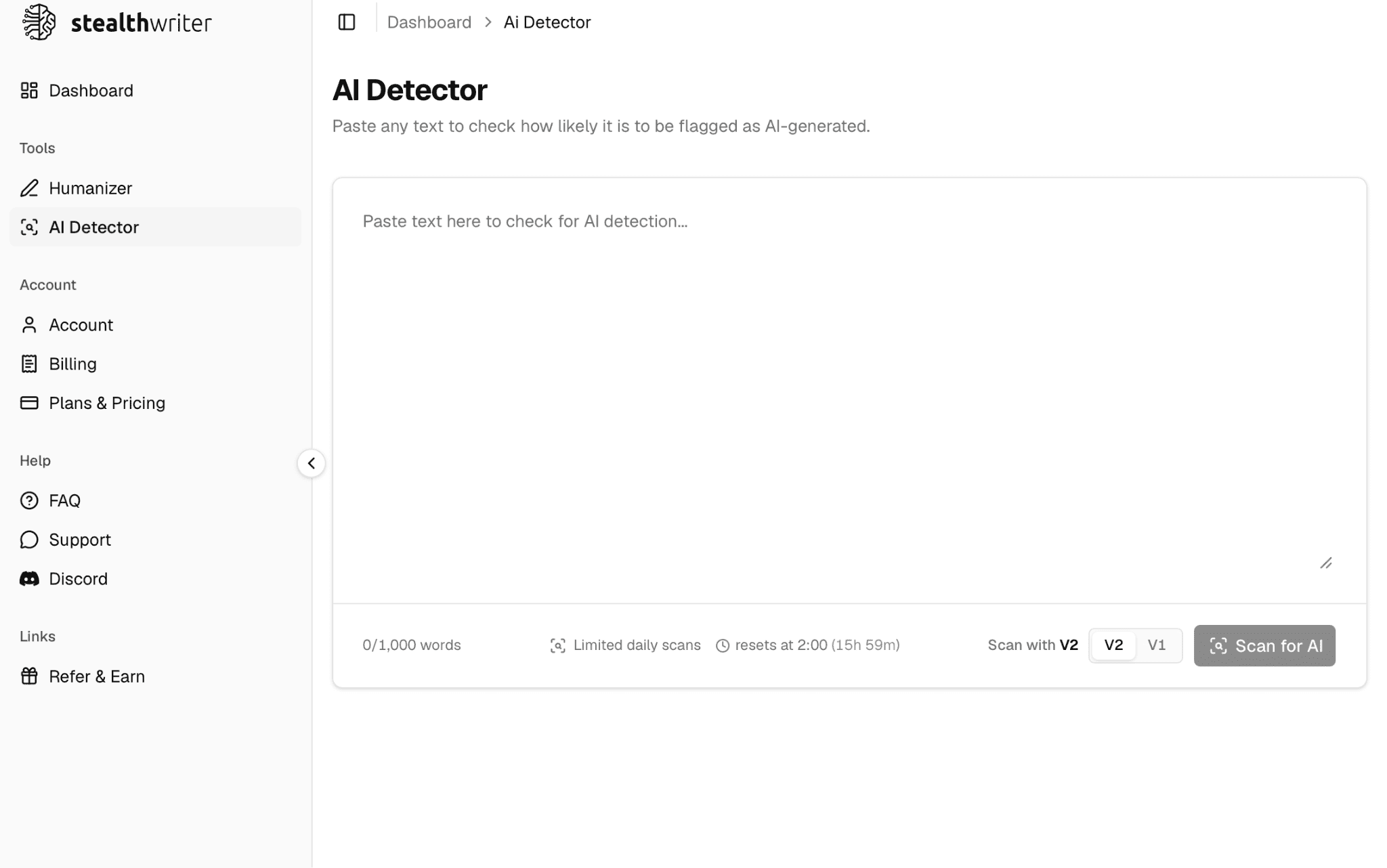
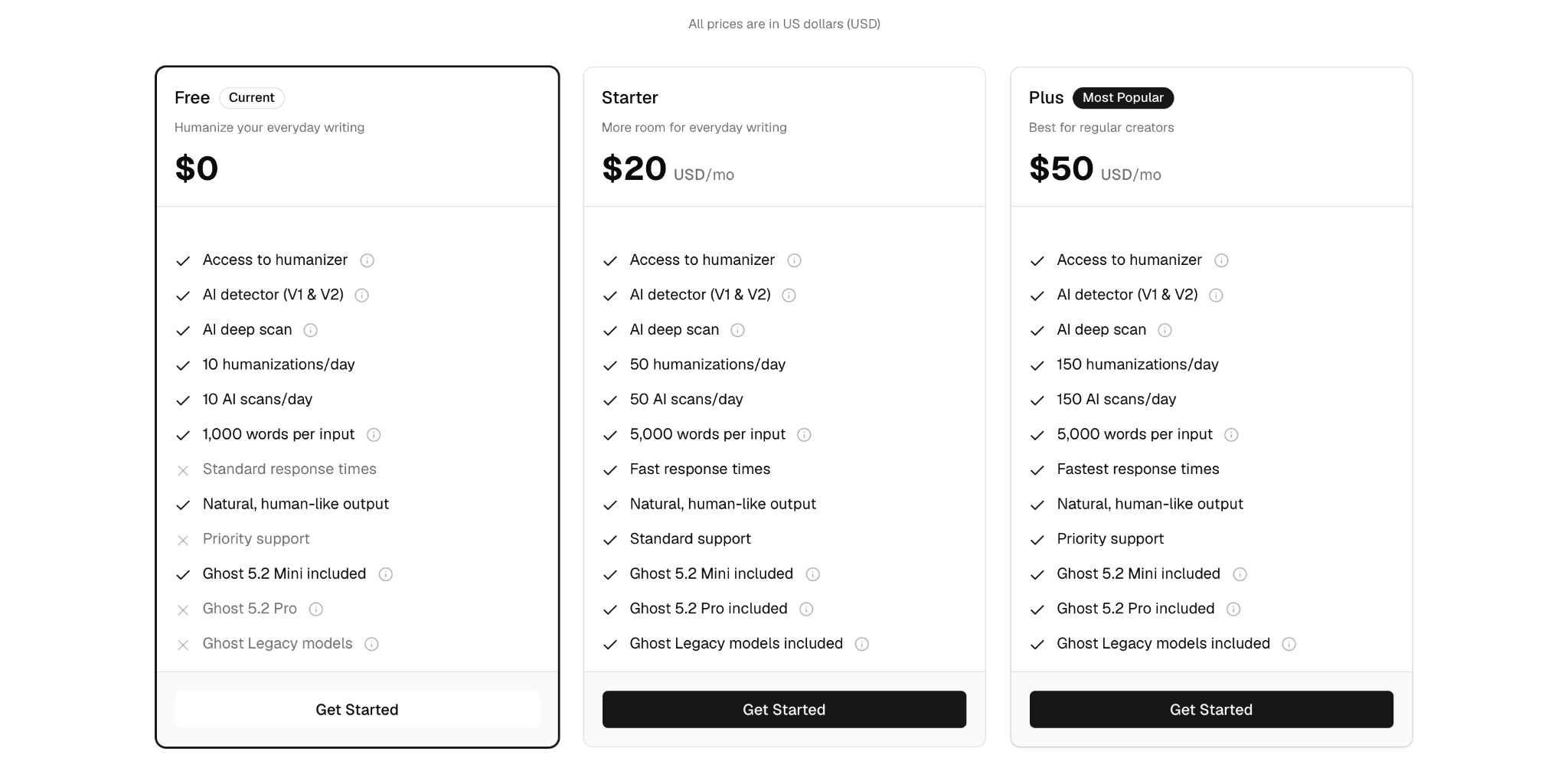
To get started, you need to sign up, even for the free version. I tested the free model, since most students would lean toward that option. The free plan includes the humanizer, AI detector V1 and V2, an AI deep scan, 10 humanizations and 10 scans per day, 1,000 words per input, and the Ghost 5.2 Mini model.
3 Key Features of StealthWriter
The core capabilities come down to how seamlessly StealthWriter’s paired AI tools — the rewriter and the detector — work together.
- The humanize tool rewrites text with the Ghost models: Ghost 5.2 Mini on the free plan, with Ghost 5.2 Pro and Legacy reserved for paid plans.
- The AI detector comes in two versions, V1 and V2, plus an AI deep scan.
- There is a loop between them: you can humanize a draft and check the result without leaving the page.
That is convenient. Still, it is also a reason for caution — both tools belong to the same company. Humanization plus an instant check is a neat loop run by one company.
Nevertheless, let’s see in practice how StealthWriter’s tools work.
I Ran 4 Tests on StealthWriter — Here’s What Happened
While testing StealthWriter, I ran four texts through the tool: two written by Claude, one published human text, and one mixed text with human edits. Each test follows the same pattern of setup, result, and observation. All scores come from StealthWriter’s own tools.
What these tests don’t cover: I tested only the free Ghost 5.2 Mini model, using Claude as the AI source. I didn’t test the paid Ghost 5.2 Pro model, other AI writing models, or the humanized output in outside detectors. I also didn’t grade how well the humanized text reads.
Test 1: A Simple Claude Text, Then Humanized
Setup: I asked Claude for a simple 1000-word text and pasted it into StealthWriter’s AI detector. Then I ran the same text through the humanizer on the free model and scanned the result.
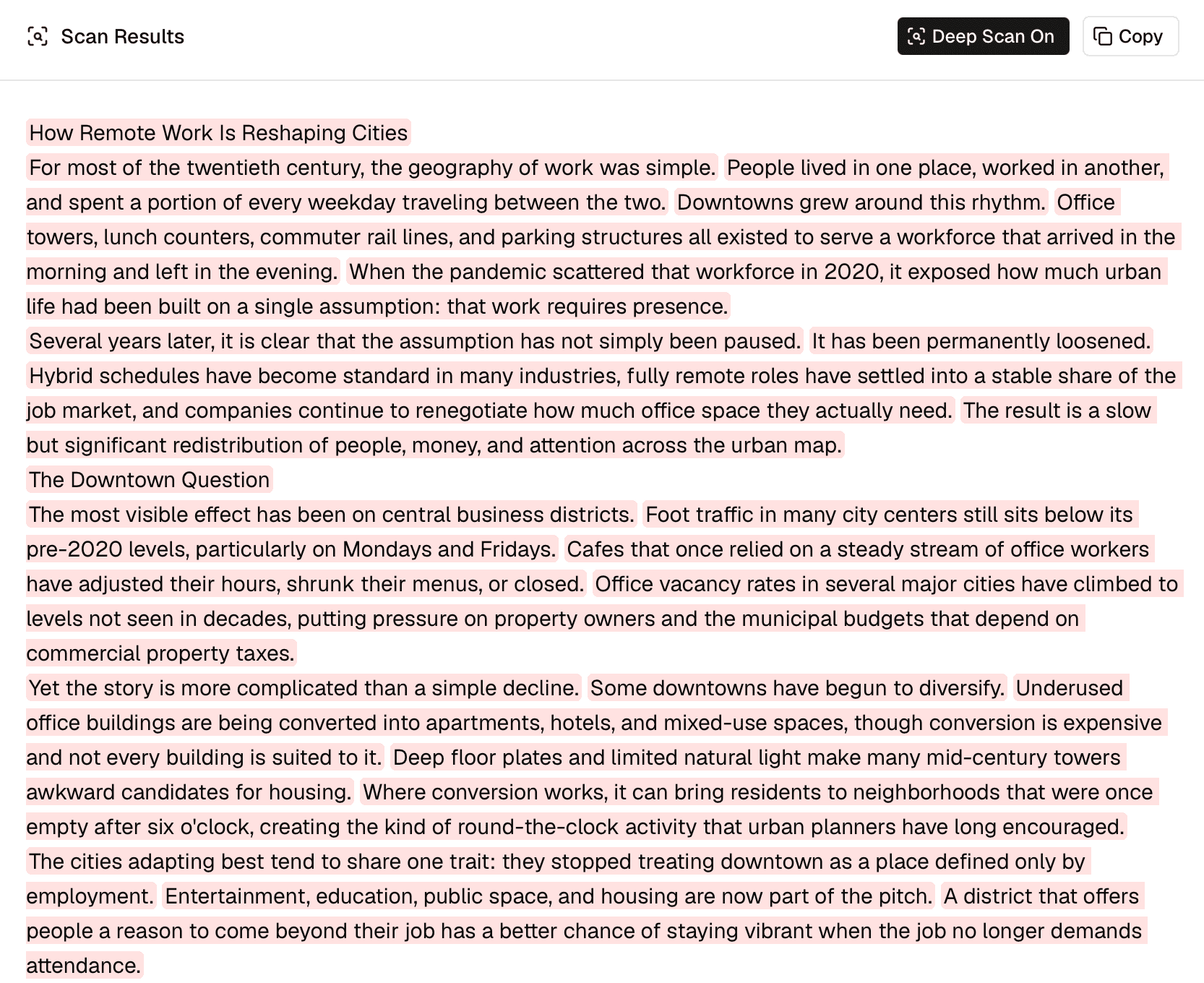
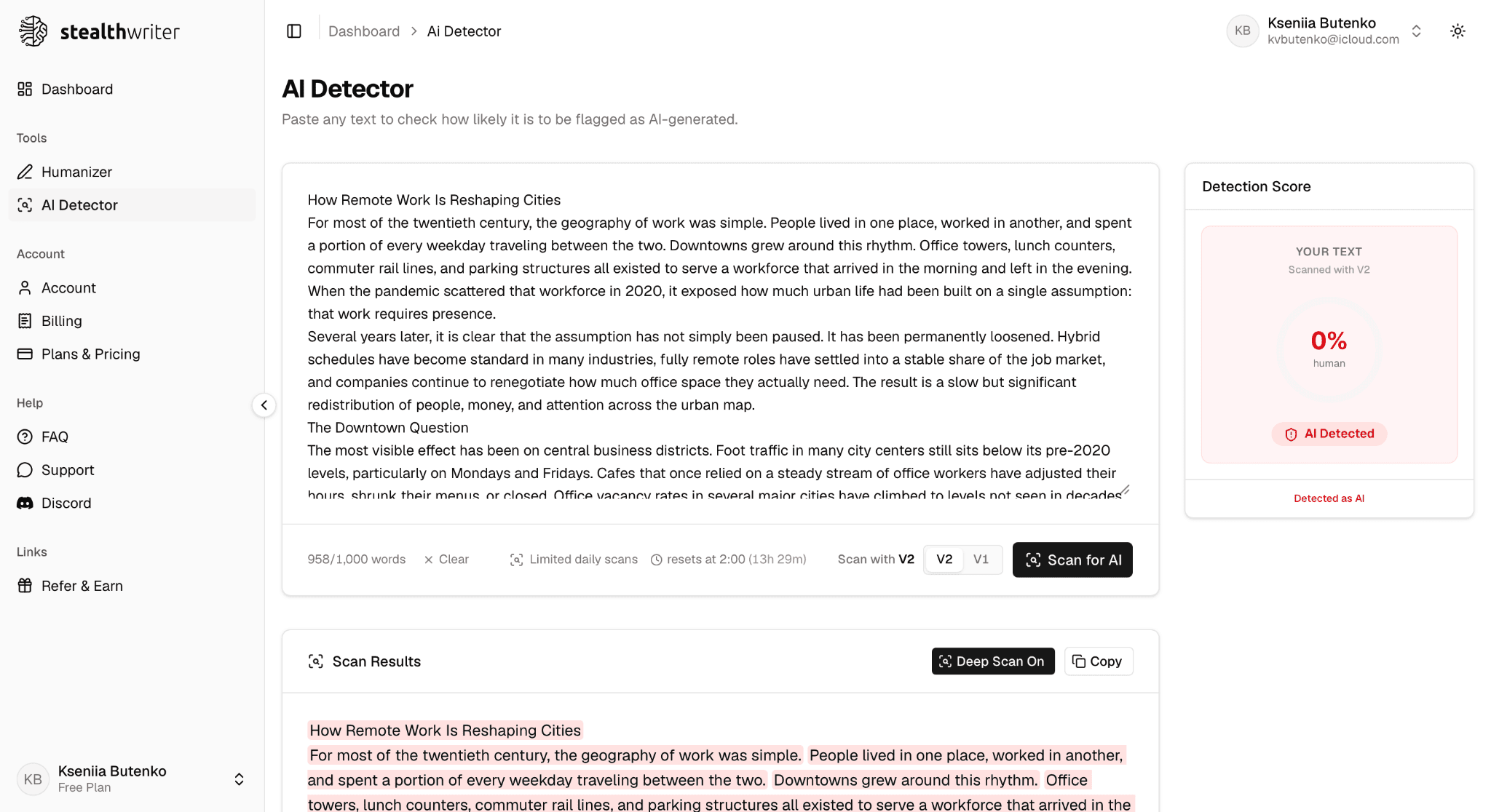
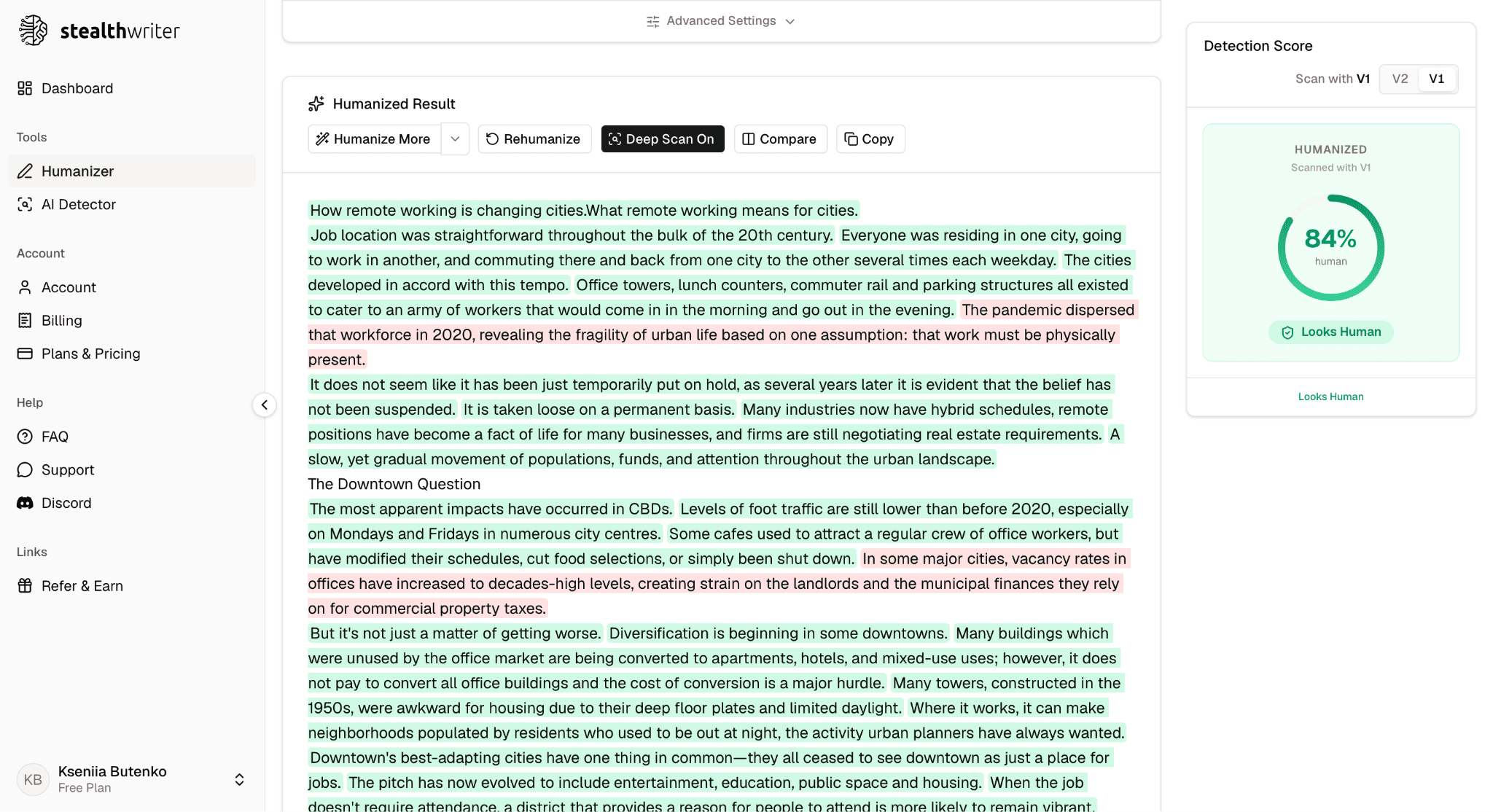
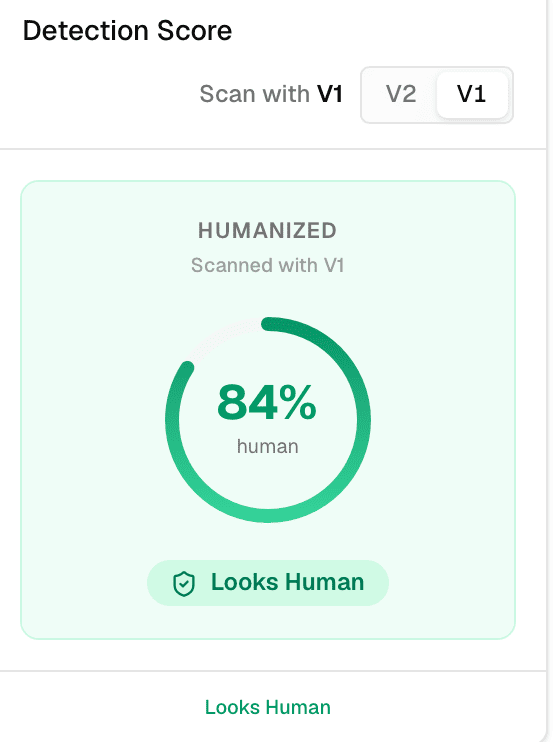
🎯 Result: The detector scored the original at 0% human and flagged it as AI work in the StealthWriter AI detector. The humanized version scored 90% human.
Observation: The detector correctly read the raw Claude output and classified the humanized version as almost entirely human. The 90% proves less than it seems. The humanizer and the detector are part of the same product, so the score indicates that the two tools agree, not that Turnitin or another checker would agree. I didn’t run the humanized text through outside detectors, so I’ll cover what other testers found below.
Test 2: A Scientific Text From Claude
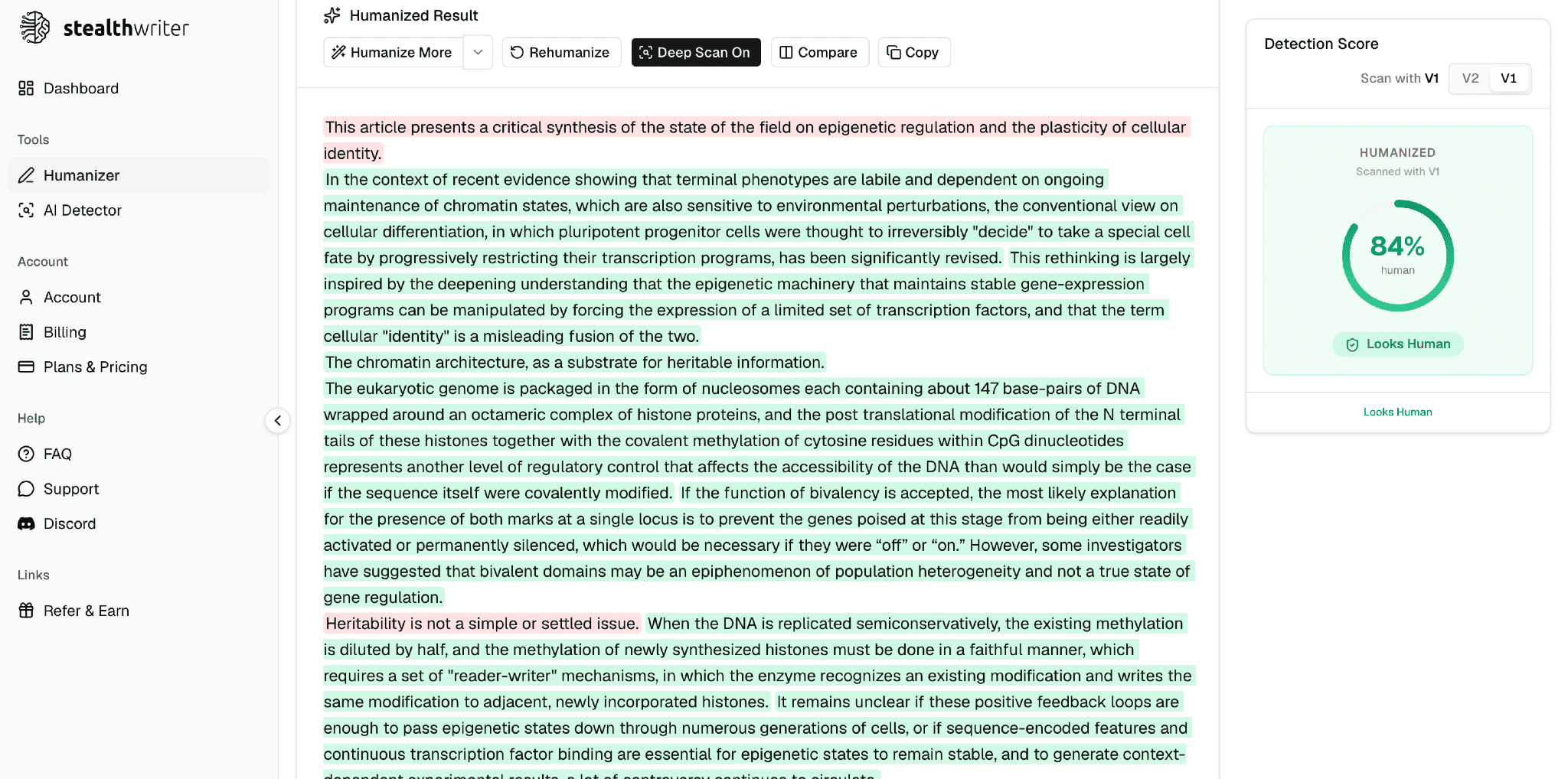
Setup: I asked Claude for a scientific text with difficult sentences, then repeated the process: detect, humanize, detect again.
🎯 Result: The detector flagged the original as AI 100%, and the humanized version scored 84% human.
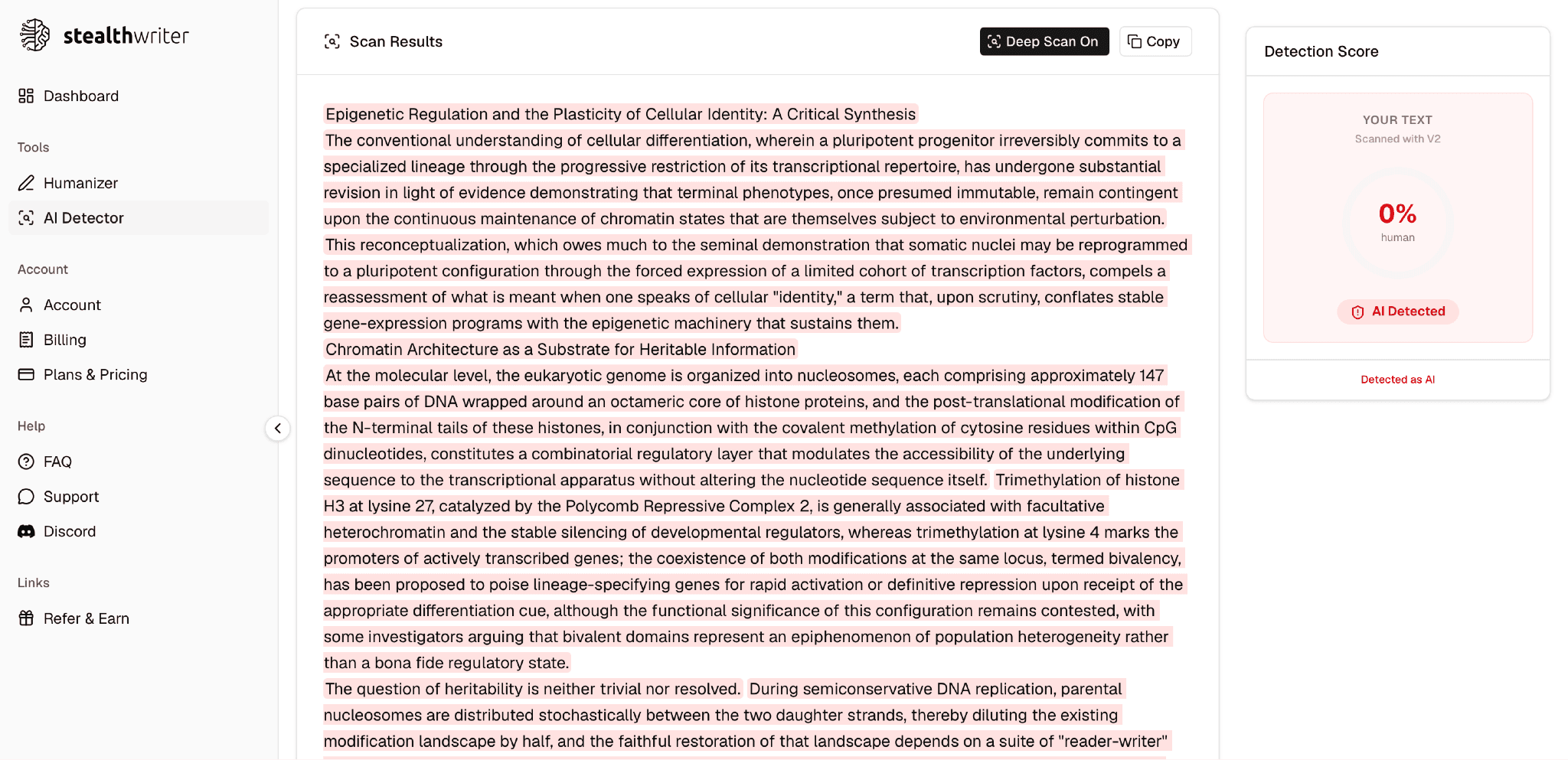
Observation: The outcome matches Test 1, so complex sentences didn’t change anything. One detail stood out before the humanizer step: the detector marked practically everything in red. That is extreme for AI detection, and it makes the highlights less useful for spotting which sentences really carry a machine pattern.
Test 3: An Alice’s Adventures in Wonderland Passage
Setup: I used a 750-word passage from Alice’s Adventures in Wonderland by Lewis Carroll, a book that Business Insider reports was among the texts used to train chatbots to write.
🎯 Result: The detector scored the passage 100% human.
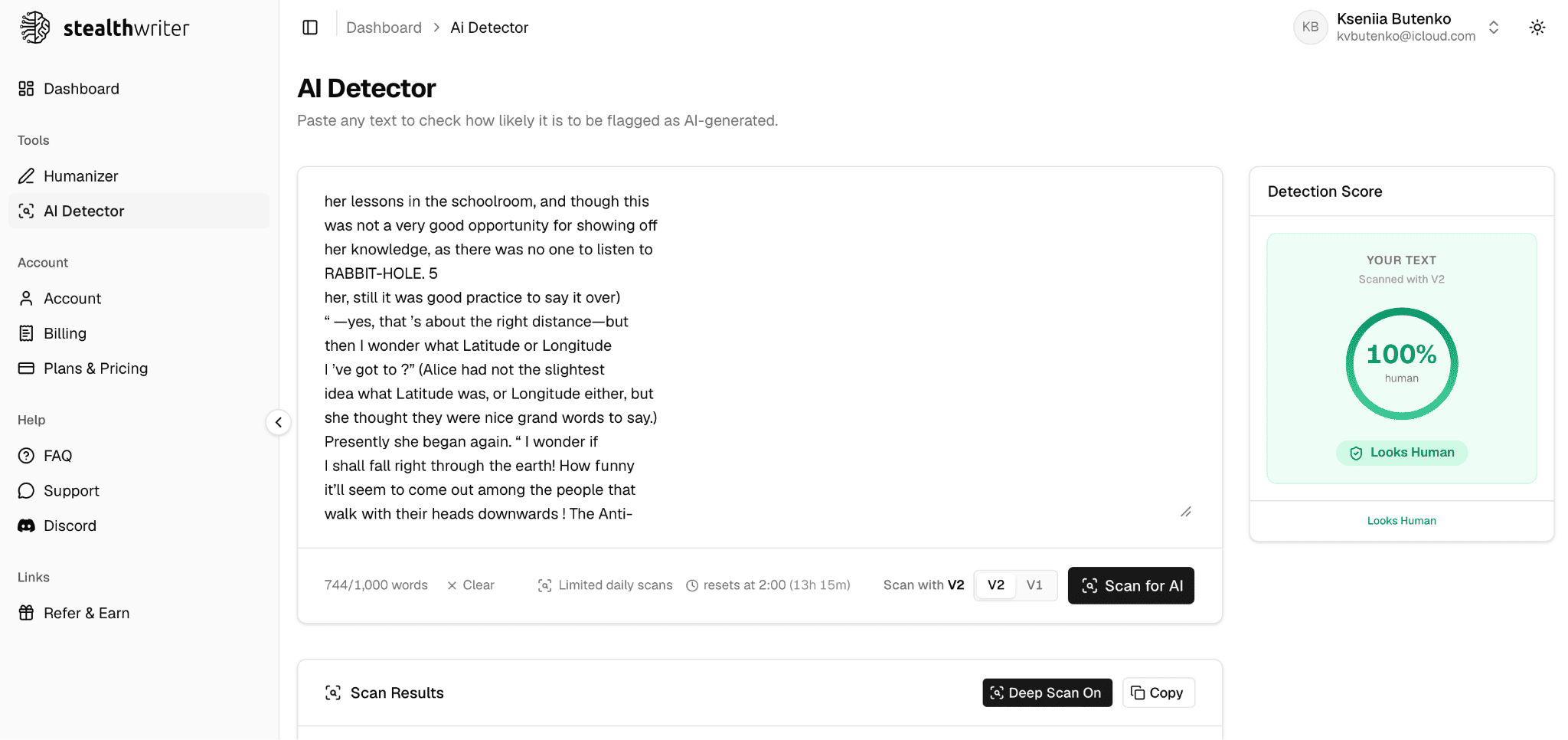
Observation: Text that language models have likely seen did not fool the detector. One passage is one data point, though, so I read this as a pass on a known edge case and nothing more.
Test 4: Mixed Text With Human Edits
Setup: I took an anonymously edited AI text, partly written by AI and then edited and corrected by a human. Turnitin had flagged it at 40% AI. I scanned only the first 1,000 words in StealthWriter because of the free limit, but we can still analyze the results.
🎯 Result: StealthWriter scored it at 8% human, meaning it read about 92% of the text as AI-generated.
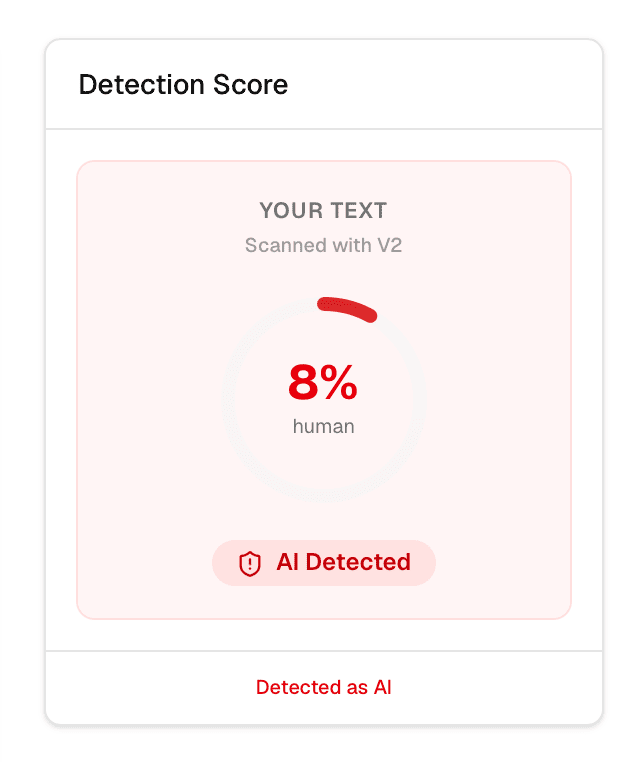
Observation: Turnitin said 40% AI, and StealthWriter said roughly 92%. Without a sentence-by-sentence ground truth, I can’t say which is right, but the pattern fits Test 2: StealthWriter’s detector leans hard toward AI, which risks false alarms on human-edited writing. The 1,000-word cap also means the score covers only part of a longer text. The gap is typical of the wider debate on how reliable AI detectors are, where different tools measure different things.
| Test | Text | StealthWriter result |
|---|---|---|
| 1 | Simple Claude text | 0% human |
| 1 (humanized) | Same text after the humanizer | 90% human |
| 2 | Scientific Claude text | Flagged as AI |
| 2 (humanized) | Same text after the humanizer | 91% human |
| 3 | Alice in Wonderland passage | 100% human |
| 4 | Mixed text, human-edited | 8% human (Turnitin: 40% AI) |
Can StealthWriter Bypass AI Detection Systems?
StealthWriter claims that its humanizer helps you bypass AI detection, and its pitch treats undetectable AI content as the goal. Basic AI detectors are usually the easiest to satisfy because they rely on a few surface-level patterns, whereas advanced AI detection, which compares patterns across an entire text, is harder to satisfy.
StealthWriter excels mostly at the first group in the reports I read. An AI detection bypass tool should be evaluated against several AI detection tools, including popular ones, not just one.
Because I used StealthWriter’s own detector, outside results fill a gap:
- A GPTZero test found that the humanized version of a Claude text still scored 100% AI, while Originality.ai rated it 88% human. Copyleaks and QuillBot both gave the raw text a 0% AI score.
- A HumanizerPRO test saw GPTZero drop from 100% to about 10% AI, while Originality.ai kept the output at 78% AI.
Both are rival vendors, and the HumanizerPRO test dates from April 2025. The two disagree about GPTZero, which says that verdicts change with the detector version, settings, and text. If your reader uses a specific detector, test with that one. Major AI detectors don’t share a single standard, so an AI vs. human verdict from one of them is a snapshot, not a ruling.
What Reddit Users Say
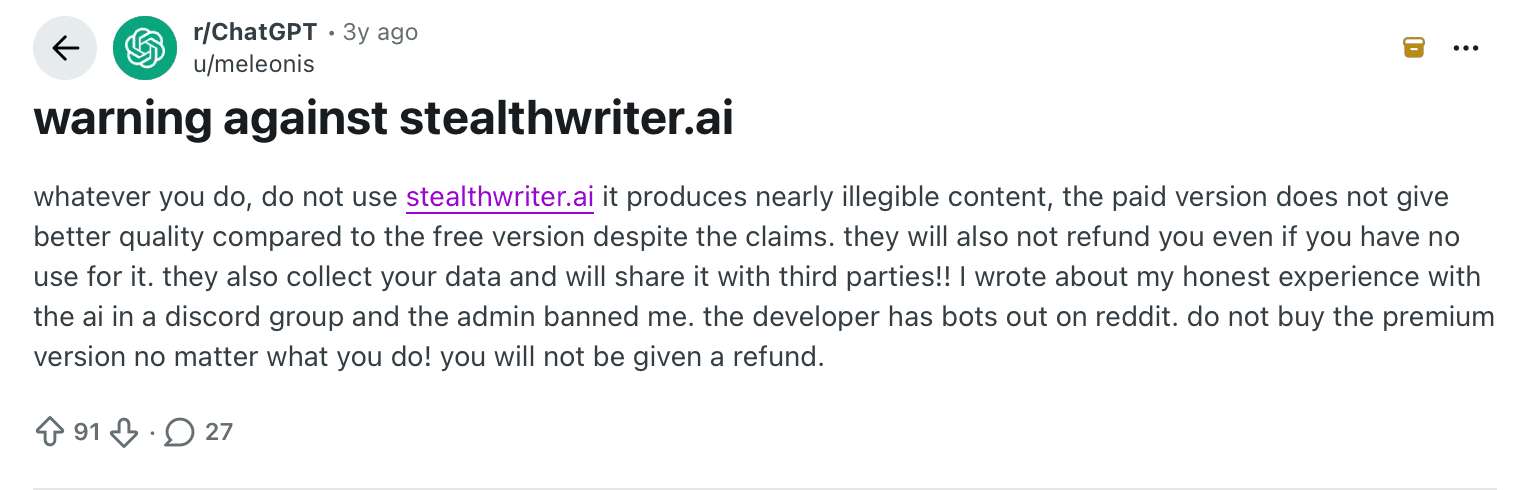
- One user warns against StealthWriter, calling the output nearly illegible and saying the paid version gave no better quality than the free one. The same post claims there are no refunds and that data is shared with third parties. I couldn’t verify those claims, and the post is about three years old, but they are worth checking against the current terms.
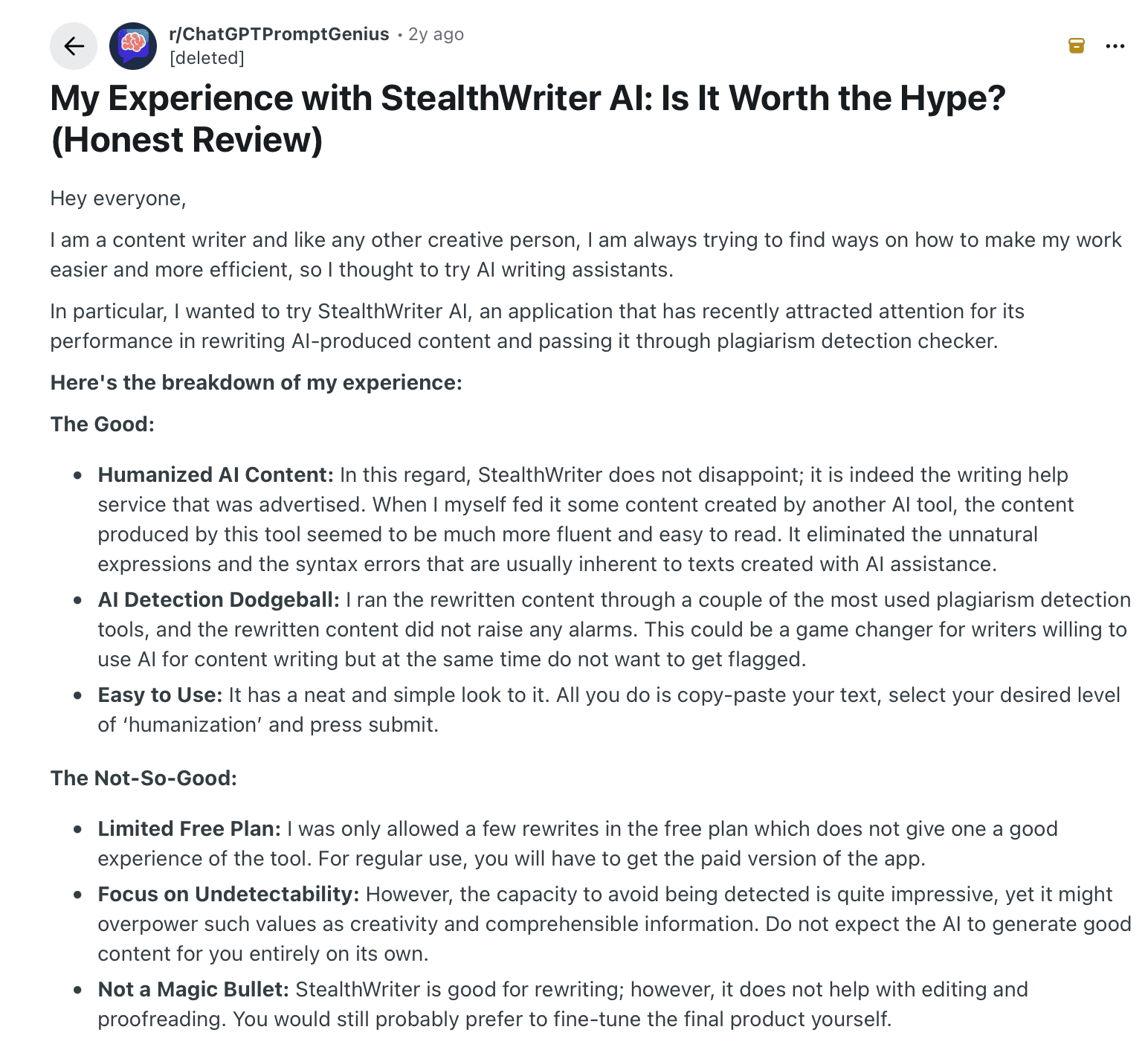
- A content writer found the humanized text more fluent and said it raised no alarms in plagiarism checkers. The same post lists a limited free plan and calls the tool no magic bullet because it doesn’t edit or proofread.
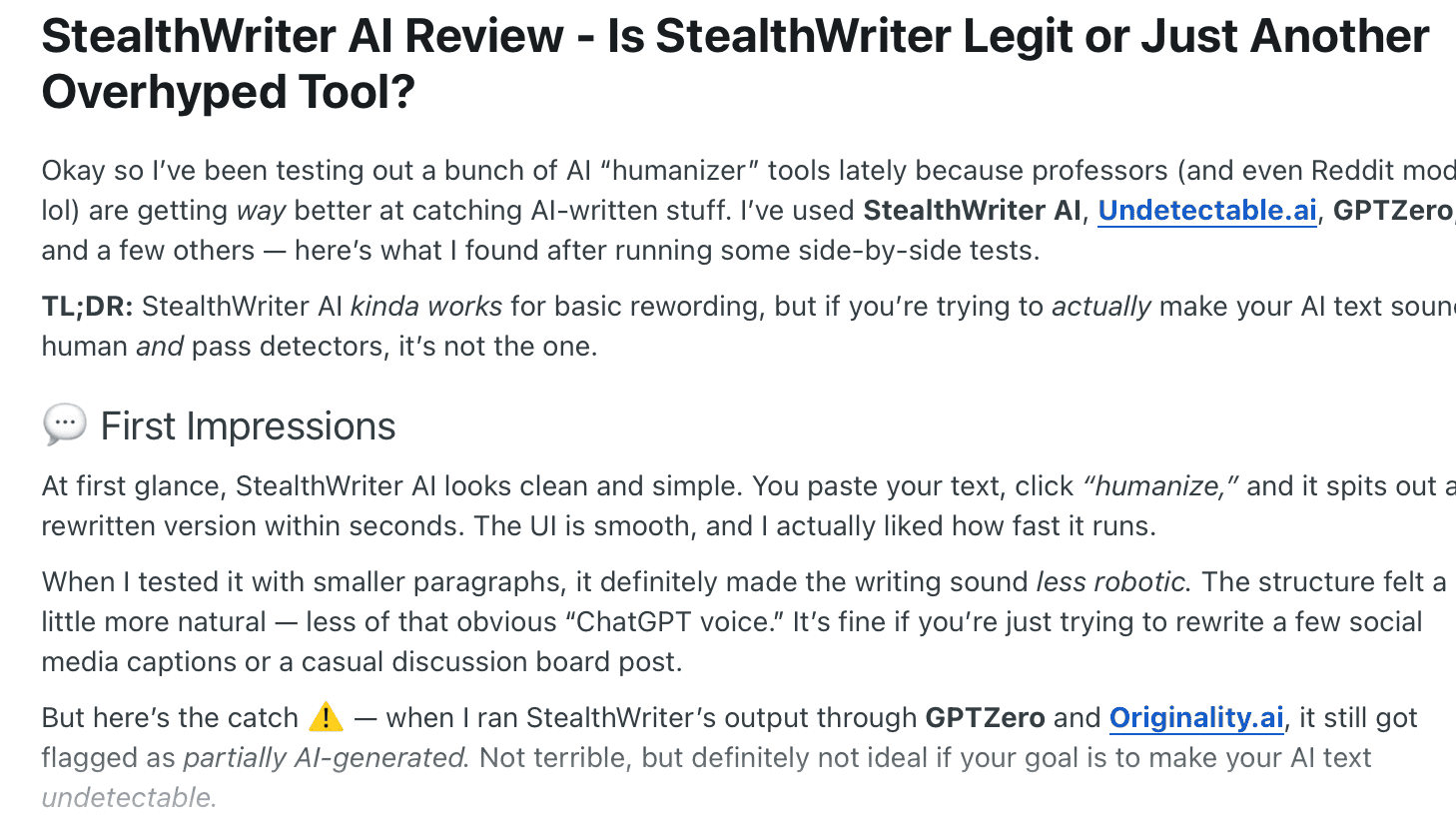
- Another user says the tool kind of works for basic rewording and makes short paragraphs sound less robotic, but GPTZero and Originality.ai still flagged the output as partially AI-generated.
- One student reports that after humanizing a paper, GPTZero still showed 90% AI, and the output had odd word order, misplaced commas, and dated phrases.
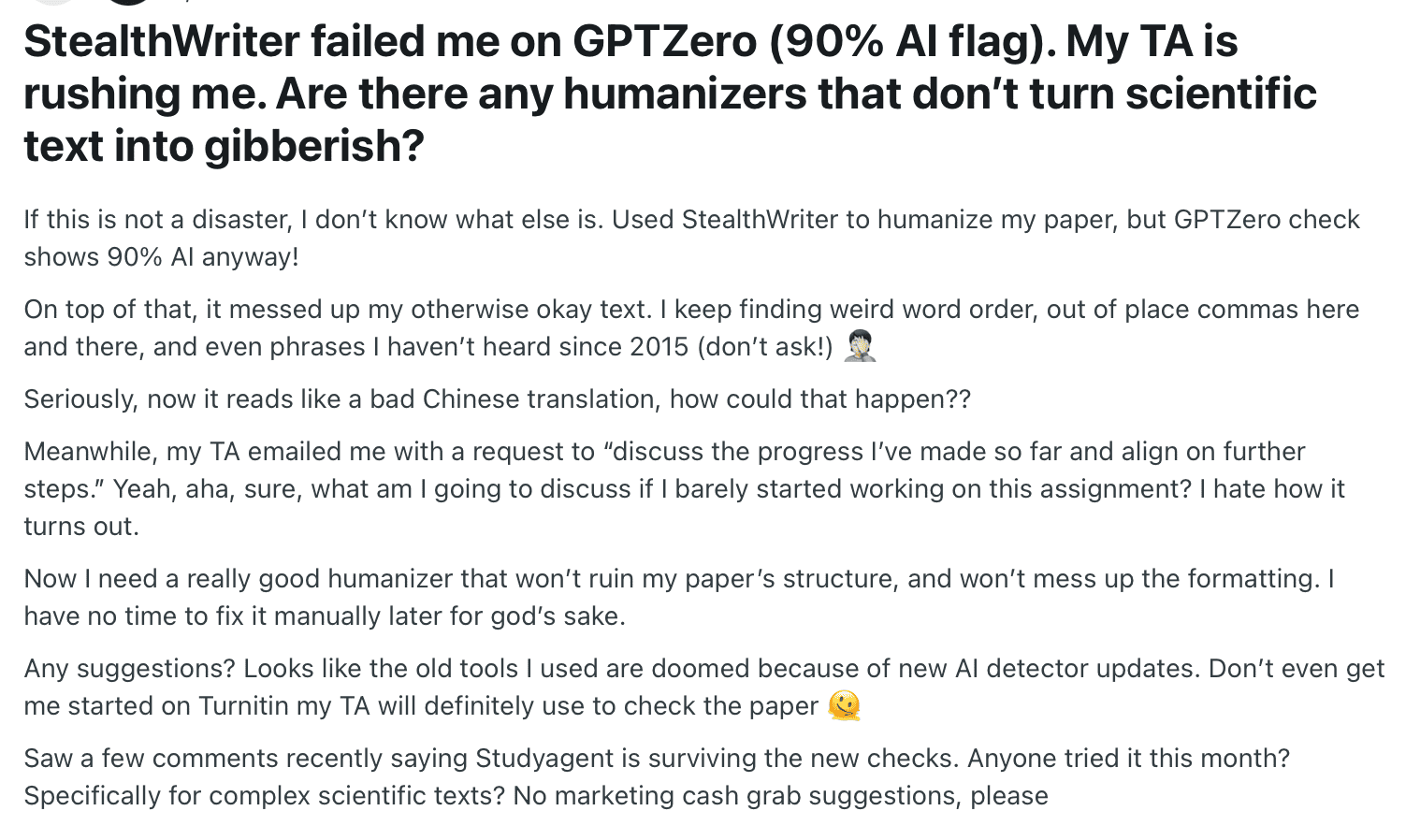
Read side by side, the four threads tell the same story from different angles. The writer who liked the smoother text still called StealthWriter no magic bullet, and the student who got 90% AI from GPTZero was left with odd commas and a TA asking for a progress meeting.
Nobody calls it useless, and nobody calls it foolproof. What they describe matches the outside tests: whether the output passes depends on which detector reads it, and the rewrite almost always needs a human pass.
➡️ If you take one thing from Reddit, take this: a humanizing tool hands you a first draft of a rewrite, not a finished text you can submit unread.
Output Quality and Editing
Detection scores are only half of the story. Users report garbled phrasing, and GPTZero’s test found a sentence where “no adapter” became “none of the adapters”, which changes the meaning.
Humanizers that rewrite sentence by sentence can lose context, and content quality is where the cost of an aggressive rewrite shows up. That matters for any digital content creation workflow, from long-form blog posts to academic essays, where context and nuance cannot be sacrificed.
Read the output against your original before you use it. To identify AI-generated writing, look for signs such as uniform sentence length, generic phrasing, and a lack of specifics. A process that produces publish-ready content still includes a human edit.
StealthWriter Pricing
Pricing as shown on StealthWriter’s pricing page on October 23, 2026.

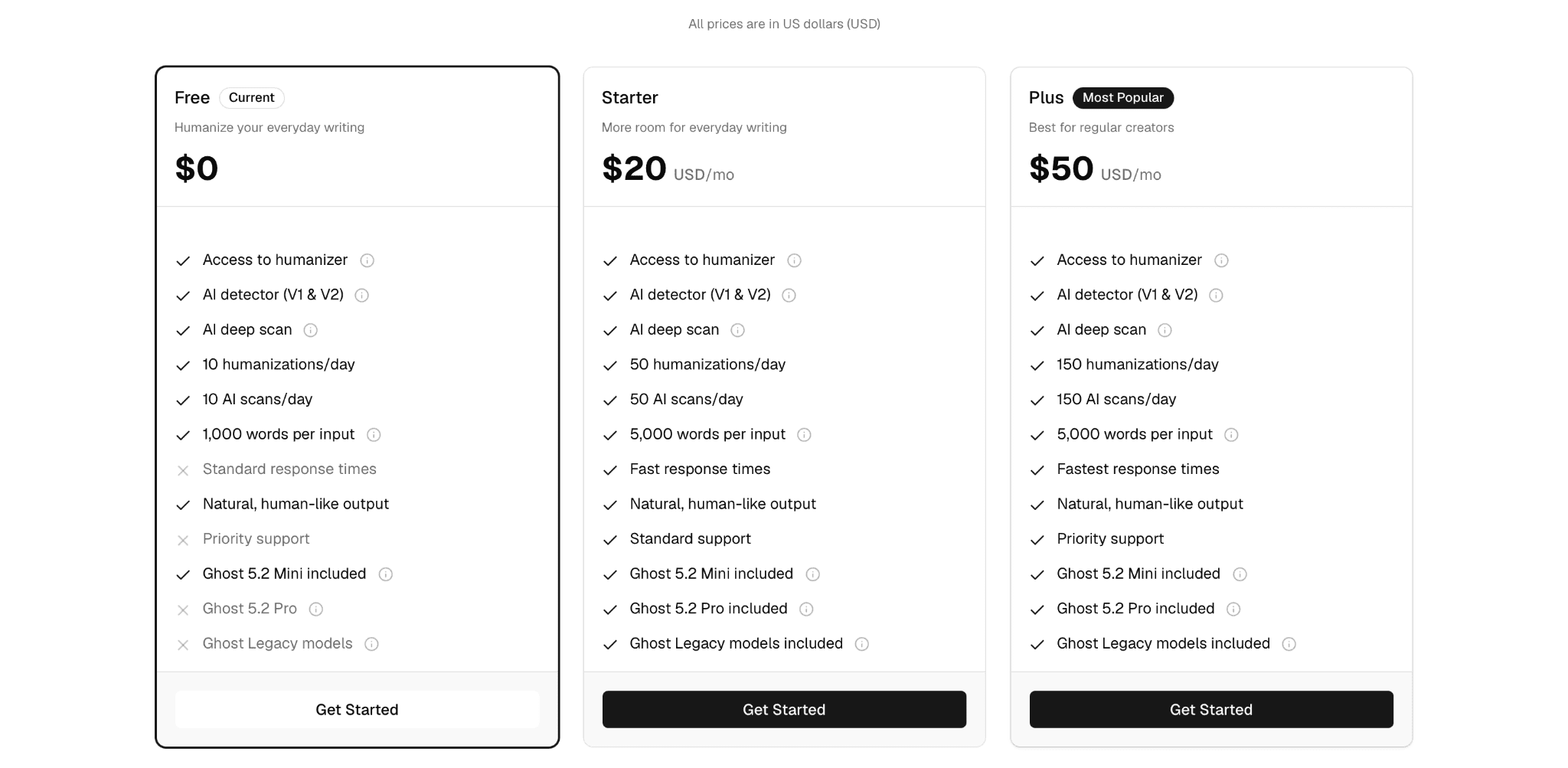
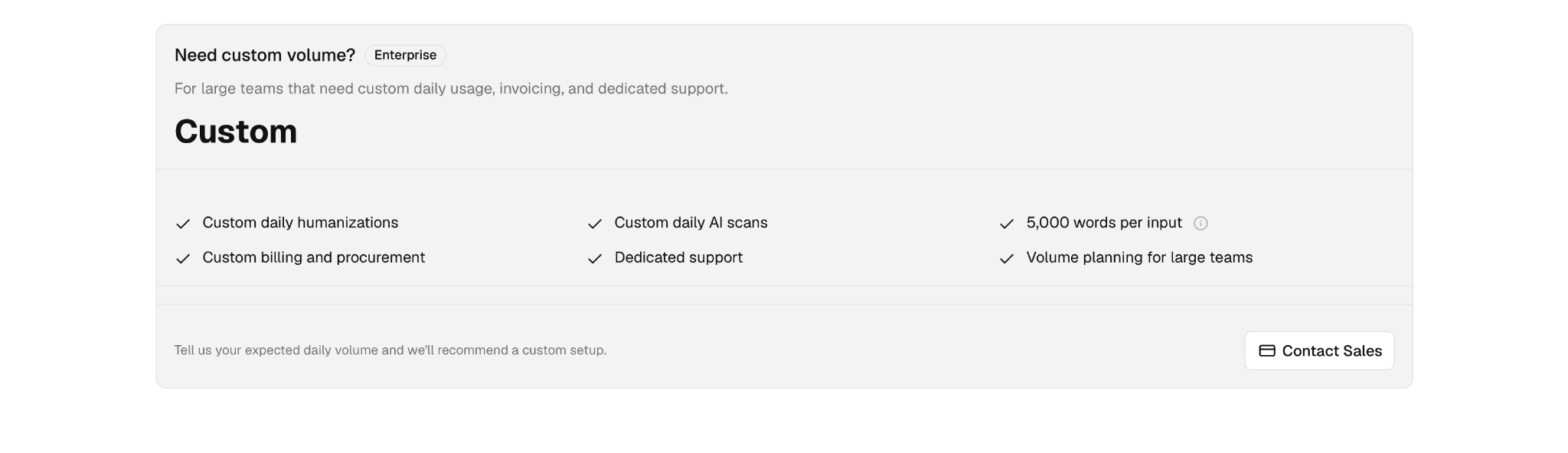

Among entry-level AI offers, StealthWriter provides a genuine free plan: 10 humanizations and 10 AI scans per day, up to 1,000 words per input, using the Ghost 5.2 Mini model. Paid plans can be billed monthly or yearly, and yearly billing saves 17%. A custom plan is available for larger needs.
- Starter: $20 per month.
- Plus: $50 per month.
- Pro: $100 per month.
- Business: $200 per month.
- Scale: $400 per month.
Older write-ups, such as a review 2025, you may find, describe earlier Ghost versions and a different plan ladder, so check the live page. StealthWriter pricing starts high for a tool that checks and rewrites text. Also, the 1,000-word limit on the detector is not enough for most full documents.
💰 Is StealthWriter AI Worth the Price? What Paid Plans Add
The free plan covers a short essay or a blog draft, so paying makes sense only if you hit the daily cap or need the paid Ghost models. Is StealthWriter AI worth it for a student who runs one paper a week? I doubt it. For a content creator who humanizes drafts daily and has content needs at volume, a paid tier may be worth the price, as long as you edit the output.
Pros and Cons of Using StealthWriter AI
👍 Advantages:
- Easy interface: all white, easy to use, with humanizer and detector in one place.
- Correct on clean cases: 0% human on raw Claude text, and 100% human on human texts.
- Usable free plan: 10 humanizations a day on Ghost 5.2 Mini.
👎 Disadvantages:
- Self-scored results: the 90% and 91% human scores come from StealthWriter’s own detector.
- Aggressive on mixed text: 8% human, where Turnitin said 40% AI.
- Detection cap: 1,000 words per scan, and a sign-up is required.
- Quality and refund reports: users describe garbled output and refund disputes, which I couldn’t verify.

StealthWriter AI vs Alternatives
When looking at the best AI humanizers on the market, alternatives like Undetectable AI and Walter Writes AI frequently come up alongside StealthWriter. I haven’t put either through my tests, so I won’t rate them.
QuillBot is a different kind of alternative: its humanizer sits inside a wider toolkit with a paraphraser and grammar tools, so you get a general writing helper instead of a dedicated rewriter.
The one head-to-head I can offer is about detectors. In a StealthWriter vs QuillBot comparison, StealthWriter AI vs QuillBot looks lopsided on raw AI text: StealthWriter scored my Claude text 0% human, while QuillBot’s detector gave AI-written text 7% and 0% in my QuillBot tests. StealthWriter AI’s detector was also harsher on mixed text, reading a human-edited draft as about 92% AI, whereas Turnitin said 40%. Harsher isn’t the same as better, though.
Without knowing the true split of that draft, I can’t call StealthWriter an accurate AI detector, only a strict one, and strict can mean false alarms on honest writing.
Who Should Use a StealthWriter?
StealthWriter is for bloggers and content creators who want to quickly humanize AI drafts and plan to edit the results, as well as for anyone who wants a free second reading of a short text. If you only need to rework a few passages, a paragraph rewriter gives you control sentence by sentence.
Skip it if you need a guaranteed result against Turnitin. Also, if you need to scan long documents in one go, or if you handle confidential text, you should avoid pasting it into any third-party tool
Final Verdict
StealthWriter AI writing tool emerges as a solid rewriting tool, not a guaranteed shield. It wins on ease of use and on clean cases: it flagged raw Claude text, scored two human texts at 100% human, and rewrote AI text to 90% and 91% human in its own detector.
It loses points for self-scored results, an aggressive detector on mixed text, a 1,000-word cap, and mixed reports on output quality.
Pick it if its rewriting matches your content needs, then edit the output yourself. Before you rely on any score, check the text with the detector your reader actually uses.