
💡 Quick disclosure before we start: GetSolved also builds an AI detector, so GPTZero is our direct competitor. We’re writing this review with that conflict out in the open, and we’re not going to pretend GPTZero gets everything wrong just because it competes with our own tool. Where it performs well, we’ll say so.
GPTZero is probably the most-searched name in AI detection right now. Therefore, the real question is whether this tool is accurate enough to base a real decision on. If you want to check a piece of text for AI-generated patterns, it helps to know whether the pricing is worth it and where the tool’s detection accuracy actually breaks down when the content isn’t clean, unedited AI text.
- We pulled together the most recent controlled benchmarks, independent classroom studies, and real user reports we could verify, covering everything from raw AI content to paraphrased and humanized text.
This choice was made because simply pasting a generated essay we wrote and calling it a test would not be sufficient to write a review. A single sample tells you almost nothing about detection accuracy across content types.
How GPTZero Actually Detects AI-Generated Content
GPTZero was built by Edward Tian, a Princeton student, and launched in January 2023 to help teachers flag AI-generated student work. It’s since grown into a broader detection platform used by several million students, teachers, and professionals, with plans aimed at individuals, teams, and institutions.
At its core, GPTZero runs on two statistical signals:
- Perplexity (how predictable the word choices are to a language model).
- Burstiness (how much sentence length and structure vary across a document).
AI text tends to score low on both predictable word choices and evenly paced sentences. Human writing is typically messier. GPTZero has since layered a broader model on top of those two signals, including sentence-level highlighting, mixed-content detection (flagging which parts of a document are AI-generated versus human-written), and an ESL de-biasing layer meant to reduce false flags for non-native English writing.
By the way, if you want the deeper mechanics of how AI detection actually works, including why perplexity and burstiness aren’t the whole story anymore, we cover that in a separate breakdown.
How We Evaluated GPTZero
Rather than running one ChatGPT essay through the tool and calling it a methodology, we leaned on three sources:
- GPTZero’s own published benchmark data (treated as a claim to check, not a fact to repeat).
- An independent classroom study of detecting AI-generated content with a real sample size.
- Reports on how GPTZero holds up against paraphrased or humanized AI text.
Each is broken down below as a separate test, with setup, result, and what it actually means for anyone deciding whether to use GPTZero on real submissions.
🎯 Test 1 — Controlled Benchmark
Setup: GPTZero was evaluated against output from GPT-4.1, Claude Opus 4, Claude Sonnet 4, and Gemini 2.0 Flash in a February 2026 benchmark run by the University of Chicago Booth School of Business.
Result: GPTZero scored 99.5% accuracy with a 0.05% false positive rate, which is the highest of any detector tested in that run.
Observation: This is a real, third-party benchmark, not a marketing number. It’s also a controlled test: clean AI output against clean human text, no editing, no paraphrasing, no mixed authorship. That matters because real submissions from ChatGPT, Claude, or Gemini rarely look like that.
🎯 Test 2 — Real Classroom Essays
Setup: Working Educators, an independent teacher-led group that accepts no vendor funding, collected 247 essays with verified authorship from eight Philadelphia-area schools, then generated 100 additional essays with ChatGPT-4 and Claude to test detection.
Result: GPTZero correctly flagged 67% of the AI-generated essays. It also flagged 23% of genuinely human-written essays as AI-generated — rising to 41% for essays from ESL students.
Observation: This is the number that matters most for anyone using GPTZero to make a real decision about a real person’s work. A 23% false-positive rate means roughly one in four honest students could be wrongly accused, and that risk climbs sharply for non-native English speakers. A gap in how accurate AI detectors really are digs further into this, since GPTZero isn’t the only tool with this exact problem.
🎯 Test 3 — Paraphrased and Humanized AI Text
Setup: Multiple independent testers ran GPT-generated text through light paraphrasing (via QuillBot-style tools) before scanning it with GPTZero, then compared the results against those from heavier, structural rewrites.
Result: Light paraphrasing reduced GPTZero’s AI score by roughly 30%, but the text still registered around 29% AI — enough that it wouldn’t pass as clean. Deeper structural rewrites, not just word swaps, pushed detection scores close to zero in the same tests.
Observation: GPTZero is checking structure and rhythm, not just vocabulary, so swapping synonyms barely moves the needle. If someone’s actually trying to make AI-assisted writing sound more natural rather than just evade a scanner, that distinction is worth understanding. To sum up, surface-level tricks and genuine rewriting produce very different results here.
Where False Positives in AI Detection Actually Happen
The pattern across every independent source we checked is consistent: GPTZero’s false-positive problem isn’t random; it’s concentrated in specific writing styles.
A 2023 Stanford study found that 61.3% of TOEFL essays written by non-native English speakers were wrongly flagged as AI-generated. The theory being that simpler vocabulary and more uniform sentence patterns produce the same low-perplexity signature the model associates with machine writing.
GPTZero has said its ESL de-biasing update brought that number down to roughly 1% on a retest of the same dataset, and that’s a real, documented fix. But it’s worth noting the gap between that self-reported figure and Working Educators’ independently measured 41% ESL false-positive rate in a 2026 classroom setting. These two different tests, two different results, and neither one should be taken as the final word on its own.
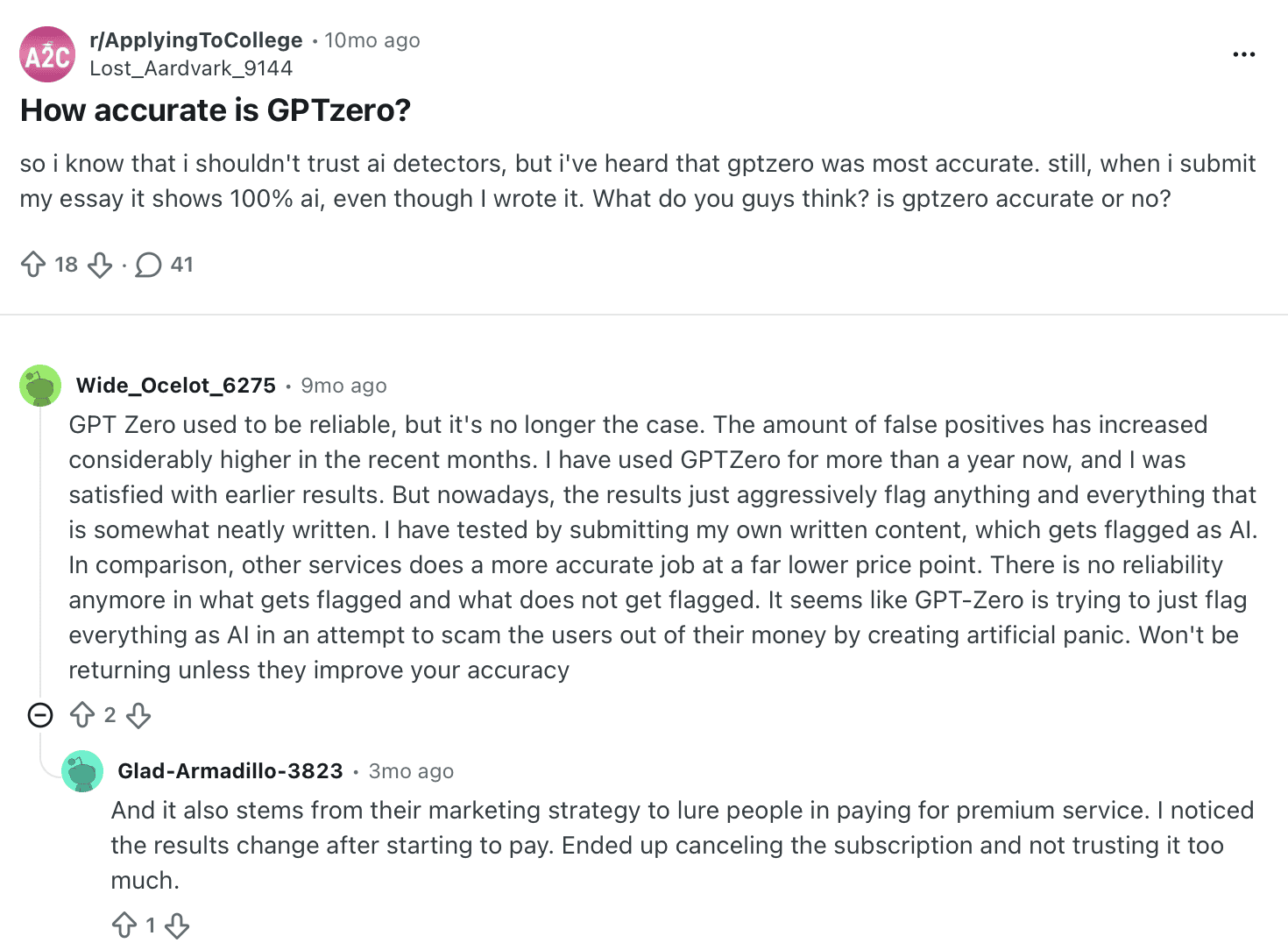
⚠️ Formally written, well-structured academic prose runs into a similar issue: students who use clear topic sentences and consistent transitions (in other words, students who write well) are statistically more likely to get flagged than students who write erratically. Moreover, academic language is more likely to be flagged. That’s a strange incentive to build into an academic integrity tool, and it’s the single most common complaint we found in user reports, including a Reddit post from a student whose own introductory paragraph was flagged and used as evidence of cheating, despite the student having written every word themselves.
What Else GPTZero Includes
Detection is the headline feature, but the paid tiers bundle a few other things worth knowing about. A plagiarism checker is included in Premium and above, though it’s secondary to the AI-detection focus and has smaller database coverage than a dedicated plagiarism tool.
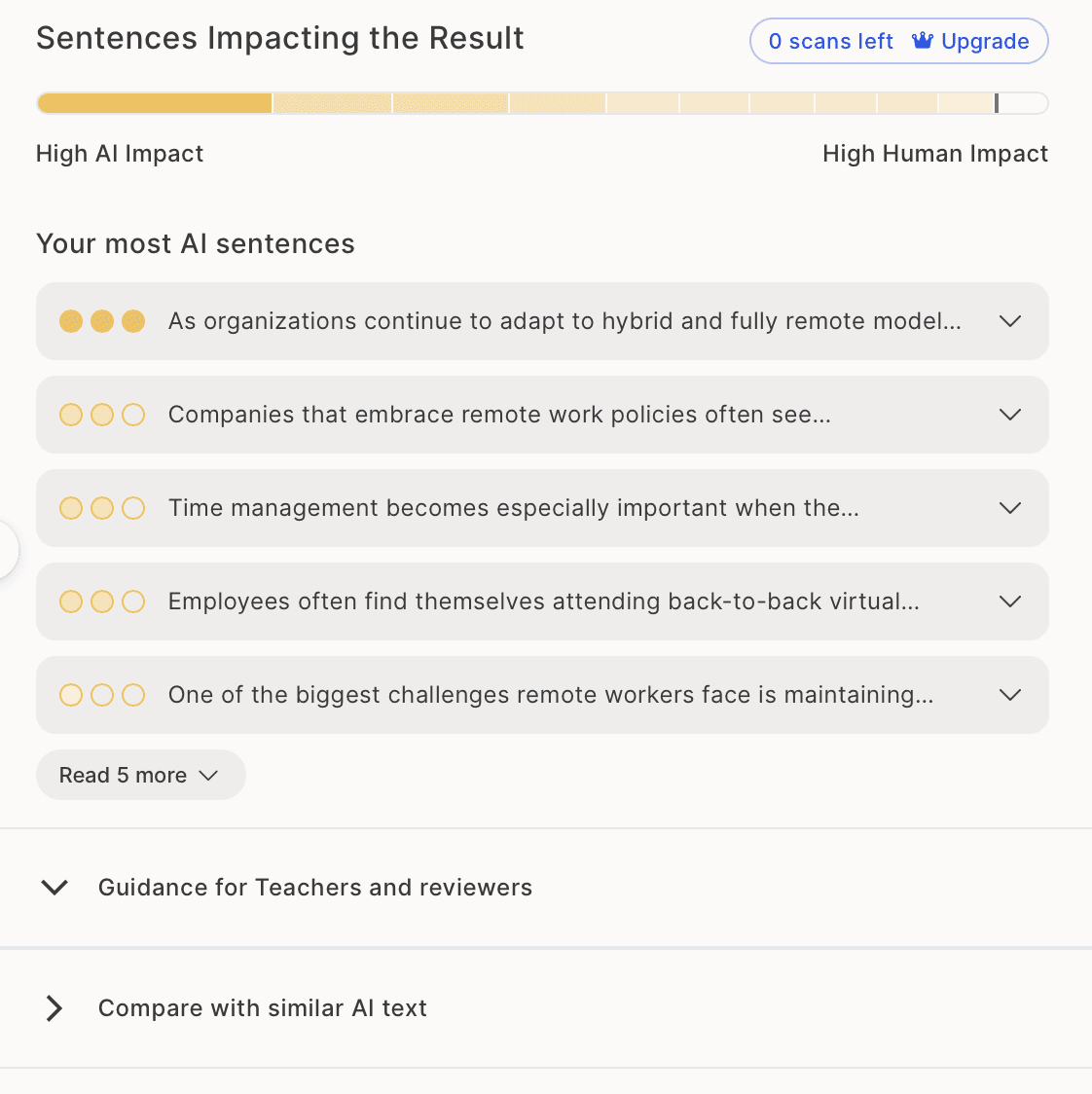
There’s also a “Compare with AI Text” tool feature, which checks a submitted text against known AI-generated patterns and texts to see how closely the language structures match or overlap with AI outputs. It is conceptually similar to how you’d compare two versions of the same text to spot what changed, but applied to authorship rather than edits.
Beyond that: a Chrome extension, Google Docs integration, LMS support for Canvas, Moodle, and Google Classroom, and an API starting around $45/month for higher-volume use.
Interpreting a GPTZero Result
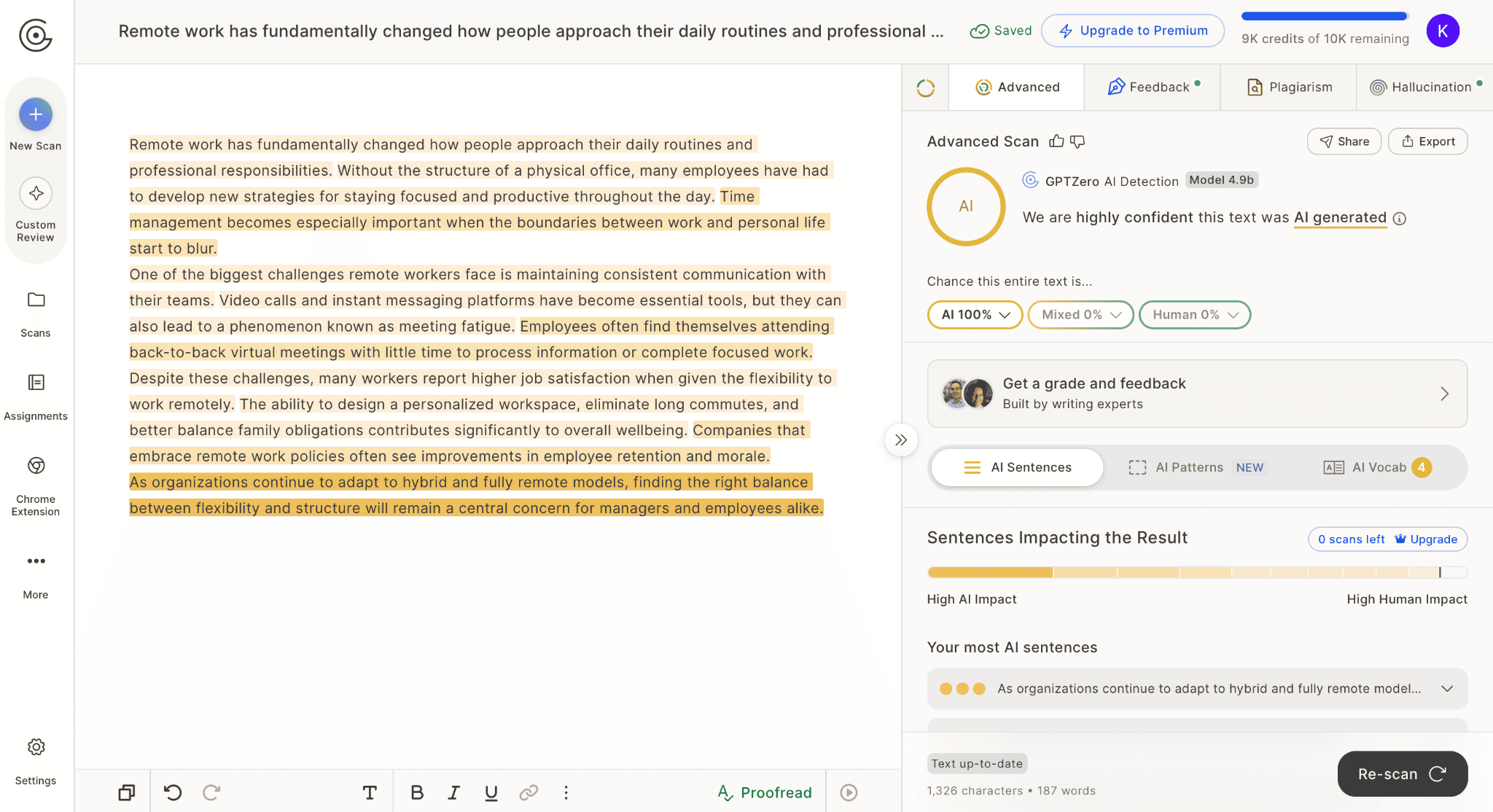
GPTZero doesn’t just give you a single AI percentage for your text. It highlights specific sentences it considers most AI-like and assigns a confidence level (high, medium, low) alongside the overall score. That’s more useful than a flat percentage because it lets you see what triggered the flag, rather than just taking the tool’s word for it.
If you’re on the receiving end of a flagged result, the practical move is to treat it as a starting point for a conversation, not a verdict. Check the specific sentences it flagged and whether a legitimate concern is behind a flag (say, a paragraph that genuinely leaned on AI-generated phrasing). Additionally, it’s more useful to clean up AI-generated text properly than to fight the score itself.
💰 GPTZero Pricing
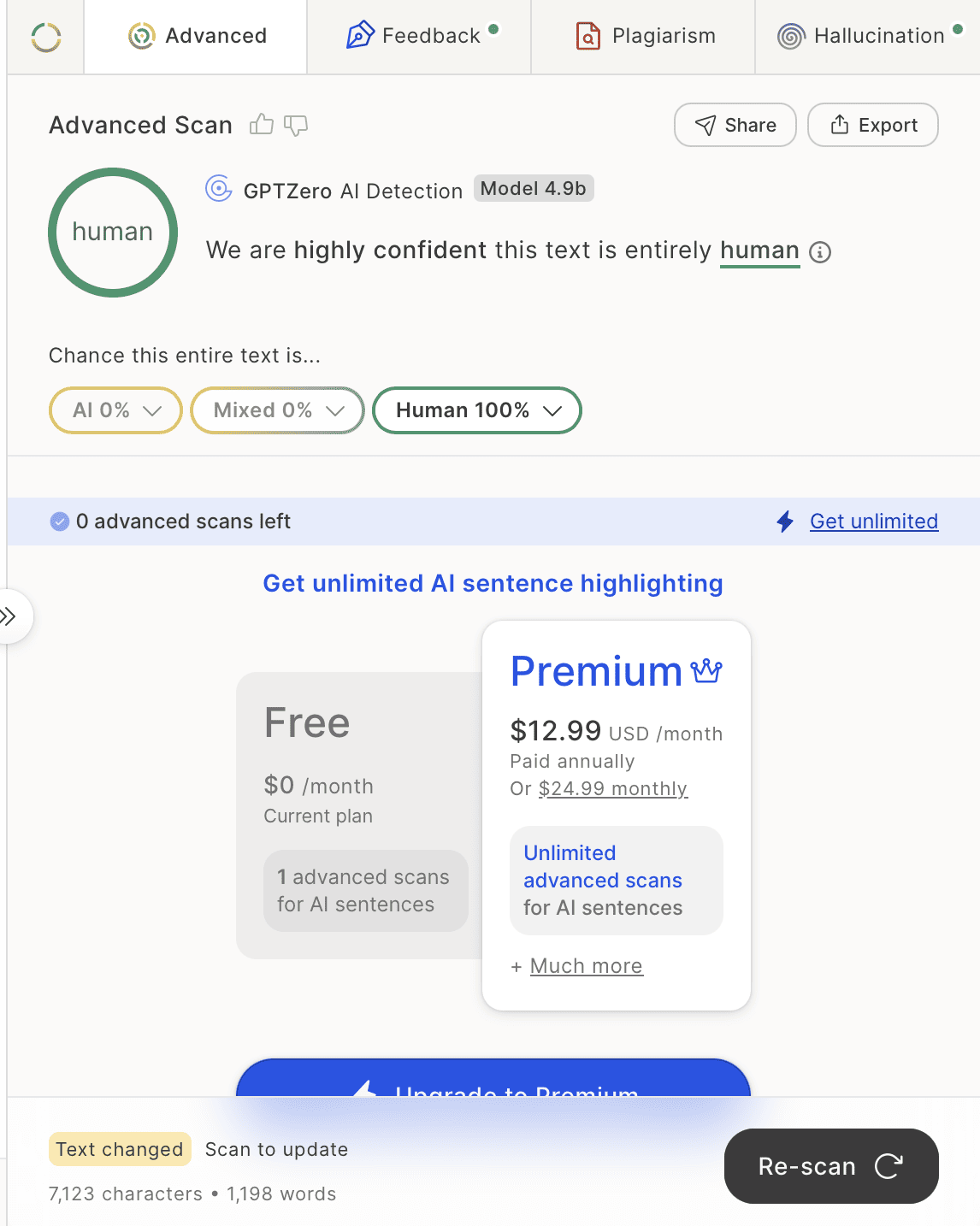
GPTZero’s own pricing page is pretty clear and explains its prices well. In September 2026, there are some discounts available for annual plans.
| Plan | Price | Word Limit | Notes |
|---|---|---|---|
| Free | $0/month | ~10,000 words/month | Basic detection, sentence highlights, limited plagiarism scan |
| Premium | $24.99/month or $12.99/mo billed annually | 300,000 words/month | Adds plagiarism checker, writing feedback, advanced scanning, multilingual AI detection, download AI reports, AI Highlights in Chrome Extension. |
| Professional | $45.99/month or $24.99/mo billed annually | Up to 2 million words overage/month | Includes all of premium, plus scans up to 250 files at once, page-by-page scanning, enterprise-grade security, and LMS Integration. |
A 33% annual billing discount applies across paid tiers, and unused word quotas do not roll over month to month.
📌 Note: Final pricing in the EU and other non-US regions may vary slightly at checkout due to local VAT/taxes and fixed currency conversion tiers.
Privacy and Data Handling
GPTZero’s SOC 2 Type II status isn’t just a stated claim. Its own trust center confirms it has undergone multiple third-party audits, is continuously monitored via Drata, and complies with GDPR, CCPA, and FERPA. For education-specific procurement, GPTZero has also completed HECVAT assessments, the standard vetting process most higher-ed institutions require from vendors.
Where it gets more nuanced is with data retention, which depends entirely on how you’re using the tool:
- If you’re calling the API, GPTZero states that it does not store or collect the documents passed through those calls.
- If you’re using the web dashboard — pasting text directly into gptzero.me or app.gptzero.me — inputs are stored by default, not auto-deleted after a set window, and used in aggregate to help improve detection.
GPTZero says it doesn’t share this data with third parties, but “stored and used in aggregate” is a meaningfully different privacy posture than “deleted next-day,” and it’s worth knowing before you scan anything you wouldn’t want sitting on a server.
Given that gap, the practical advice remains the same either way: don’t paste highly sensitive, proprietary, or legally restricted documents into GPTZero without first checking your organization’s data processing agreement, and use the API rather than the dashboard if retention is a real concern for your use case.
5 GPTZero Alternatives
GPTZero is a good tool, but it still faces a lot of competition in the market. To mention a few:
- Turnitin remains the institutional standard and is licensed to schools rather than individuals. It has a stronger plagiarism database but a similar false-positive discussion happening in academic circles.
- Scribbr, also Turnitin-powered, leans more toward plagiarism than toward AI detection.
- Copyleaks and Originality.ai both push further on multi-language support and batch/site-wide scanning, which GPTZero doesn’t match as well.
- Grammarly folded a detector into its existing grammar suite — convenient if you’re already using it daily. Nevertheless, we found real accuracy gaps you should know about before you rely on it. Our Grammarly AI Detector review covers where it underperforms and overperforms GPTZero on the same content types.
If you’re looking for a simple way to scan your writing without committing to GPTZero’s subscription, running a side-by-side test with a direct alternative is the best move before you decide.
Final Verdict on GRTZero AI Detector
GPTZero is genuinely strong at one specific thing: flagging clean, unedited AI text, especially from GPT-family models, with a low false-positive rate on native-English, informally written text. If your exact use case is spot-checking obviously unedited AI output — it’s a reasonable, well-supported choice!
It’s a weaker fit the moment real-world conditions show up: non-native English writers, heavily structured academic prose, or any text that’s been paraphrased rather than pasted raw. The gap between GPTZero’s controlled 99.5% benchmark and Working Educators’ real-classroom 67% detection rate (with a 23% false-positive rate on human work) is the number to sit with before using it as the sole basis for an accusation or a grade.
Pair it with human judgment and, ideally, a second tool. Remember that no single detector, ours included, should be the only signal behind a high-stakes decision.
FAQ
Is GPTZero accurate?
GPTZero is one of the solid ways to tell whether content was AI-generated. It depends heavily on the content type. Independent benchmarks place real-world accuracy in the 81–88% range, and a classroom study using 247 real student essays found a 67% detection rate for genuine AI text and a 23% false-positive rate for human writing. It’s stronger on clean, unedited AI content than on paraphrased or heavily structured text.
Does GPTZero have a false-positive problem?
Yes, particularly for non-native English writers and formally structured academic writing. A Stanford study found a 61.3% false-positive rate on TOEFL essays from ESL students before GPTZero’s de-biasing update. A more recent independent classroom test still detects a 41% false-positive rate for ESL.
Can GPTZero be bypassed?
Light paraphrasing reduces its confidence score but doesn’t reliably clear a passage. Tested samples still scored around 29% AI after light edits. Deeper structural rewriting, not just synonym swaps, has a much bigger effect on the score.
Is GPTZero free to use?
There’s a genuine free tier that covers roughly 10,000 words per month, with basic detection and limited plagiarism scanning. Paid plans start at $24/month for higher word limits and additional features.
What’s the difference between GPTZero and Turnitin?
Turnitin is licensed to institutions, not individuals, and is built primarily for plagiarism detection, with AI detection layered on top. GPTZero is available to anyone directly and is purpose-built around AI detection first, with a smaller plagiarism database as a secondary feature.