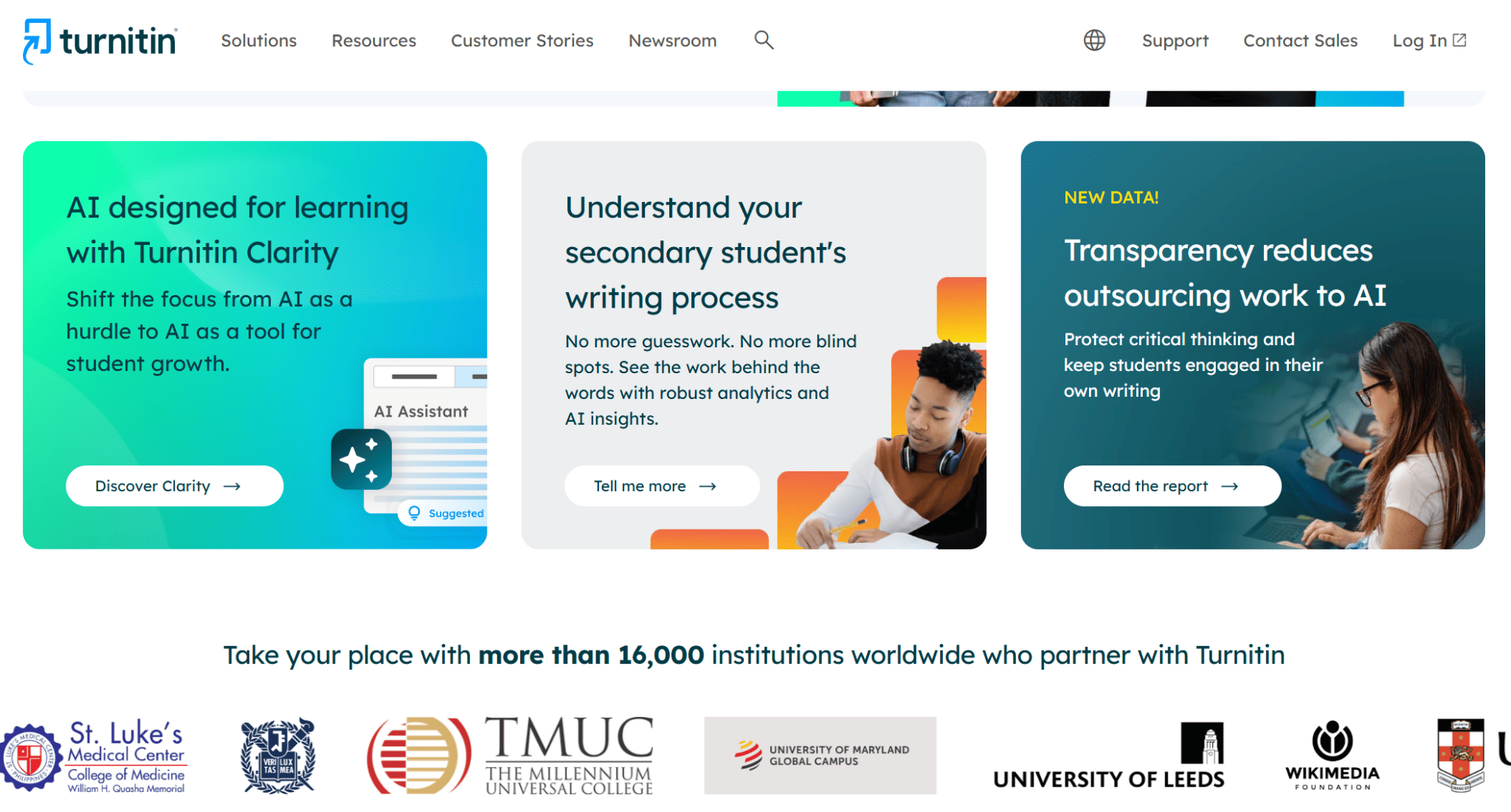
You finish an essay, upload it to your course page, and wait: will the AI score come back clean, or will it flag work you wrote yourself? At many schools, that score comes from Turnitin, one of the most widely used checkers in higher education, with more than 16,000 customers in 185 countries and territories.
Turnitin’s own July 2026 report found that 19.4% of US higher-education submissions scored above 80% AI between October 2025 and April 2026. And in GetSolved’s survey on what Gen Z believes about AI capabilities, students said their biggest fear was very specific: being accused.
So, can Turnitin detect AI? Turnitin says it does, even when generative AI text has been paraphrased or “humanized.” But its own guidance, along with many students and educators, says the score isn’t proof. This AI detector is only sold to institutions, so I couldn’t test it myself. Instead, I went through its guides, university policies, news reports, Reddit threads, and review sites. Here’s what I found.
✅ Turnitin AI Detection Review: Quick Summary
- Best for: schools and universities that pay for Turnitin Originality.
- Not for: individual students and writers, who can’t access it directly, or as the only evidence in a cheating case.
- Turnitin claims to catch AI-written, AI-paraphrased, and humanized text.
- Turnitin is rated 1.3 out of 5 on Trustpilot.
What Is Turnitin’s AI Writing Detection and Who Uses It?
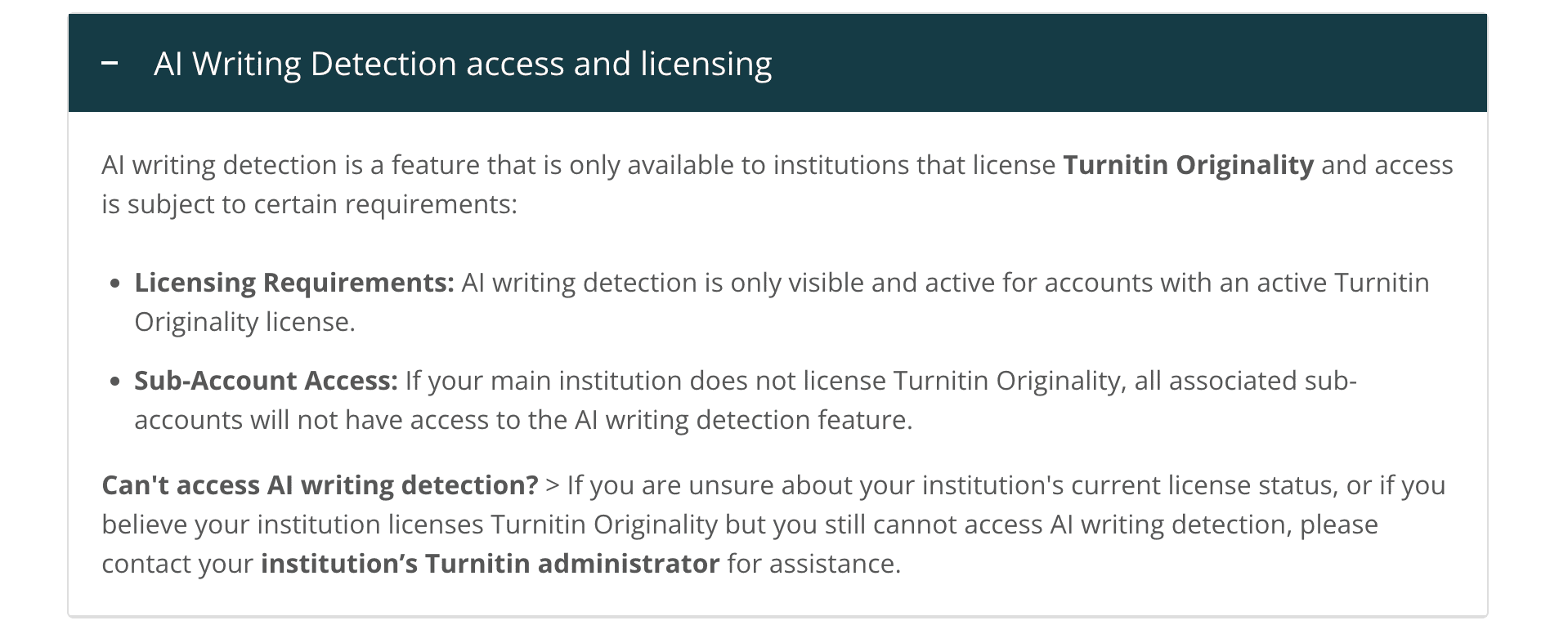
Best known as a plagiarism checker, Turnitin added AI writing detection in 2023. The feature is part of Turnitin Originality, so only institutions with that license can use it. Students use it through their school’s learning platform, such as Canvas, Moodle, Blackboard, or D2L.
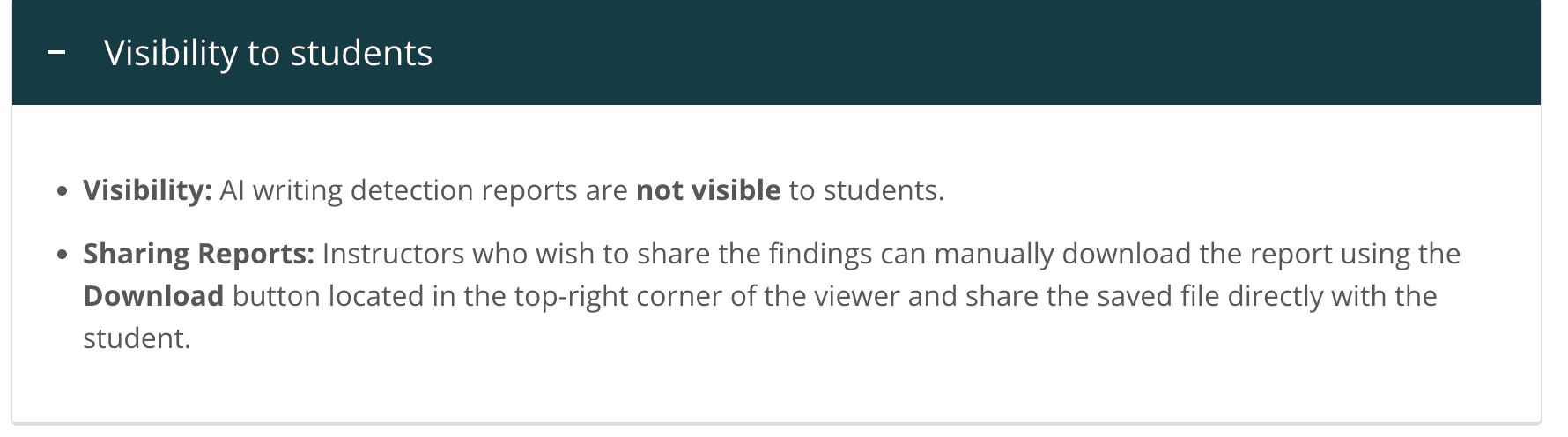
Students can’t see the AI writing report, though. Only instructors can open it, but they can download it and share it. The AI check is different from Turnitin’s similarity score. The latter shows how much of a paper matches existing sources, while the AI check estimates whether the text was written using AI. They appear in separate reports.
How Does Turnitin Detect AI?
Turnitin claims its model uses a “transformer deep-learning architecture.” It is trained to recognize AI-generated text, but the platform shares very little besides that. However, it shouldn’t be very different from how AI detectors identify writing patterns usually.
It’s important to know that two major updates have followed since launch. In July 2024, Turnitin began detecting AI-generated text that had been reworded using a paraphrasing tool. About a year later, it added AI bypasser detection, which looks for text that was run through a humanizer. Both features only work on English submissions for now.
What Turnitin Analyzes: Qualifying Text and File Requirements
To get a report, a file needs to meet these requirements:
- It contains 300 to 30,000 words of regular prose, known as qualifying text.
- It’s smaller than 100 MB and saved as a .docx, .pdf, .txt, or .rtf file.
- It’s written in English, Spanish, Japanese, Arabic, German, Dutch, or Turkish.
If a paper scores between 1% and 19%, the AI indicator doesn’t show the number. It shows “*%” instead, with no text highlighted. This is meant to reduce false positives.
Can Turnitin Detect AI? What Turnitin Itself Claims
In figures first published in 2023, Turnitin said that for documents with 20% or more AI writing, it wrongly labels fully human-written text as AI less than 1% of the time. Single sentences were less reliable: about 4% of sentences highlighted as AI could actually be human-written.
Most of these mistakes happened in mixed documents. In that same analysis, 54% of wrongly flagged sentences sat right next to text that really was written by AI. Turnitin has updated its model several times since, and says the document-level rate is still below 1%.
A separate Turnitin check looked at whether its detector is harder on people who write in English as a second language. The platform reports a false positive rate of 0.014 for English language learners and 0.013 for native English speakers, which it treats as no real difference.
Other tools have done worse here: a Stanford study of seven popular detectors, which didn’t include Turnitin, found that on average they labeled about 61% of TOEFL essays written by non-native English-speaking students as AI-generated.
In the platform’s own words, its tools are “resources, not deciders.” Turnitin also says a score shouldn’t be the only reason to take action against a student.
What Students and Educators Say About Turnitin’s AI Detection
That’s Turnitin’s side. To hear from the people who deal with the results, I checked Reddit, an educator forum run by Turnitin, review sites, and university policies.
Real Cases From Reddit
The most discussed case I found was posted on r/slatestarcodex by a public health student at the University at Buffalo. She wrote that her assignment was entirely her own work. Turnitin still flagged it as “likely AI-generated,” and the university opened an academic integrity investigation based on that score. She added that other students, including ESL, disabled, and neurodivergent students, had been through the same thing.
The same student eventually started a petition asking the university to stop using Turnitin’s AI detection, which gathered more than 1,100 signatures. The University at Buffalo said it doesn’t rely on detection software alone in these cases.
What Educators Report on Turnitin’s Own Forum
In a 2023 discussion on the Turnitin Educator Network, Turnitin’s online community for teachers, instructors pointed to scores of 55%, 64%, and 73%, with students reporting they had only used Grammarly.
Another instructor ran a small test: a human-written piece edited with Grammarly scored 0%, while ChatGPT text scored 100%. A Turnitin staff member responded by pointing out that it is “just one indicator” to consider. It’s worth mentioning that these 2023 reports describe an older version of the model, yet the doubts they raise still apply.
What Review Sites Show
On Trustpilot, Turnitin currently has a rating of 1.3/5 stars based on 78 reviews, 97% of which are 1-star. These reviews largely concern human text being incorrectly identified and inconsistent scores on the same text. However, I believe that this doesn’t really show the limits of AI detector results but rather how online review scores should be taken with a grain of salt and analyzed on a case-by-case basis.
On the other hand, the G2 rating is more favorable at 4.2/5 from 245 reviews. Yet, it reflects the full product line, with only one review about Originality, the product that includes AI detection.
What Universities Decided
While the University of Melbourne still uses Turnitin but treats the score as “a prompt for further investigation” and requires staff to consider additional evidence before making an allegation of misconduct, others have pulled back.
Vanderbilt turned off Turnitin’s AI detector in August 2023. Curtin University in Australia switched it off across all campuses as of January 1, 2026, but keeps the plagiarism check. After all, plagiarism checkers have proved to be way more reliable. If you are interested in tools for that, you can see the top plagiarism checkers compared side by side.
Pros and Cons of Turnitin’s AI Detection
| 👍 Pros | 👎 Cons |
|---|---|
| Works inside the learning platforms schools already use | Individual students and writers can’t check the score on their own |
| Highlights flagged sentences when a score is 20% or higher | Users keep reporting human writing marked as AI |
| Hides scores from 1% to 19% to cut false positives | Paraphrase and bypasser detection only work in English |
| Detects AI writing in seven languages | Won’t score anything under 300 words |
💰 Turnitin Pricing
Turnitin doesn’t publish its prices. The cost depends on the type of school, the number of users, and the features it needs. Schools request a quote via a sales form, and a sales representative responds within 3 business days. There’s no individual plan for students.
Who Turnitin’s AI Detection Is Best For
Turnitin makes the most sense for schools that already use it. The tool also works for instructors who treat a flag as a reason to talk to the student, not as a final answer. That’s how Turnitin describes its own role, too.
If your work has been flagged, ask your instructor to share the report with you. Bring your drafts and notes, since some schools may ask for them.
Alternatives to Turnitin That Are Accessible to Anyone
While you can’t check your own drafts with Turnitin, you can use the three AI detectors below.
| Tool | Free option | Paid plan | Trustpilot rating |
|---|---|---|---|
| GetSolved AI Detector | Free checks, no sign-up | Monthly Plan, $19.99 | 4.3/5 (497 reviews) |
| Originality.ai | Limited free use | Pro, $12.95/month (billed yearly) | 4.5/5 (1,378 reviews) |
| Copyleaks | Limited free use | Personal, $13.99/month (billed yearly) | 2.7/5 (395 reviews) |
With GetSolved, you get a free search of up to 10,000 words without an account, plus results for each individual sentence. It reports a 97.5% detection rate for AI texts, with false positives on human-written work at under 2%. Other than the AI detector, it offers several more tools, including a useful citation checker.
Originality.ai works well for individuals and small teams, offering both a free tier and a Pro subscription. A 2023 peer-reviewed study found it to be one of only 3 detectors with high accuracy across all 3 essay samples (Copyleaks and Turnitin were the others), whereas 13 others could not reliably differentiate student essays from GPT-4 output.
Copyleaks, in addition to being used by individual students, is also widely used by universities themselves, mainly because it integrates with the learning platform the school already uses. Among its strengths is the fact that it shows exactly which sentences contributed to a high score, and it works in over 30 languages.
That said, even GetSolved’s accuracy page states that, since no AI detector is currently foolproof, results from these checkers should be read as an indication that your content might be flagged, not as a reliable way to predict your Turnitin AI % result.
Final Verdict
Turnitin’s own published figures suggest that false positives on fully human-written work are uncommon. Still, students, educators, and several universities have raised concerns about relying on the AI score alone, and Turnitin itself warns against using it that way. In my view, Turnitin can detect AI-generated text, but its score should start a conversation, not serve as proof that someone used AI.
FAQ
Will Turnitin flag ChatGPT?
Turnitin says it can, and lists OpenAI’s GPT models, which power ChatGPT, among those its detector is trained to recognize. However, no detector is perfect, and false positives are still possible.
How much AI is acceptable on Turnitin?
Turnitin has not defined a threshold, nor does it consider any score ‘good’. Your institution likely has its own policy on this matter.
Can Turnitin detect AI-written text that’s been paraphrased or humanized?
Turnitin added a feature in July 2024 for catching paraphrased AI text, followed in August 2025 by the ability to detect AI text run through an AI content humanizer. Since August 4, 2026, the AI writing report no longer separates paraphrased text from other AI-generated text.