Scribbr’s free AI detection may be one of the AI content detectors students reach first. It is obvious why: no account, no payment, fast and easy. Also, the trust in Scribbr is high: the tool pairs practical academic tools with large-scale review visibility and clear policies on data and pricing.
📊 If you look at the numbers, Scribbr has over 15,700 reviews on Trustpilot, with roughly 88% five-star ratings and a score between 4.0 and 4.3 out of 5.
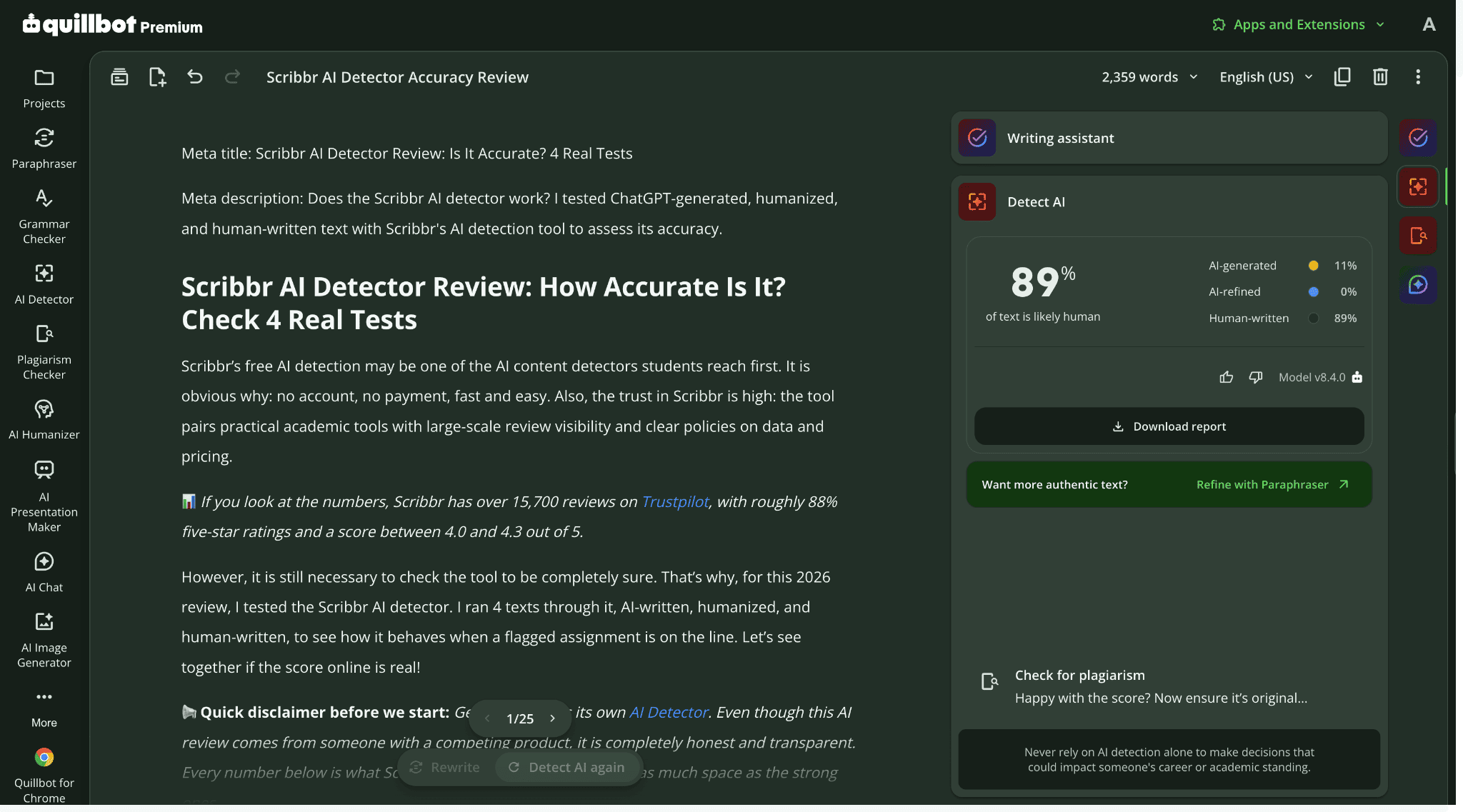
However, it is still necessary to check the tool to be completely sure. That’s why, for this 2026 review, I tested the Scribbr AI detector. I ran 4 texts through it, AI-written, humanized, and human-written, to see how it behaves when a flagged assignment is on the line. Let’s see together if the score online is real!
📢 Quick disclaimer before we start: GetSolved builds its own AI Detector. Even though this AI review comes from someone with a competing product, it is completely honest and transparent. Every number below is what Scribbr showed. The weak spots get as much space as the strong ones.
Scribbr AI Detector Review Summary
⭐ Verdict: a convenient free first check, but not a score you can use as proof of anything.
👍 Best for: quick checks of plain, non-academic writing.
👎 Skip if: your text is formal or academic.
Here is a quick breakdown of how Scribbr performed across my test samples, along with its free usage limits:
- Both unedited AI texts from ChatGPT scored 100% AI.
- The same academic text, after a humanizer pass, dropped to 36% AI.
- A human-written academic text scored 81% AI despite passing a Turnitin check.
- Two human-written non-academic articles, one from The Guardian, scored 0% AI.
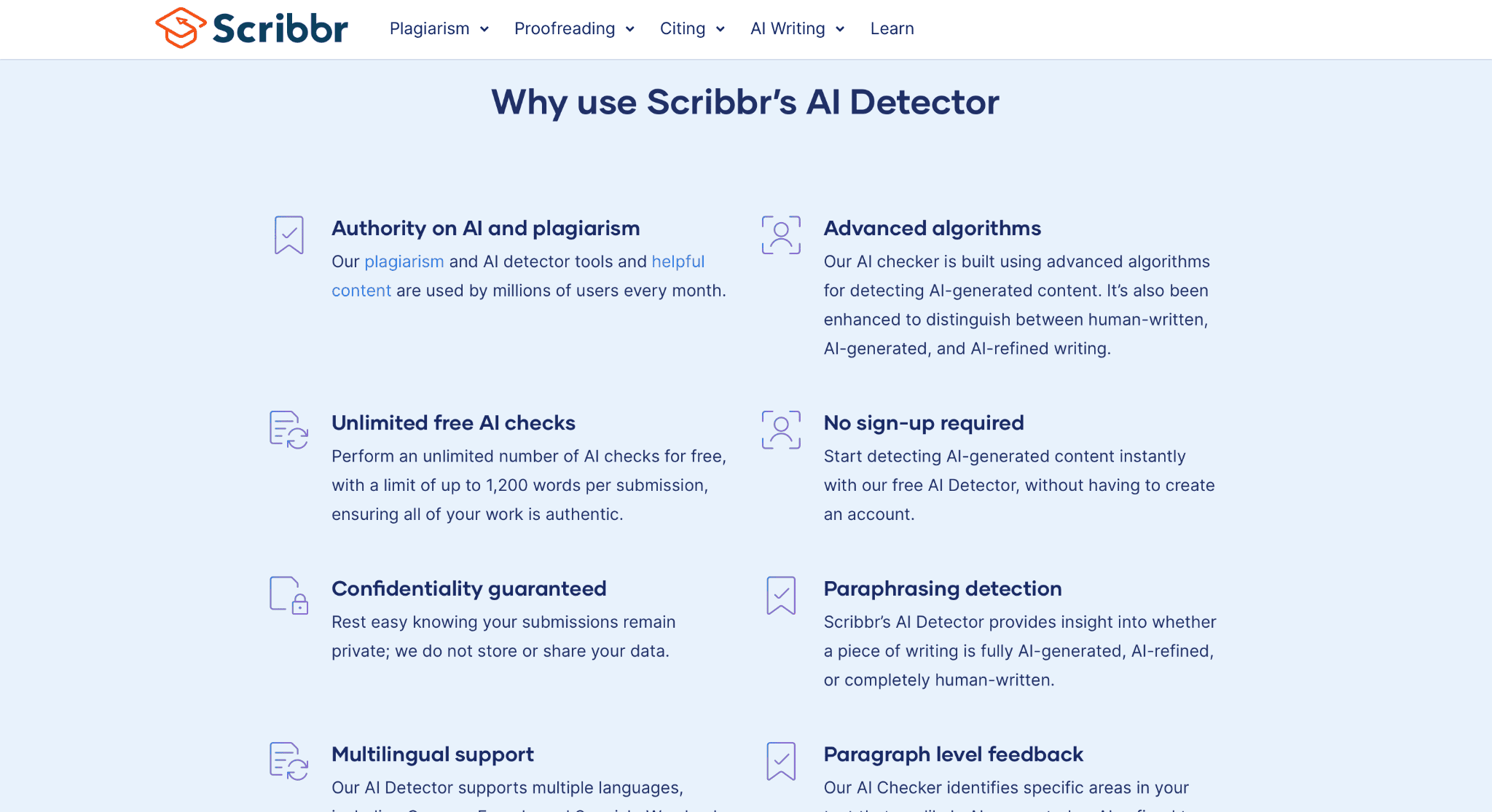
- Free use: unlimited checks, up to 1,200 words each, no sign-up.
Overall, its generous free tier and accuracy on casual writing make it useful for a fast baseline check. Still, you shouldn’t trust it with formal academic work or edited AI drafts.
What Is the Scribbr AI Detector?
Scribbr is an academic services company known for proofreading, citations, and plagiarism checks. Its AI detector is a separate tool: you paste text, and it returns the percentage it believes was written by AI.
According to Scribbr, the detector detects text from major AI tools like ChatGPT, Gemini, and Copilot, distinguishes human-written, AI-generated, and AI-refined content, and provides paragraph-level feedback. Scribbr also states that no AI detector can be completely accurate, which should always be taken into account.
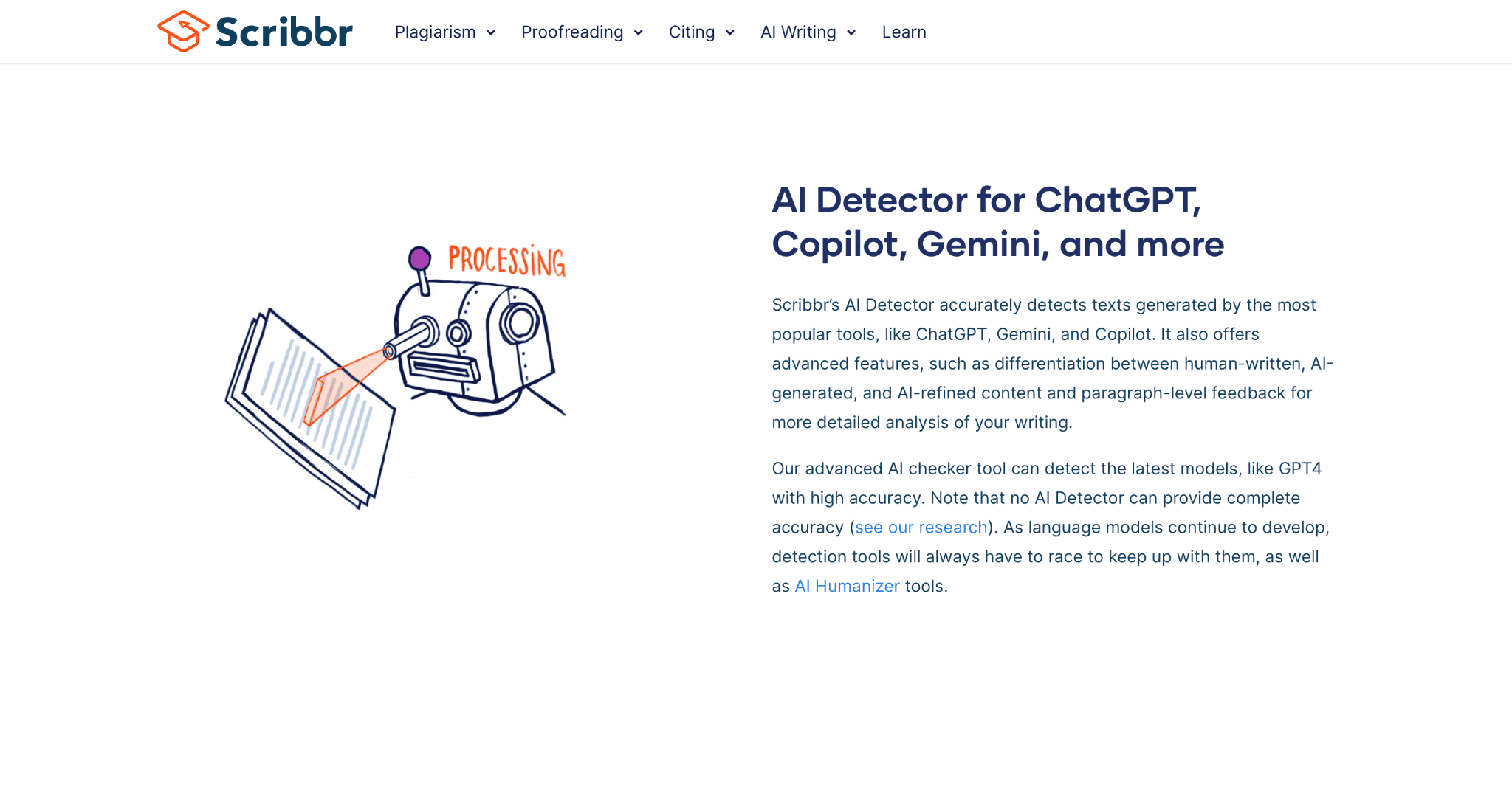
Scribbr puts its premium detector at 84% accuracy and the free version at 78%. Those are vendor claims, so I treated them as things to test.
The key features of Scribbr matter less than its origin. Scribbr and QuillBot are owned by the same parent company, Learneo. Thus, the detector is directly connected to QuillBot’s tool (you can see it on the tool’s page directly).
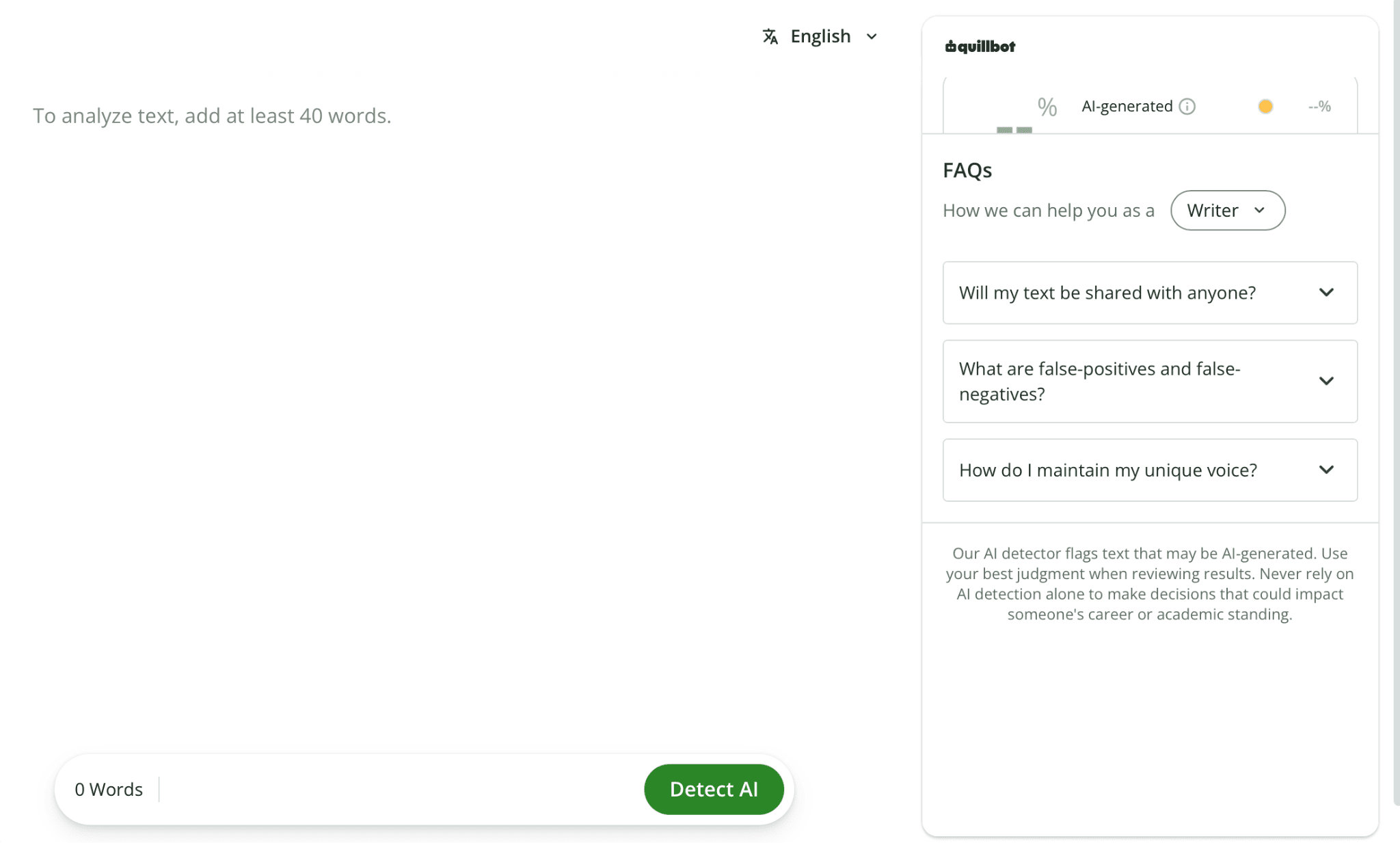
Thus, you are actually using QuillBot’s plagiarism and AI detector under another name. I covered that product separately in my QuillBot AI review. Here I try to judge only Scribbr’s AI detection on its own results. Interestingly, they appear pretty similar to what I saw in QuillBot.
How I Tested the Scribbr AI Detector Across 4 Samples
The test I took was pretty easy, so you can try it yourself. I used the free version of Scribbr’s AI detector on November 18, 2026, with no account, and took a screenshot of each result as it appeared.
Four kinds of input went in: two unedited AI texts from ChatGPT, one of which was later humanized and checked too, a human-written academic paper, and human-written non-academic articles. Every sample stayed under the 1,200-word limit per check (notice that if your text is more than 1200 words, you will not see the results).
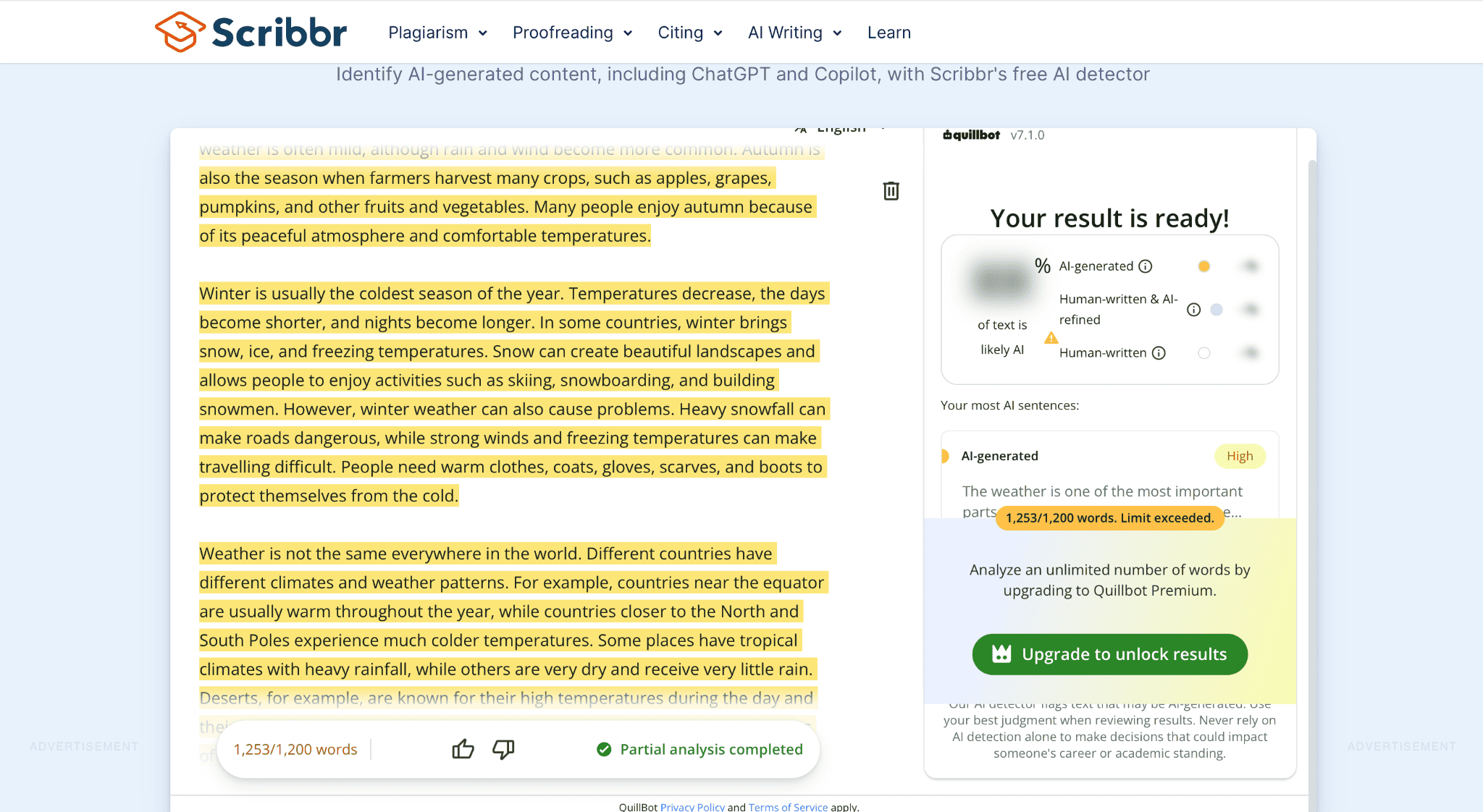
What I didn’t test: the premium detector, mixed human and AI drafts, and any language other than English, so I can’t say how well the AI detector supports other languages.
In the broader picture, the breakdown of AI detector accuracy across different tools shows how results vary between checkers.
🟣 Test 1: Unedited AI Text From ChatGPT
Setup: I asked ChatGPT for “a 1000-word text about the weather,” then for “an academic text about weather.” Both outputs went into the detector with no edits, so each was unedited AI. The second text, which was 1200 words, used an academic register to see whether tone would change the verdict.
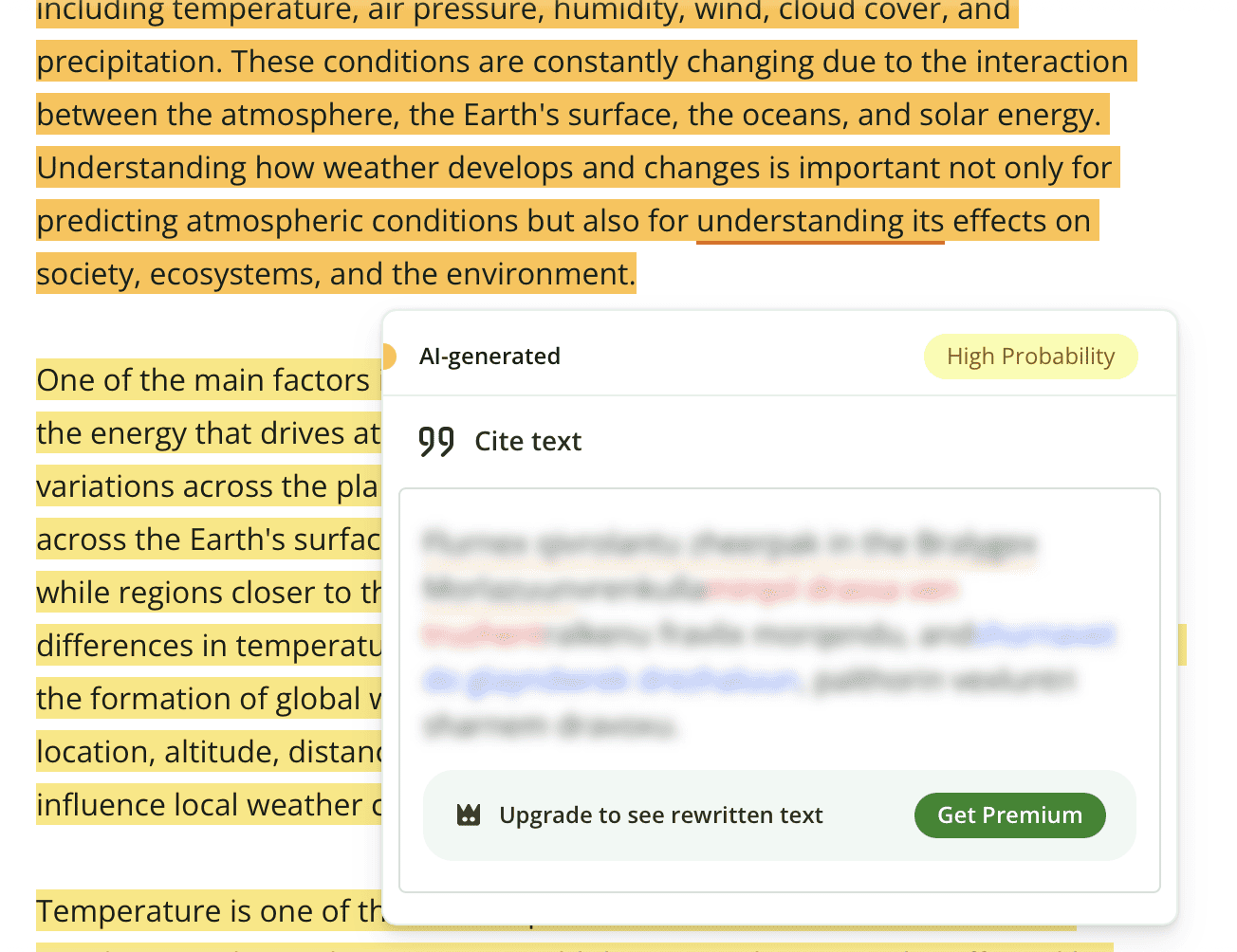
Result: 100% AI for both texts.
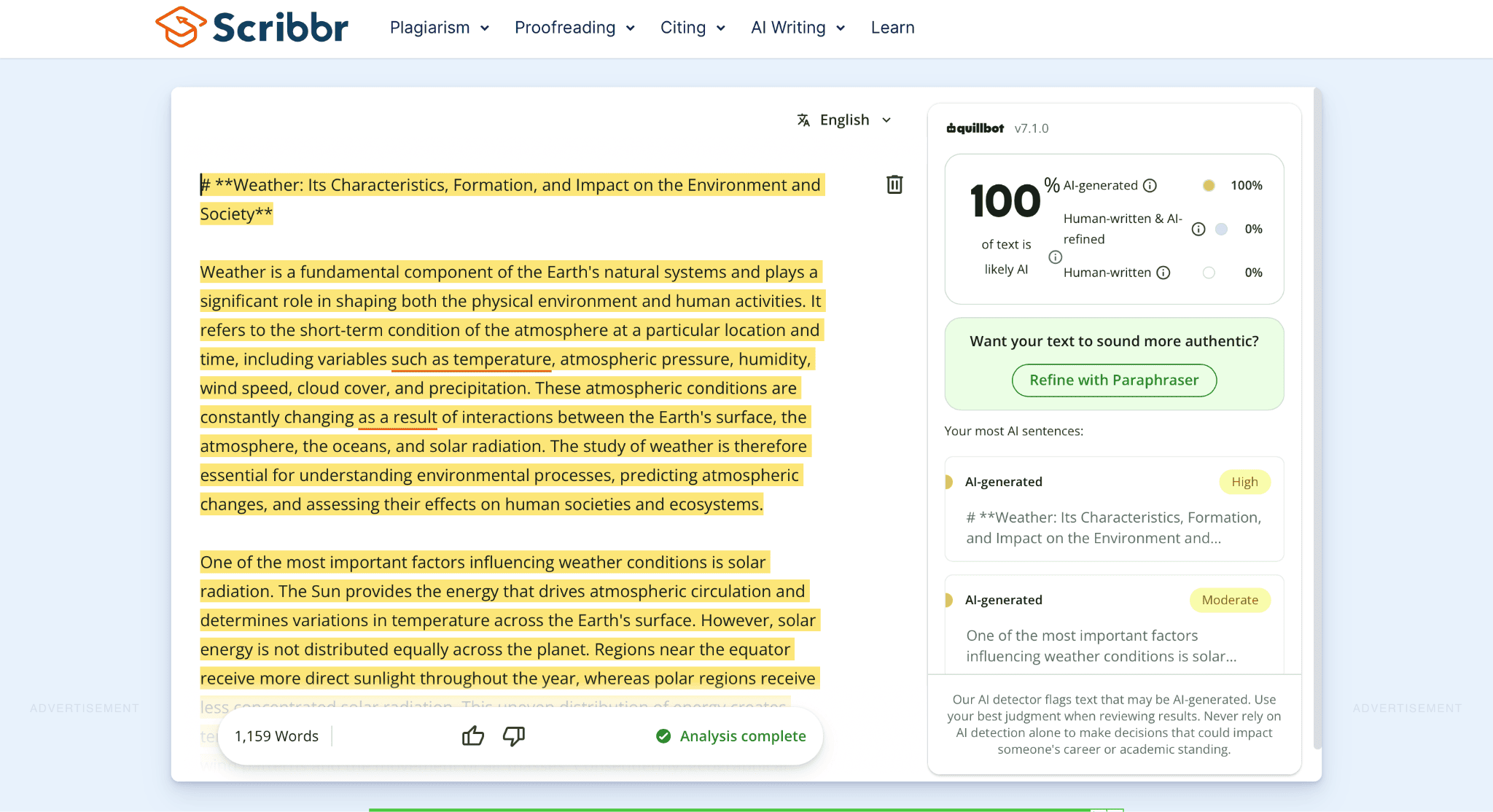
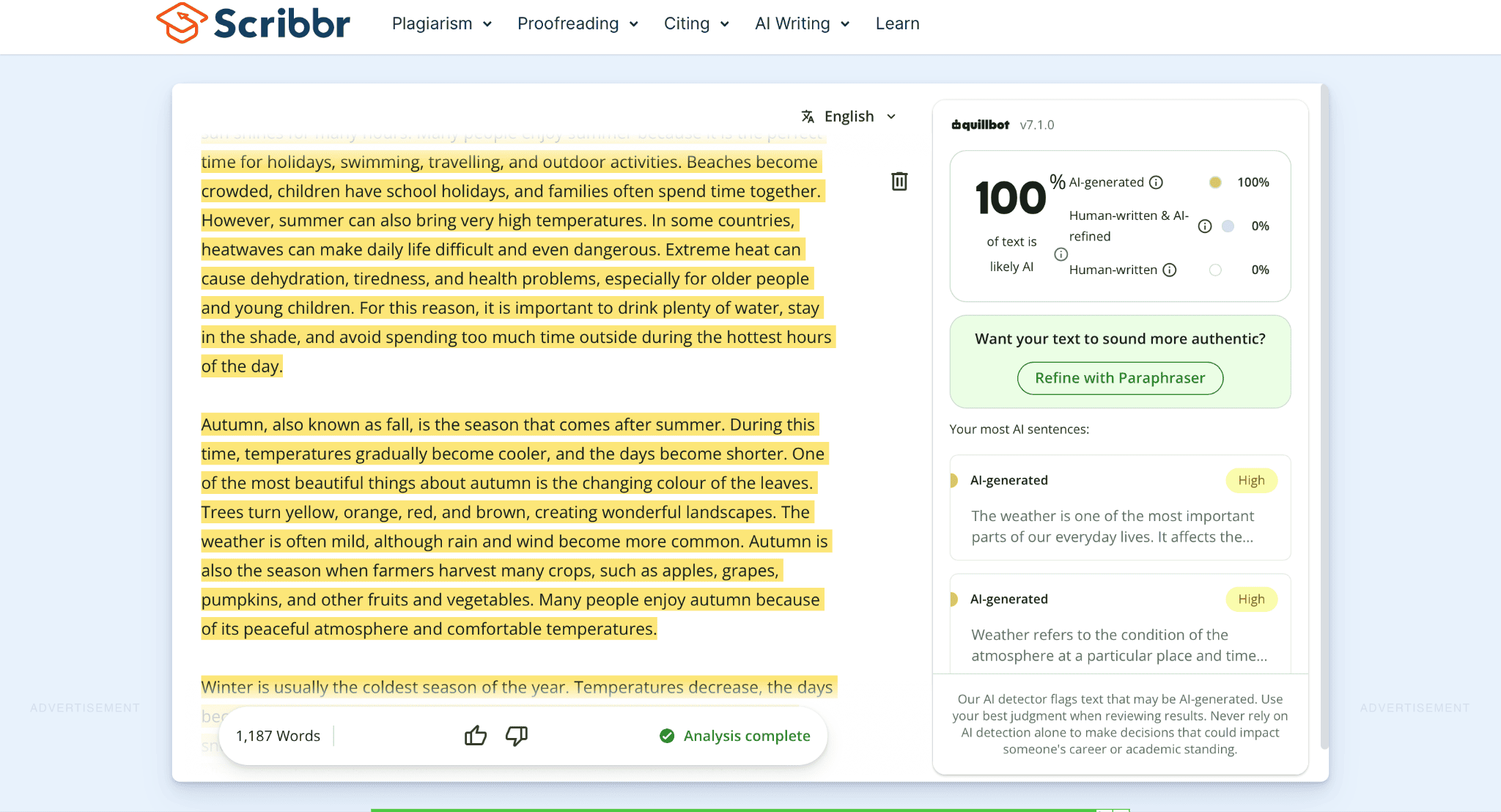
Observation: The verdict is correct. I can only know that because I produced the text myself. A flat 100% implies certainty that no detector can honestly have, because it implies that every sentence matches AI output (which, let’s be honest, is impossible). The ceiling is difficult to reconcile with Scribbr’s own page that says no AI detector will be 100% accurate.
🟣 Test 2: Humanized AI Text
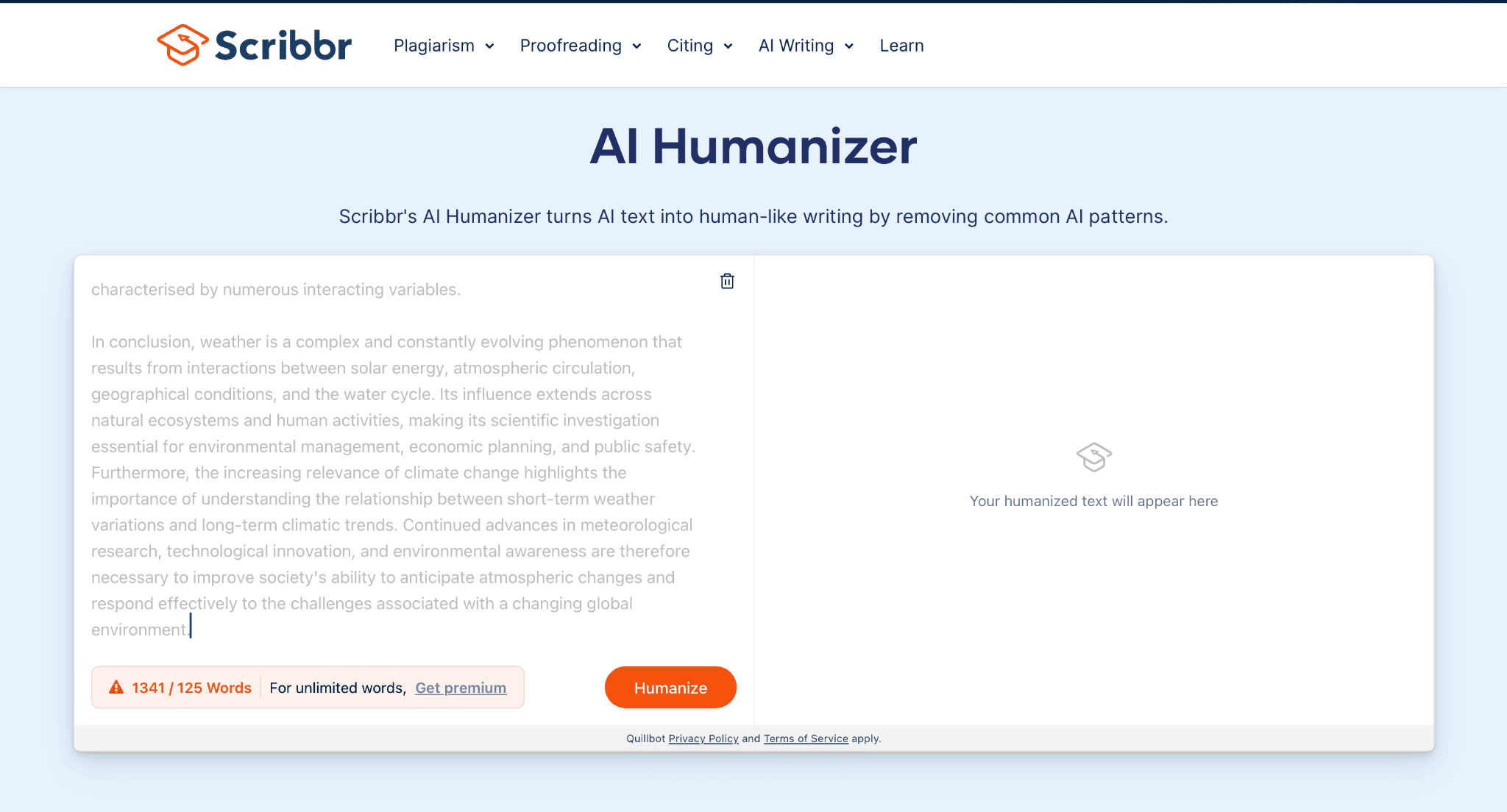
Setup: I took the academic ChatGPT text and ran it through Scribbr’s AI humanizer. However, it only accepts 125 words per run, which is too few for the full text. So I used QuillBot’s Premium humanizer instead, then ran the output through Scribbr’s AI detector.
Result: 36% AI score.
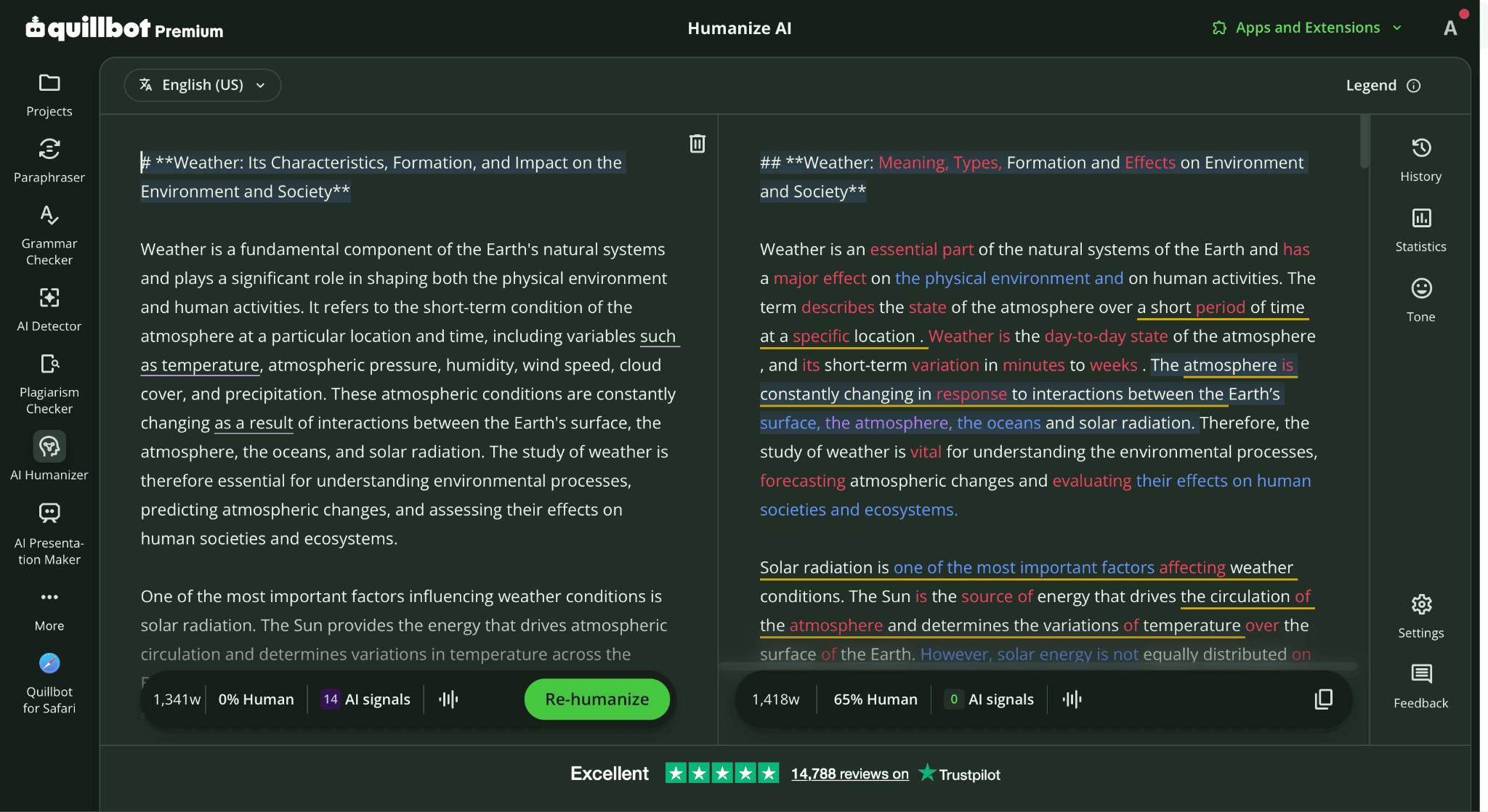
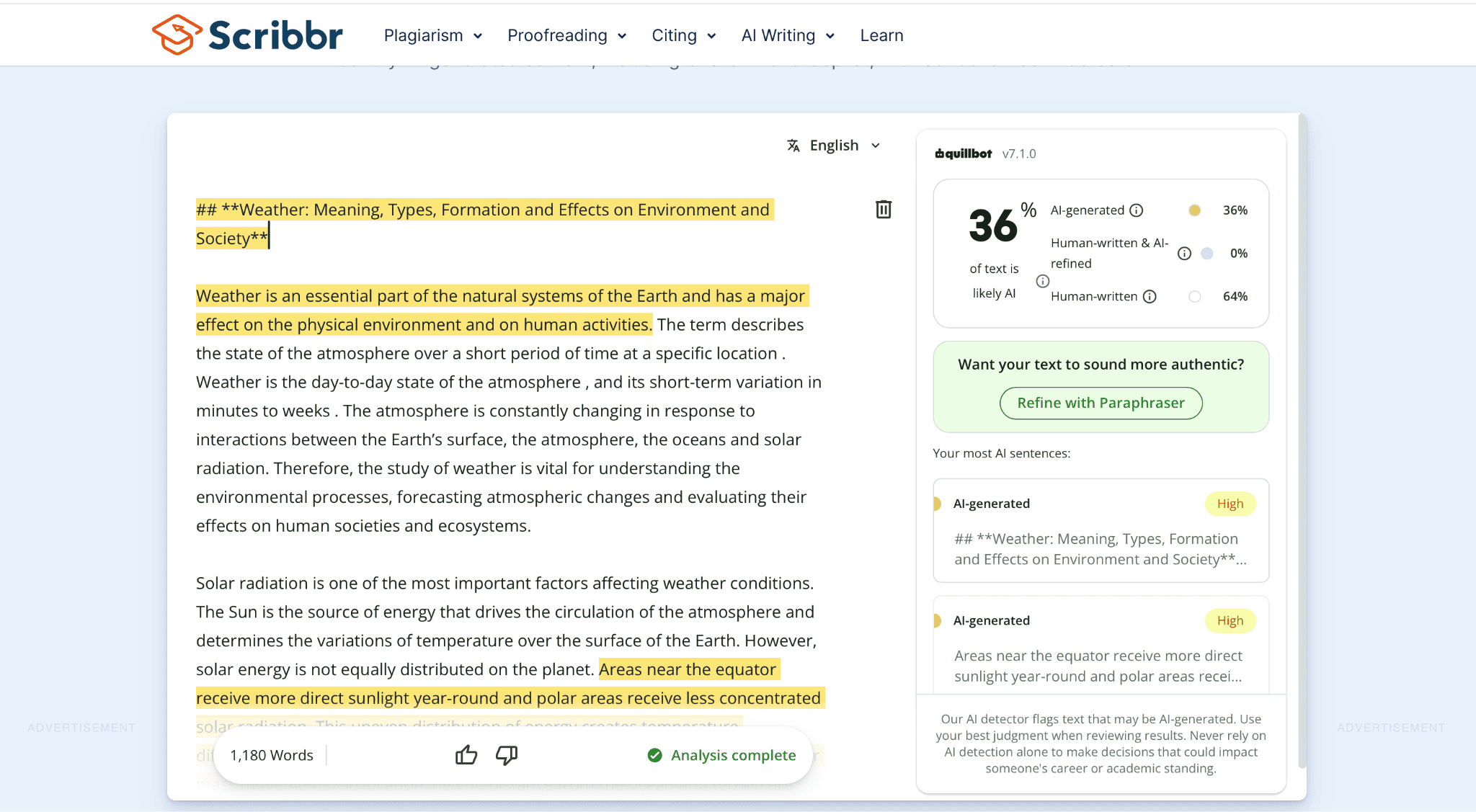
Observation: A single pass moved the score from 100% to 36%. The detector and the humanizer come from connected tools, so that swing is odd — the number changes fully once their own tool has touched the text. It shows the score tracks surface patterns, not who wrote the text. I consider it a disadvantage. Yes, when you want to humanize AI text, you expect the AI percentage to be lower. Still, it doesn’t mean the text becomes less AI; it means literally that the AI detection sees less AI. Thus, it doesn’t say that the tool is good.
🟣 Test 3: Human-Written Academic Text
Setup: I decided to check the anonymous academic assignment, written by a person, that had already passed a Turnitin check. It worked as a control: a text with a verified human origin, in the style that Scribbr’s audience writes every day.
Result: 81% AI.
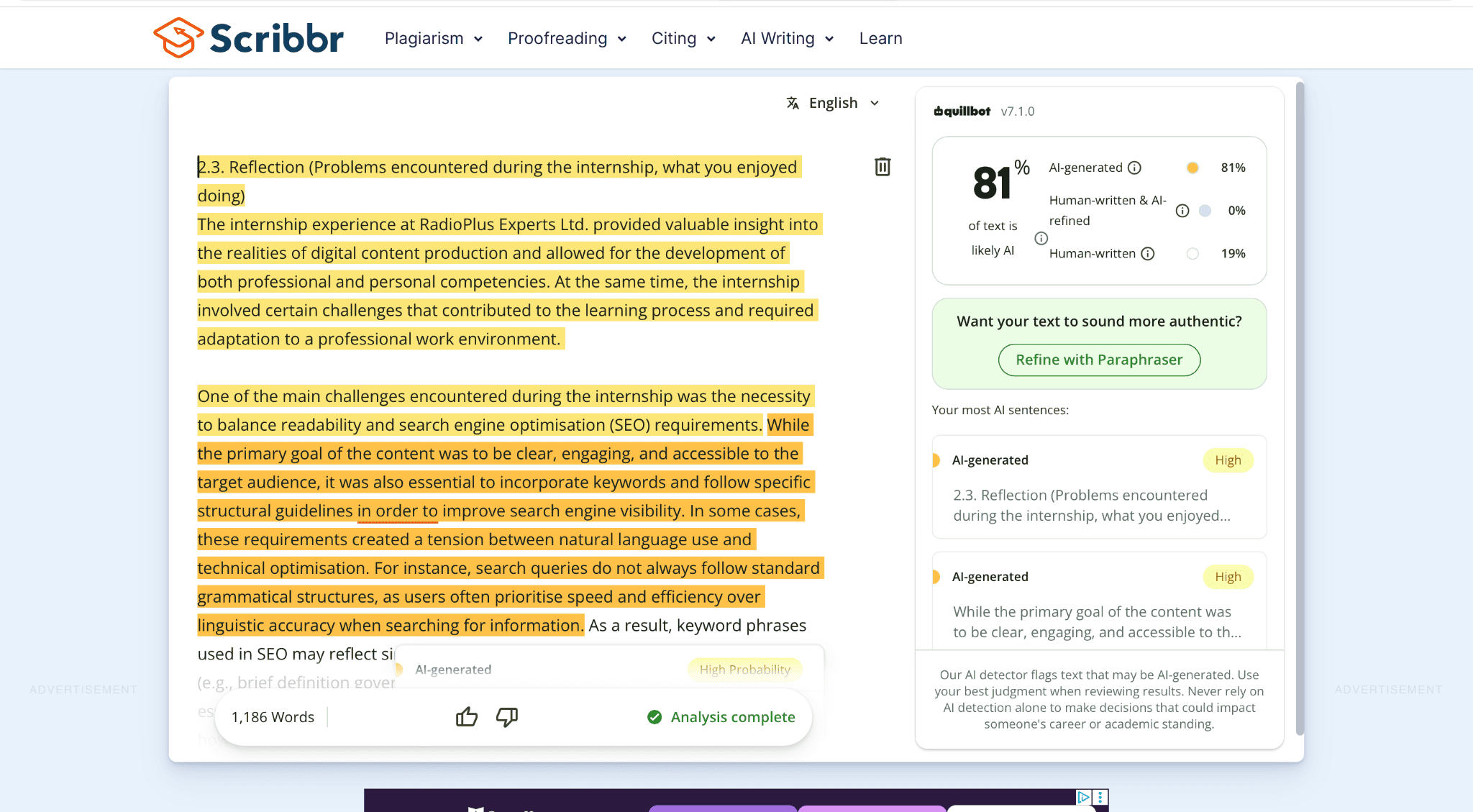
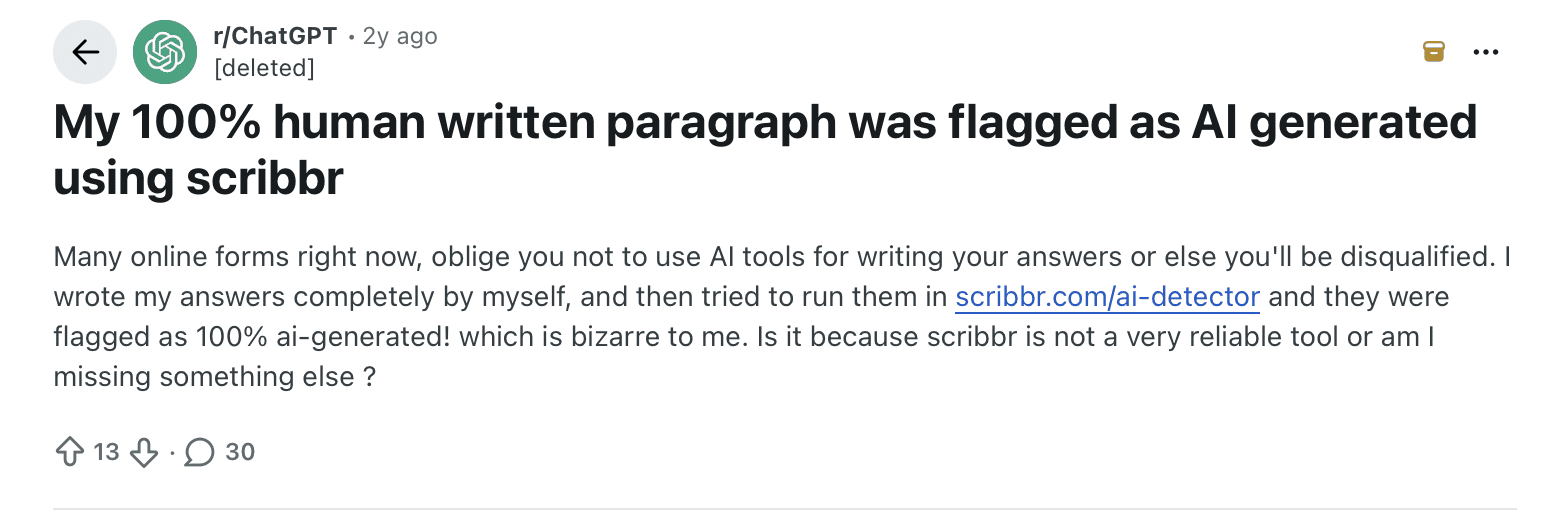
Observation: This was the failure I feared. A text that cleared Turnitin came back as mostly machine-written, which is the false positive that frightens students most. A Reddit post shows the same thing: the poster wrote their answers themselves and reported being flagged as 100% AI-generated.
🟣 Test 4: Human-Written Non-Academic Articles
Setup: One last chance I gave to Scribbr was one more non-academic, human-written article from The Guardian by Kate Wyver.
Result: 0% AI.
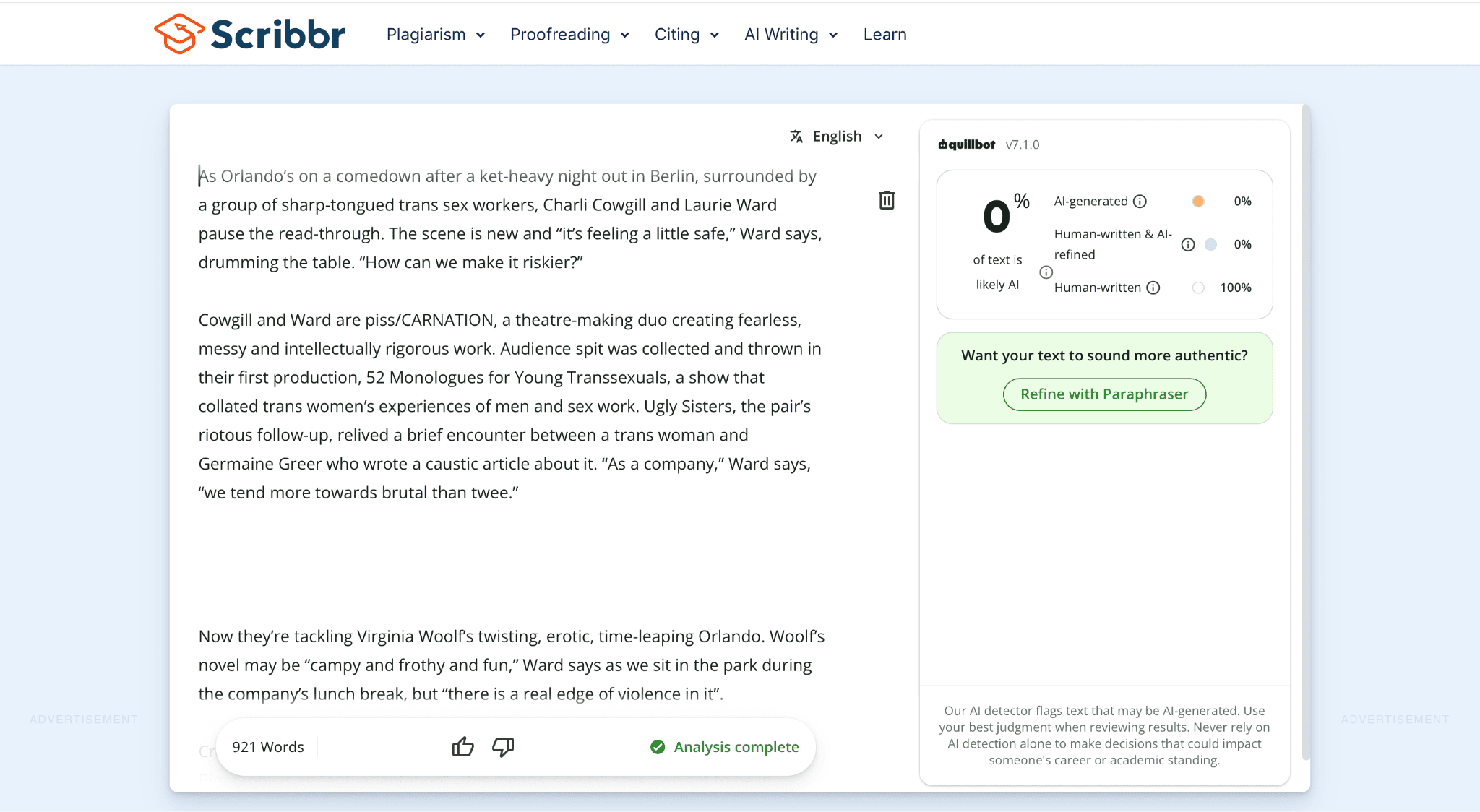
Observation: Same detector, opposite outcome. Next to Test 3, this points to one pattern — Scribbr does not recognize academic language as human. Formal structure and careful vocabulary push the score up, while conversational prose passes without trouble.
My sample is small, so read this as a pattern worth checking, not a rule. Running one AI detector on a text is never the end of the process. For example, you can also check the GPTZero AI detector review that shows how a different engine handles similar input.
So, How Accurate Is the Scribbr AI Detector?
The main question is: Is the Scribbr AI detector accurate?
My verdict is: for unedited ChatGPT output, yes, it caught both samples. For human writing, though, it is hit-or-miss depending on the register.
Raw ChatGPT prose and polished human prose both land near the top of the scale, and casual prose lands at the bottom. A rewrite lowers the number without changing who wrote the text.
Overall, the score answers “does this look like typical AI output?” and not “did a person write this?” For a student, those are different questions with different consequences. Scribbr’s 78% and 84% figures come from its own test set, so they describe that experiment and not your essay.
In my own AI detector accuracy test, the score was reliable at one extreme and unreliable everywhere else. To see how accurate any checker is on your kind of writing, you have to test your own texts.
At this point, I recommend you check out a comparison of popular AI checker tools to choose the tool that matches your writing style more.
➕ Pros
- Free with no sign-up. The free version of Scribbr’s AI detector lists unlimited checks at up to 1,200 words each. You can run every test without an account, which is convenient.
- Catches unedited AI. Both raw ChatGPT outputs scored 100% AI in Test 1.
- Plain writing passes. Both non-academic human articles scored 0% AI in Test 4.
- Fits a wider toolkit. Scribbr pairs the premium AI check with its paid plagiarism checker, which is ideal for students who already use it for proofreading and citations.
➖ Cons
- False positives on academic writing. A human text that passed Turnitin scored 81% AI in Test 3, and Scribbr may flag precisely the formal style students are taught.
- Scores move with rewriting. One QuillBot pass took the same text from 100% to 36% in Test 2.
- Hard size caps. The free check stops at 1,200 words, so a 5,000-word paper needs several runs, and Scribbr’s own humanizer accepted only 125 words in my attempt.
- Weak on mixed text, by Scribbr’s own account. Its research says even the premium tool finds only about 60% of AI text blended with human writing or paraphrased.
- A percentage without context. The number doesn’t show why the AI system reached it or how confident it is.
💰 Scribbr AI Detector Pricing: Free Version vs Paid
Regarding pricing, Scribbr’s website is unclear because it lacks a dedicated pricing page. But I figured out that if you want their premium AI detector, you must buy QuillBot’s, since they are connected even at that level. So, the cost is 8.33$/ month [November 18, 2026].
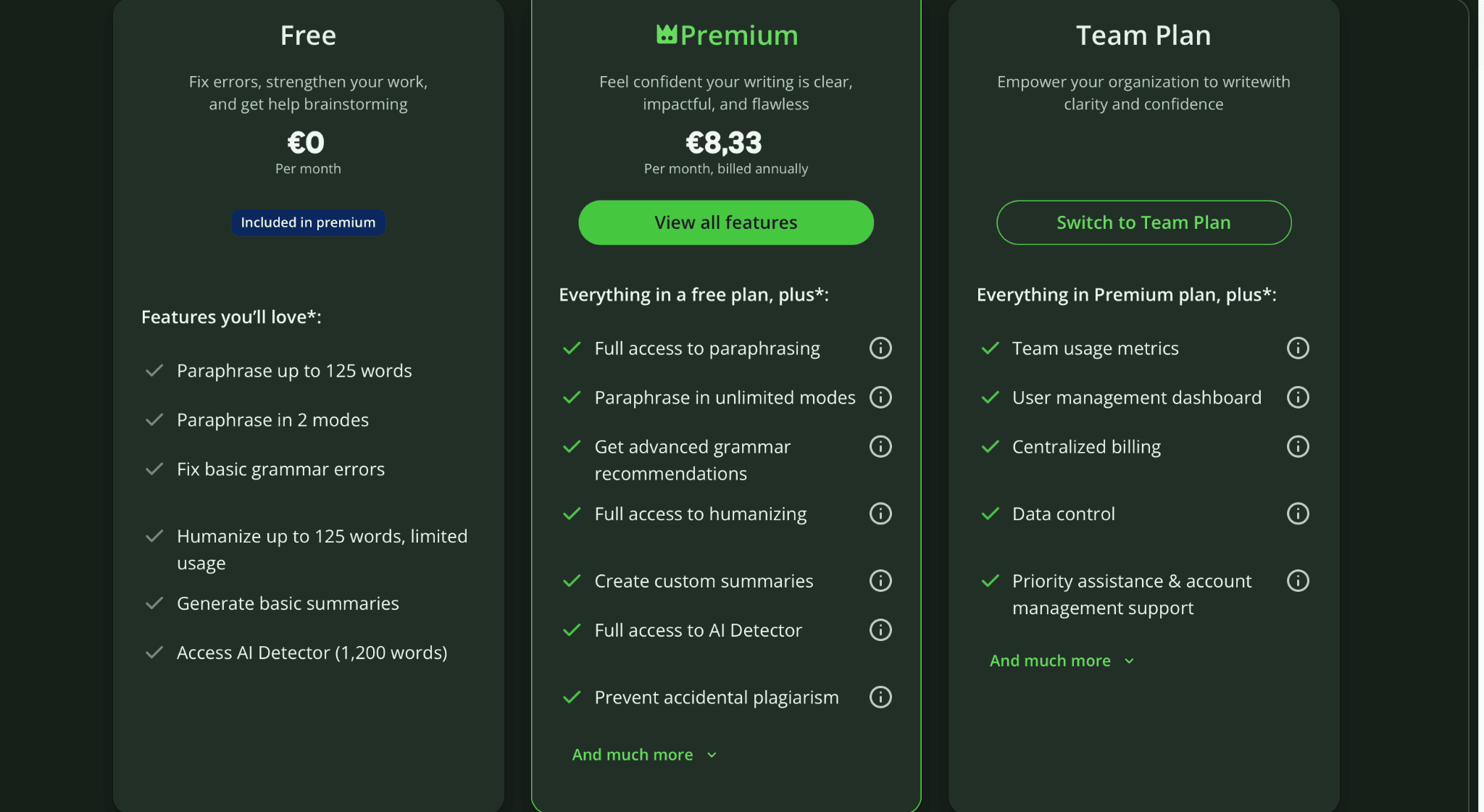
The premium AI checker includes unlimited AI detection checks, a plagiarism checker report, and other QuillBot features. So, you must consider if you need their full toolkit. If you’re aiming only for AI detection, this tool isn’t for you.
Limitations and False Positives
Formal writing is the main trap. Tests 3 and 4 show academic prose being flagged while casual articles pass, which is exactly the AI-detector false-positive problem people complain about. A clean Scribbr result also won’t predict a Turnitin result, because the two run on separate systems with separate scoring.
Several things stayed untested: the premium detector, short texts, mixed human and AI drafts, and output from models other than ChatGPT.
If you are flagged unfairly, keep your drafts, notes, and version history, and offer to write a short sample under supervision. That evidence holds up better than another tool’s number. It also helps to run text through a second detector before you submit it and to treat each result as part of a larger review.
📌 Tip: writers who draft with an AI writing assistant should keep a record of their own edits, because AI involvement in a text is easy to claim and hard to disprove after the fact.
Who Scribbr’s AI Detector Is Best For
Use Scribbr for a quick sanity check for plain writing like blog posts, emails, and articles. It also works for anyone who wants to start doing AI checks on raw output from tools like ChatGPT without creating an account. Sadly, unedited AI was found in every one of my tests.
Don’t use it for academic work! If you write essays, theses, or reports, 81% on verified human text means you’re at risk of being flagged for good writing. No grader or hiring person should take its percentage as proof alone. If you are learning how to use AI responsibly in your coursework, you should be relying on drafts and process, not a detector’s verdict.
Alternatives to Scribbr AI Detector
If you want a second opinion on your text, these are the options worth running it through:
- QuillBot’s AI detector: the closest match, since Scribbr’s detector is directly connected to QuillBot’s tool. Expect similar results, so it serves more as a cross-check on the same engine than a true second opinion.
- Turnitin: available through institutions, not to individual users, but it is considered the most reliable for academic work.
- GetSolved’s AI detector: a free option for running the same text through a different checker.
So, you can get a first mark with tools like Scribbr. But a second detector will tell you if the results are real.
Bottom Line
Scribbr’s AI detection tool is easy to use and free, and it catches unedited AI text every time.
I can’t call it reliable for academic writing, though: 81% AI on a human text that passed Turnitin, 0% on casual human articles, and 36% after a humanizer pass.
To sum up, I recommend using it as a rough first check on plain text. Run anything important through different AI detectors. And remember: none of the AI detectors give a verdict on who wrote the text. Treat every result as a signal, not an outcome of your work!
Frequently Asked Questions About Scribbr AI Detector
Can I use the Scribbr AI detector for free?
Yes. Scribbr’s page offers unlimited free checks, each up to 1,200 words.
How accurate is the Scribbr AI detector?
Scribbr’s own research says that their tool is 84% accurate with a premium subscription and 78% with the free version. In my tests, it scored 100% on raw ChatGPT text, 81% on a human academic text, and 0% on casual articles. It depends on unedited AI output and is unreliable for formal human writing.
Does Scribbr use QuillBot’s AI detector?
The tools are connected, and both companies are owned by Learneo, so Scribbr and QuillBot’s detectors work together in practice.
If my text passes Scribbr, will it pass Turnitin?
No. They are separate systems. My Test 3 text passed Turnitin and still scored 81% AI in Scribbr.
Can Scribbr detect AI-humanized text?
Partly. My humanized sample scored 36% AI. Scribbr itself says that “humanizing AI-generated content can make it sound more natural; detector results are not always definitive.”