One flagged sentence can cost you a grade, a byline, or a multi-thousand-dollar client relationship.
If you’ve ever hit “submit” on an essay or manuscript with a knot in your stomach, you already know why a reliable checker matters. Plagiarism issues rarely announce themselves before it’s too late. To see which tools actually deliver in 2026, I spent months putting 14 popular plagiarism checkers through rigorous testing. I evaluated real-world detection against direct copying, paraphrasing, and AI-assisted text.
Below is my honest, hands-on ranking so you don’t waste time on tools that fail when it matters most.
💡 Good to know: Turnitin is strictly licensed to institutions and isn’t sold to individuals. Every other tool on this list is something you can sign up for and use today.
Key Takeaways
- Best overall for most people: GetSolved’s plagiarism checker, because it’s bundled with AI detection, citation, and fact-checking tools you’ll likely need anyway.
- Best free plagiarism checker: Quetext, for its genuinely usable free scan and citation generator.
- Best detection accuracy (independently tested): Copyleaks, at 81.8% in Reedsy’s 2026 comparison.
- Best for academic submissions: Scribbr, because it runs the same way Turnitin works.
- Worth skipping if accuracy is your priority: Grammarly’s plagiarism checker and DupliChecker both underperformed in independent tests.
How I Chose and Tested These Tools
I evaluated each plagiarism checker on four things:
- Detection accuracy (how much real plagiarism it actually catches, based on independent testing where available).
- How it handles paraphrasing plagiarism versus direct copying, and how generous the free attempts are before you need to pay.
- Whether the pricing matches the value you get, including how each free account compares once you move to a paid plan.
- I leaned on published head-to-head tests (Reedsy) rather than marketing claims whenever possible, because self-reported “99% accurate” numbers rarely hold up in real-world use. If you just need to check plagiarism in a single paragraph, the right plagiarism checker tool might be a different one entirely from the checker tool built for a 10,000-word manuscript.
Full Comparison Table
The free vs. paid split below matters as much as the accuracy column. A tool that offers a free scan generous enough for your real workload beats a slightly more accurate one that charges from word one.
| Tool | Best For | Free vs Paid Option | Starting Price | Detection Notes |
|---|---|---|---|---|
| GetSolved | All-in-one writers & students | Free scan available | Paid plans | Bundled with AI detection & citation tools |
| Copyleaks | Highest accuracy | Yes | $13.99/mo | 81.8% detection (Reedsy, 2026) |
| Quetext | Best free plagiarism checker | 1000 words free | $14.99/mo | 63.6% detection (Reedsy, 2026) |
| Grammarly | Writers already using Grammarly | Basic grammar only | $12/mo | 54.5% detection (Reedsy, 2026) |
| Scribbr | Academic/thesis submissions | Risk plagiarism score only | $14.95/doc | 72.7% detection (Reedsy, 2026) |
| Turnitin | Institutions | N/A | Institutional license | Industry benchmark, schools only |
| GPTZero | Plagiarism + AI detection combo | 7 days free premium plan use | $9.09/mo | Claims 99% on its own test sample |
| QuillBot | Overall balance of accuracy & UX | Limited | $4.17/mo (billed annually) | 72.7% detection (Reedsy, 2026) |
| iThenticate | Journals & publishers | No | $125/manuscript | Deep academic database |
| DupliChecker | Quick free checks | 10,000 words/scan | $9.99/mofor 30,000 words | ~23% detection in GPTZero’s test |
| Copyscape | Web content & SEO | 2 free scans | $0.03/200 words | Weak on paraphrasing |
| PrePostSEO | Free tool bundles | 300-500 words free | $6.75/mo | Inconsistent limits across plans |
| Paperpal | Research manuscripts | 7,000 words/mo free | $7.20/mo | Large academic database |
| PlagScan | EU/GDPR-compliant institutions | No | Custom pricing | Customizable similarity settings |
The 14 Best Plagiarism Checkers, Ranked
1. GetSolved — Best Overall Plagiarism Checker
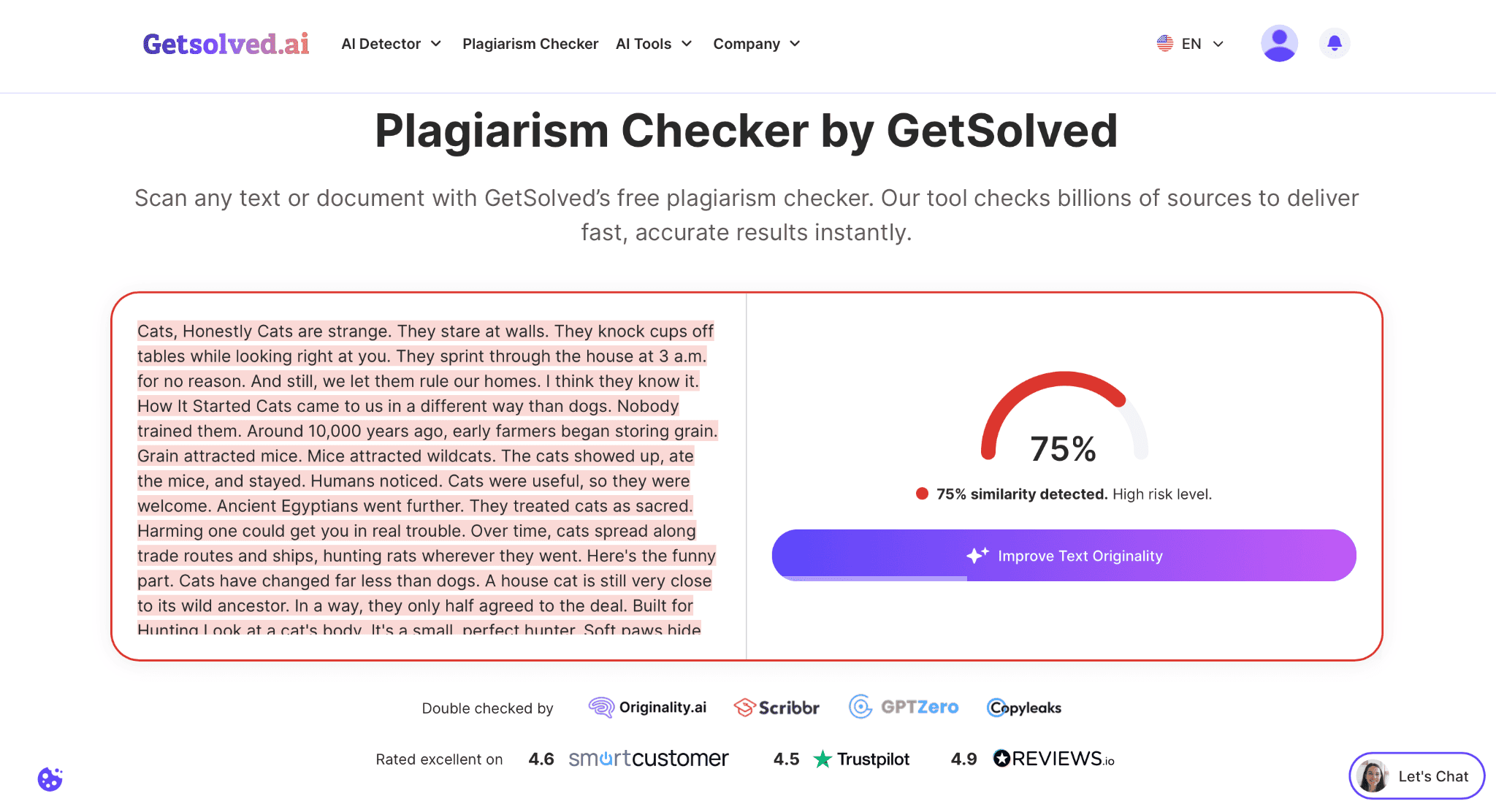
GetSolved is the one I keep coming back to, mostly because it doesn’t make you juggle five different tabs. You can not only check your text for possible plagiarism there but also use an AI detector, a fact-checker, and a citation tool. Meaning, you’re checking originality, catching AI-flavored phrasing, and cleaning up references in one pass instead of bouncing between apps.
Key features:
- Plagiarism scan alongside AI detection in the same report.
- With encrypted, private document handling, you can delete uploads from your account.
- Built-in citation and fact-checking tools for the same document.
🌟 Highlights: Multiple reviewers specifically noted it caught overlap that a previous tool they’d used had missed, and that support responded within hours rather than days. It’s not purely a plagiarism specialist like Copyleaks or iThenticate, so if your only need is heavyweight, academic-journal-level checking, keep reading — but for everyday writers, students, and content teams, the all-in-one setup is the practical win.
💰 Pricing: Free scan available, with paid plans for higher volume.
2. Copyleaks — Best for Raw Detection Accuracy
If detection rate is the only metric you care about, Copyleaks currently wins. In Reedsy’s 2026 five-tool test, it caught 81.8% of plagiarized content, the highest rate in the group. It also does that across more than 100 languages, which matters if you’re writing (or checking) in anything other than English.
Key features:
- 100+ language support for plagiarism detection.
- In-interface source preview so you don’t need to open new tabs.
- LMS integrations (Canvas, Moodle, Blackboard) plus a Chrome extension.
👍 Pros: Highest independent detection rate tested; strong for multilingual work; solid report design.
👎 Cons: Citations aren’t easy to copy out of the report. Some users flag a buggy login and a hard-to-find cancellation button.
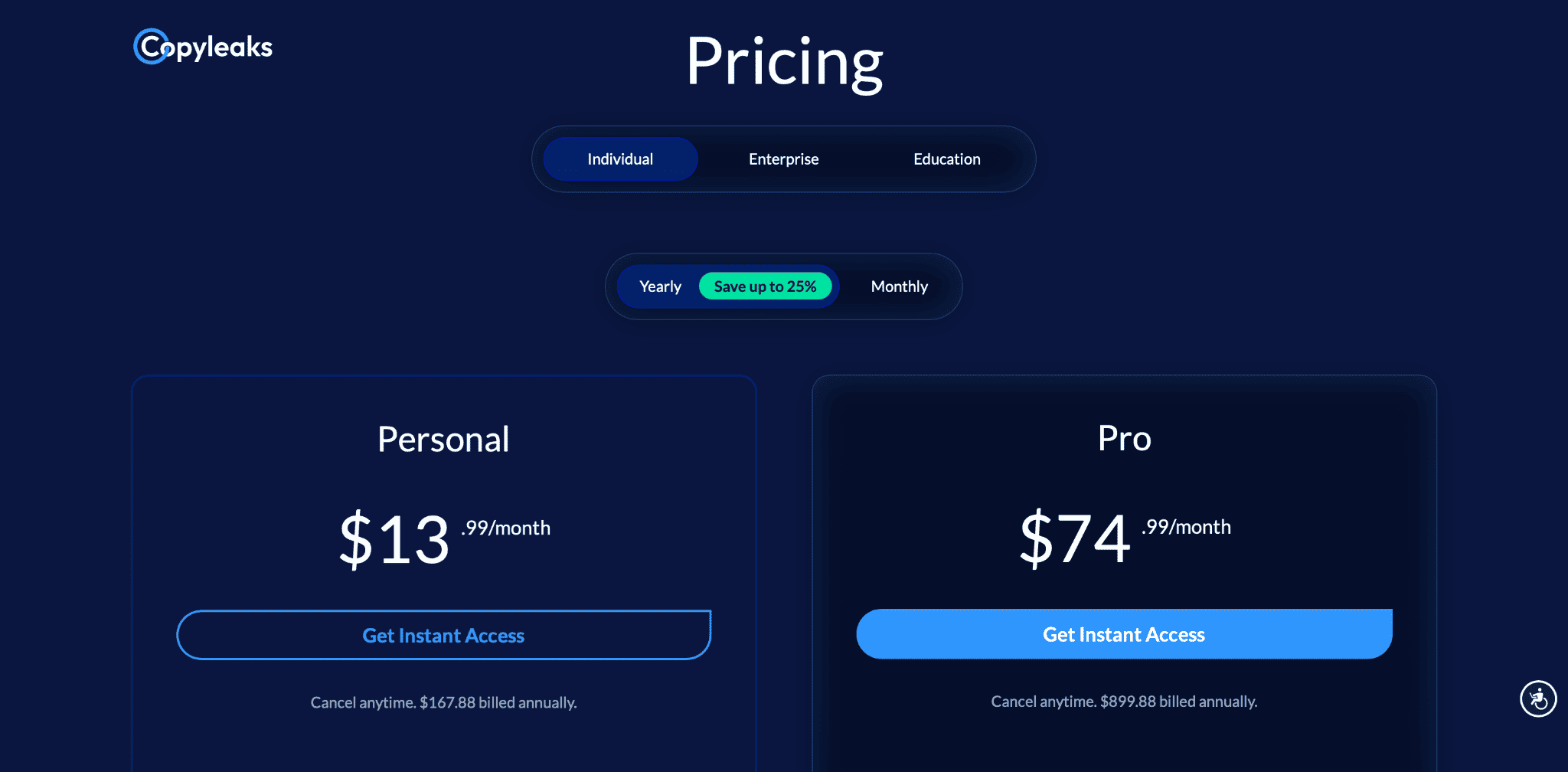
💰 Pricing: Paid plans start at $13.99/month.
3. Quetext — Best Free Plagiarism Checker
Quetext’s free scan is the one I point people to when they just want a fast, no-commitment plagiarism check without a credit card request, before committing to anything paid. You get 1000 words free before signing up, plus one more free run after you register — a genuinely useful free online plagiarism checker if you just need a quick check on a short piece. For a broader set of no-cost options beyond plagiarism, it’s worth pairing this with a look at free writing tools for editing and review as well.
Key features:
- DeepSearch technology is designed to detect paraphrased content.
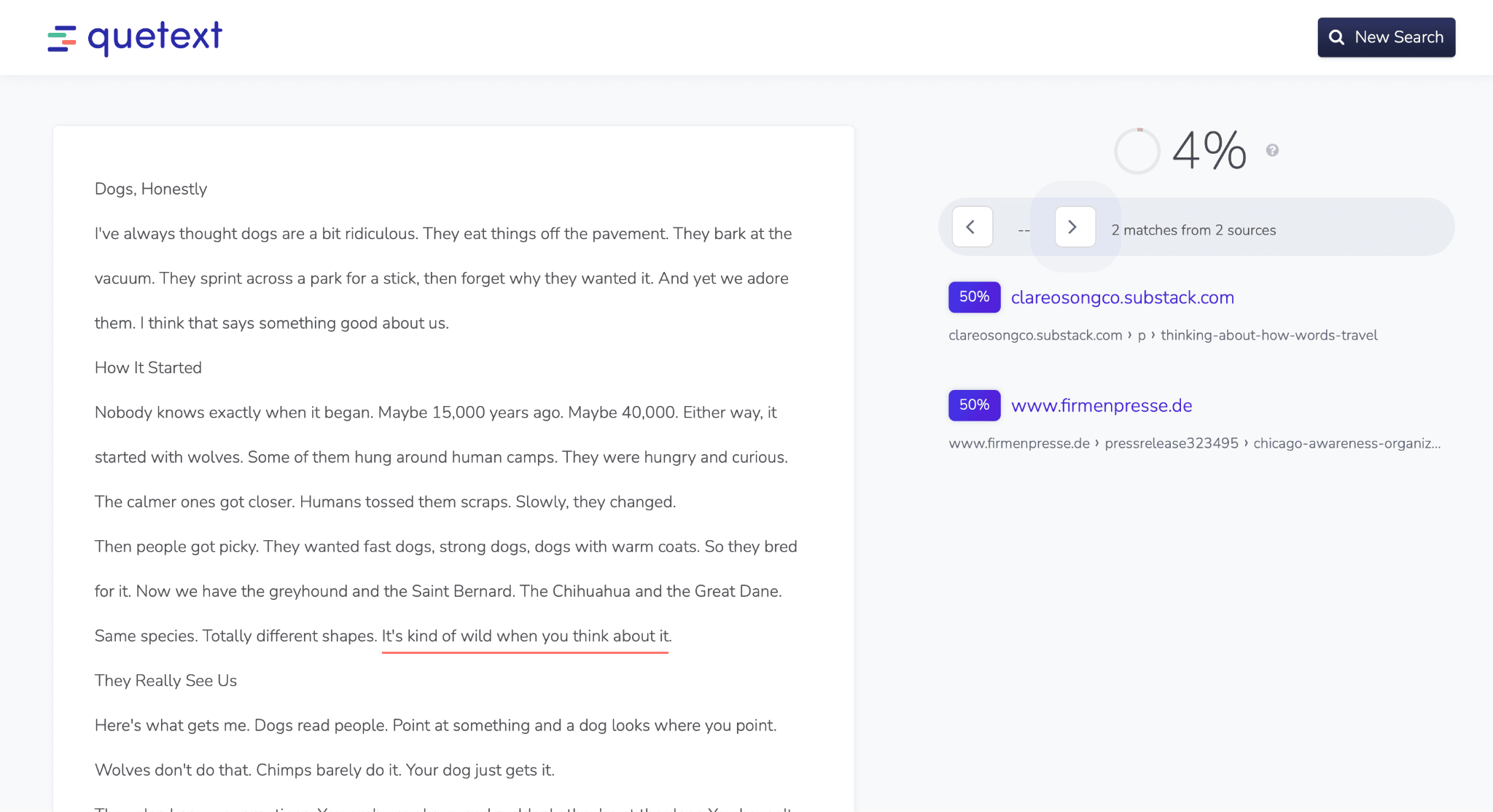
- Color-coded underlining showing match severity.
- Built-in citation generator (APA, MLA, Chicago).
👍 Pros: Best free plagiarism checker on this list by a clear margin; affordable paid tier (up to 100,000 words); easy to use; one of the more generous free plagiarism checkers online for a first draft.
👎 Cons: Scans run slower than competitors. Reedsy’s testing put detection accuracy at a middling 63.6%.
💰 Pricing: Free for 1000 words; paid plans from around $14.99/month.
4. Grammarly — Best If You’re Already Paying for It
Grammarly is the tool most people already have open in a browser tab. It is exactly why its grammar and plagiarism checker get used even when it isn’t the strongest option. It’s bundled into the Pro plan, checks your text against billions of web pages (16 billion, by Grammarly’s own count) plus ProQuest’s academic databases, and makes citation formatting easy to copy and paste.
Key features:
- Plagiarism check bundled with grammar, tone, and clarity suggestions.
- 16 billion web pages plus ProQuest academic database access.
- Easy citation copy-paste in APA, MLA, or Chicago.
👍 Pros: Convenient if you’re already a subscriber; clean, familiar interface. Works across browsers, desktops, and mobile.
👎 Cons: Weakest detection rate independently tested, just 54.5% in Reedsy’s comparison — not what you want when trying to avoid plagiarism on something high-stakes. No downloadable report; Grammarly’s plagiarism checker isn’t available on the free plan at all.
💰 Pricing: $12/month with 7 free days.
5. Scribbr — Best for Academic Submissions
Scribbr leans hard into the academic crowd, and for good reason: its plagiarism checker runs on the same underlying technology as Turnitin, which is part of why it handles academic plagiarism and a dense research paper about as well as anything short of Turnitin itself. Institutions that already pay for something like Turnitin or Scribbr tend to stick with whichever one their department picked years ago.
Scribbr’s database includes research journals, student papers, and institutional archives, and it uses advanced AI alongside Turnitin-style matching to flag paraphrased overlap, not just exact copies. By the way, if citations are part of what’s slowing you down before a submission, you should also check citations before submitting or publishing to catch formatting slips.
Anyways, even though it is one of the best checkers based on score, there are no free options, which is why I put it lower on the list.
Key features:
- Turnitin-powered detection against academic databases.
- Self-plagiarism checker for comparing against your own past work.
- Detailed side-by-side source comparison in reports.
👍 Pros: Strong academic database coverage; detailed, professional-looking reports; solid 72.7% detection rate in independent testing.
👎 Cons: Only sign-up; no free options; you pay for documents; checking small documents costs $14.95 per document and up, scaling to $39.95 for longer documents; no refunds.
💰 Pricing: From $14.95 per document.
6. Turnitin — The Institutional Benchmark
Turnitin is the name most people mean when they say “plagiarism checker,” even though most people reading this can’t actually buy it. It’s the way Turnitin has always worked: sold exclusively to schools and universities, which compare submitted papers against academic journals, institutional archives, and a massive bank of previously submitted student work, catching everything from accidental plagiarism to deliberate mosaic plagiarism, where copied phrases get stitched between original sentences.
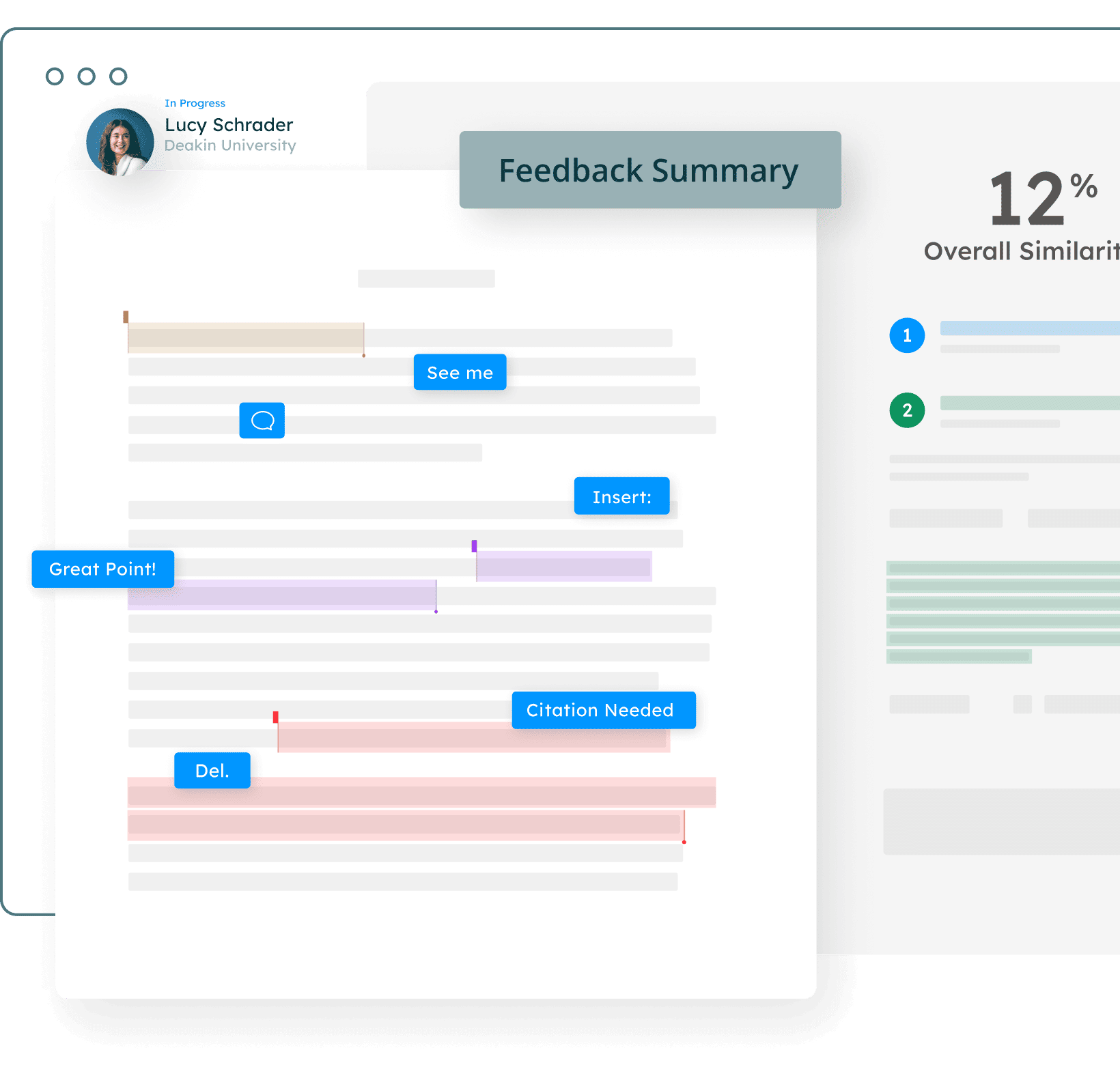
Image from Turnitin Web
Key features:
- Match Group feature that organizes properly cited references versus problematic overlaps.
- Flags Panel that catches manipulation tricks like hidden or swapped characters.
- Proprietary institutional and academic databases.
🌟 Highlights: If your school or employer already has a Turnitin license, use it. It’s still the reference point against which every other tool on this list is measured. If you don’t have access, that’s exactly why the other 14 tools here exist.
💰 Pricing: Institutional licensing only, no individual plans.
7. GPTZero — Best for Plagiarism + AI Detection Together
GPTZero built its name on AI detection, but its plagiarism checker deserves attention on its own. Since plagiarism and AI detection are answering genuinely different questions, it’s worth understanding why AI detection and plagiarism detection are different before you lean too hard on either one alone.
Still, in its own testing, GPTZero’s plagiarism checker correctly traced every sentence of a plagiarized sample back to its source.
Key features:
- Plagiarism detection across 100M+ sources.
- Sentence-by-sentence scanning for more contextual accuracy.
- Generous free tier: 10,000 words per month.
👍 Pros: Free tier is genuinely usable, not just a teaser. Affordable paid plans, with the first month free. Maintains original document formatting and has a history of checks.
👎 Cons: Source names aren’t shown directly in results; you have to hover or click through to see them. Can be used only after signing up for a premium plan; a 7-day free option available.
💰 Pricing: Paid plans from $9.09/month (annual billing).
8. QuillBot — Best Balance of Accuracy and Usability
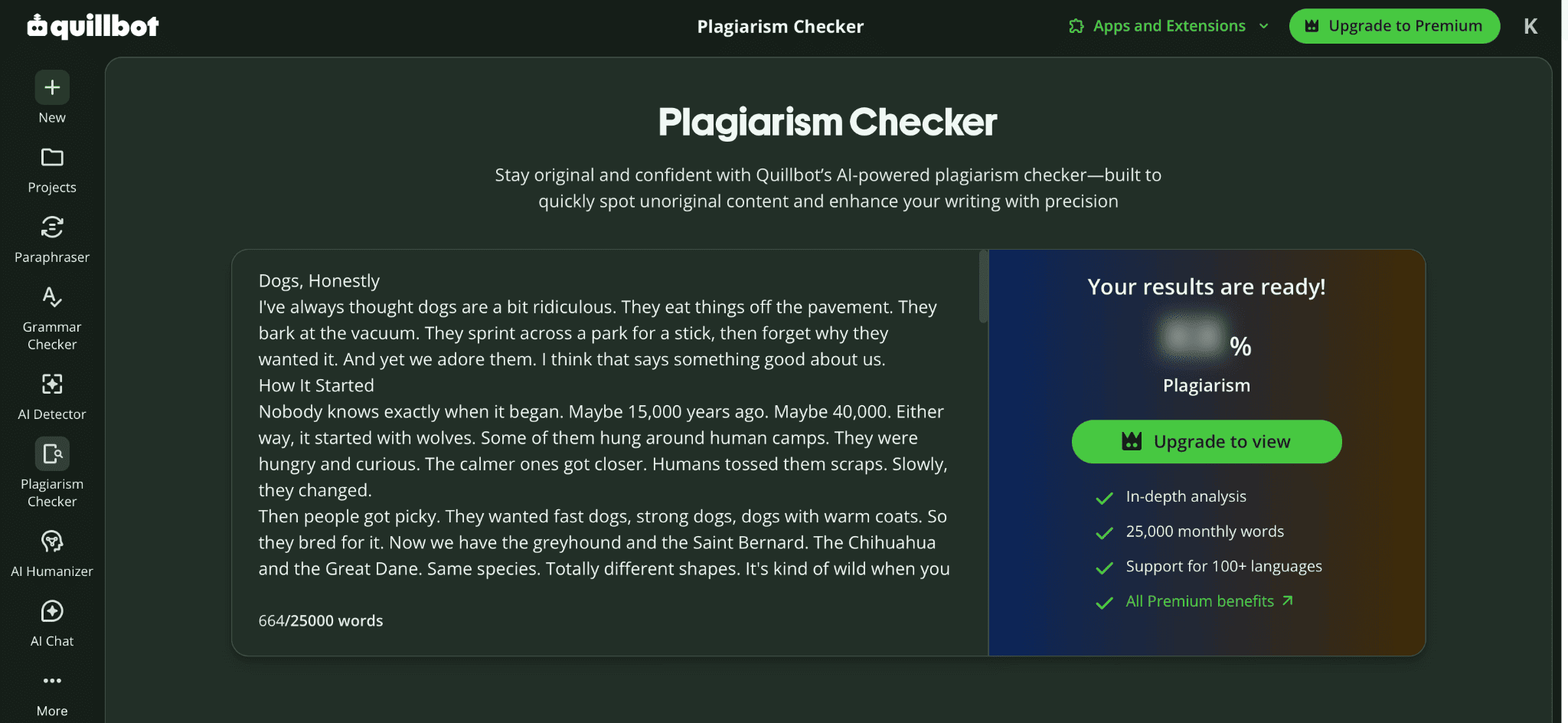
QuillBot came out on top in Reedsy’s full 2026 comparison, not because it had the single highest detection rate, but because it balanced solid accuracy (72.7%) with genuinely useful citation support and clean, easy-to-read reports.
Key features:
- Automatic citation formatting across APA, MLA, and Chicago styles.
- Clean report layout highlighting flagged passages and sources.
- Detection tuned to catch recent web content, not just older indexed pages.
👍 Pros: Best overall balance in independent testing. Strong citation tools. Fair pricing. By paying, you have full access to all of QuillBot’s tools
👎 Cons: Interface can be buggy or slow to load; processing drags on longer documents; only on paid plan.
💰 Pricing: From $4.17/month, billed annually.
9. iThenticate — Best for Publishers and Journals
If you’re submitting to an academic journal, there’s a decent chance the editor is already using iThenticate on the other end. It’s built to compare against a genuinely massive corpus of published research, journals, and books rather than the open web — a traditional plagiarism-detection setup aimed squarely at academic plagiarism rather than web content.
In some ways, it’s doing the same underlying job as a general-purpose tool to compare two texts for similarities, just scoped specifically to academic publishing.
Key features:
- Massive database of published academic research.
- Detailed match reports showing exactly which sections overlap with which sources.
- Simple upload-and-scan dashboard.
👍 Pros: Extremely thorough for academic and research content. Straightforward interface despite the depth of data behind it.
👎 Cons: No free trial at all. Unused credits expire after 12 months. Among the most expensive tools on this list. Limited file type support.
💰 Pricing: $125 for one manuscript (up to 25,000 words); $300 for multiple checks.
10. DupliChecker — Best for Zero-Cost, No-Signup Checks
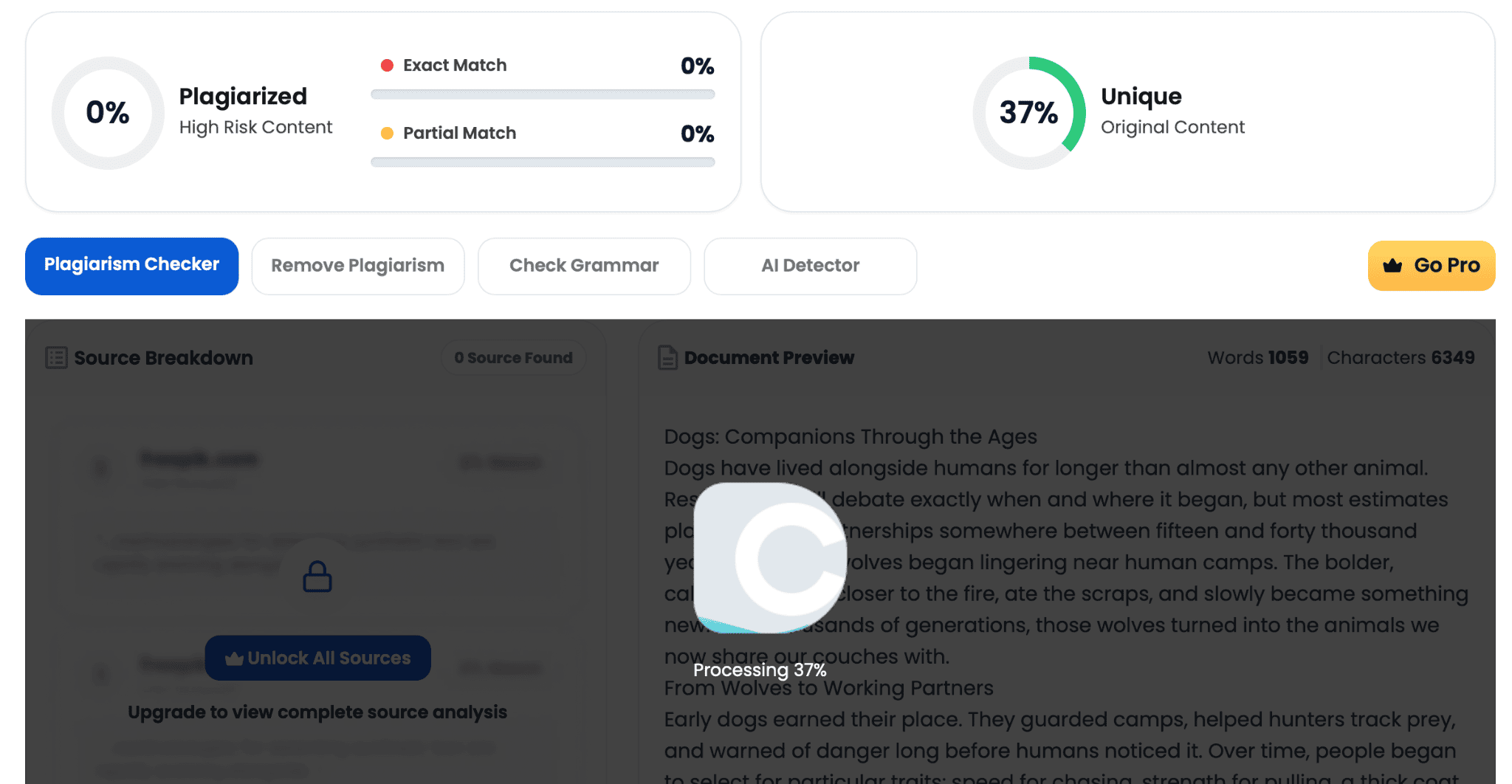
DupliChecker‘s whole pitch is that you don’t need an account at all: paste your text, hit the button, and get a result in seconds. That’s genuinely handy for a quick free check on potential plagiarism before you commit to anything heavier. In GPTZero’s testing, it caught only about 23% of a fully plagiarized sample and missed an entire section from a Medium article outright. This serves as a reminder that free plagiarism detector tools, like this one or bundles such as Small SEO Tools, are best used as a preliminary pass. They should never be treated as a final verdict.
If what you actually need is help tracking down and citing legitimate sources rather than just flagging overlap, a dedicated tool to find credible sources for your claims will get you further.
Key features:
- No signup required, free scans available.
- Multilingual checks available.
- Fast.
- Direct upload from Dropbox and Google Drive.
👍 Pros: 10,000 words for free; simple, no-friction interface.
👎 Cons: Low detection accuracy in testing. Only flags partial sentences match, even when it does catch something. Ad-heavy site experience. Takes a lot of time to give results,
💰 Pricing: Starts at $9.99/month for 30,000 words.
11. Copyscape — Best for Web Content and SEO Checks
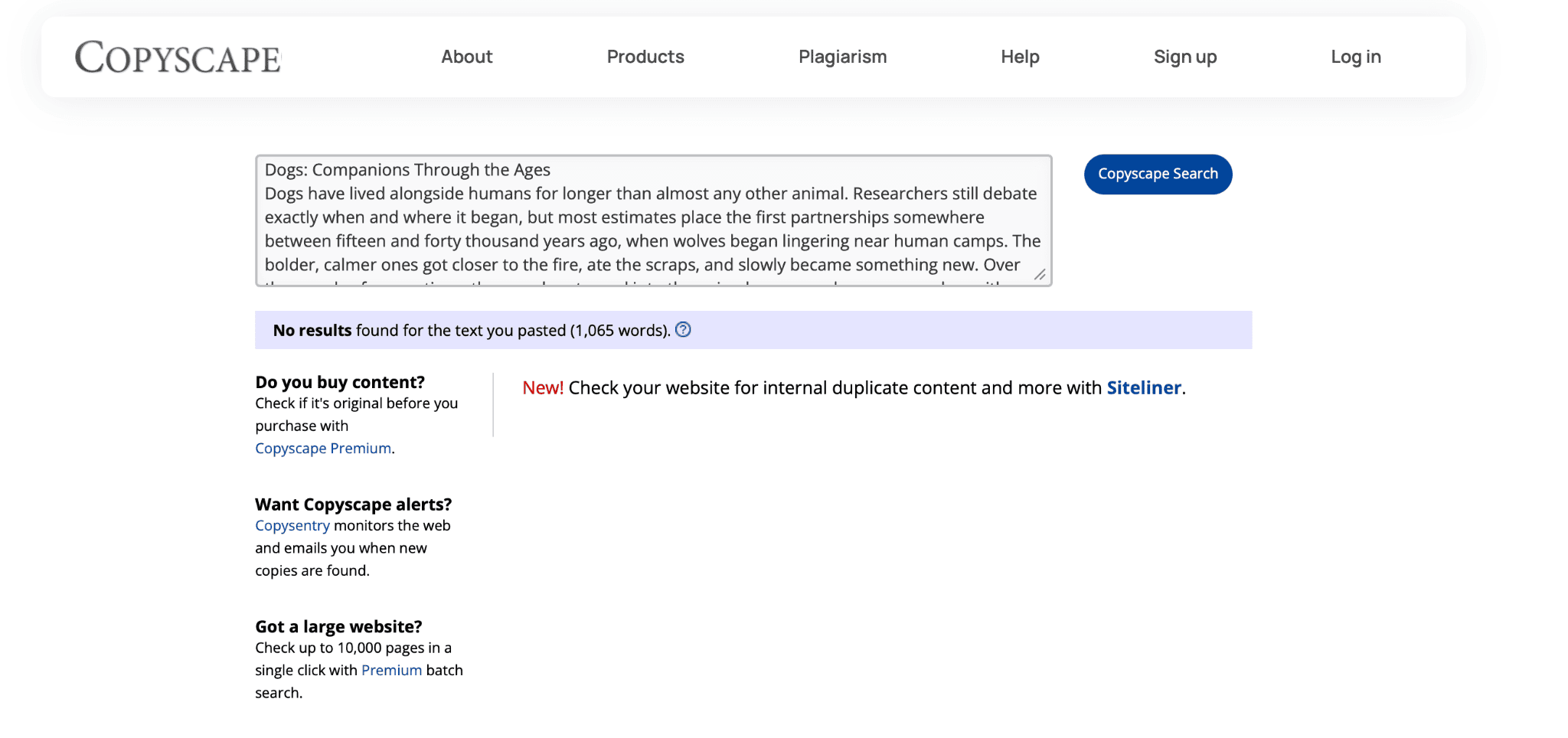
Copyscape has been around since 2004, and it shows — the interface hasn’t kept pace with the rest of this list. But it’s still a trusted name for one specific job: catching unintentional plagiarism on published web content that’s been scraped or duplicated elsewhere.
Key features:
- Pay-as-you-go pricing with no subscription required.
- Strong at surfacing republished or scraped scholarly content.
- Simple text-paste or URL-based scanning.
👍 Pros: Long track record and trusted by publishers.
👎 Cons: Only signed-up checks. Pay-per-search credit cost. An outdated interface. Weak detection for AI-written texts.
💰 Pricing: $0.03 per 200-word scan, plus $0.01 per additional 100 words.
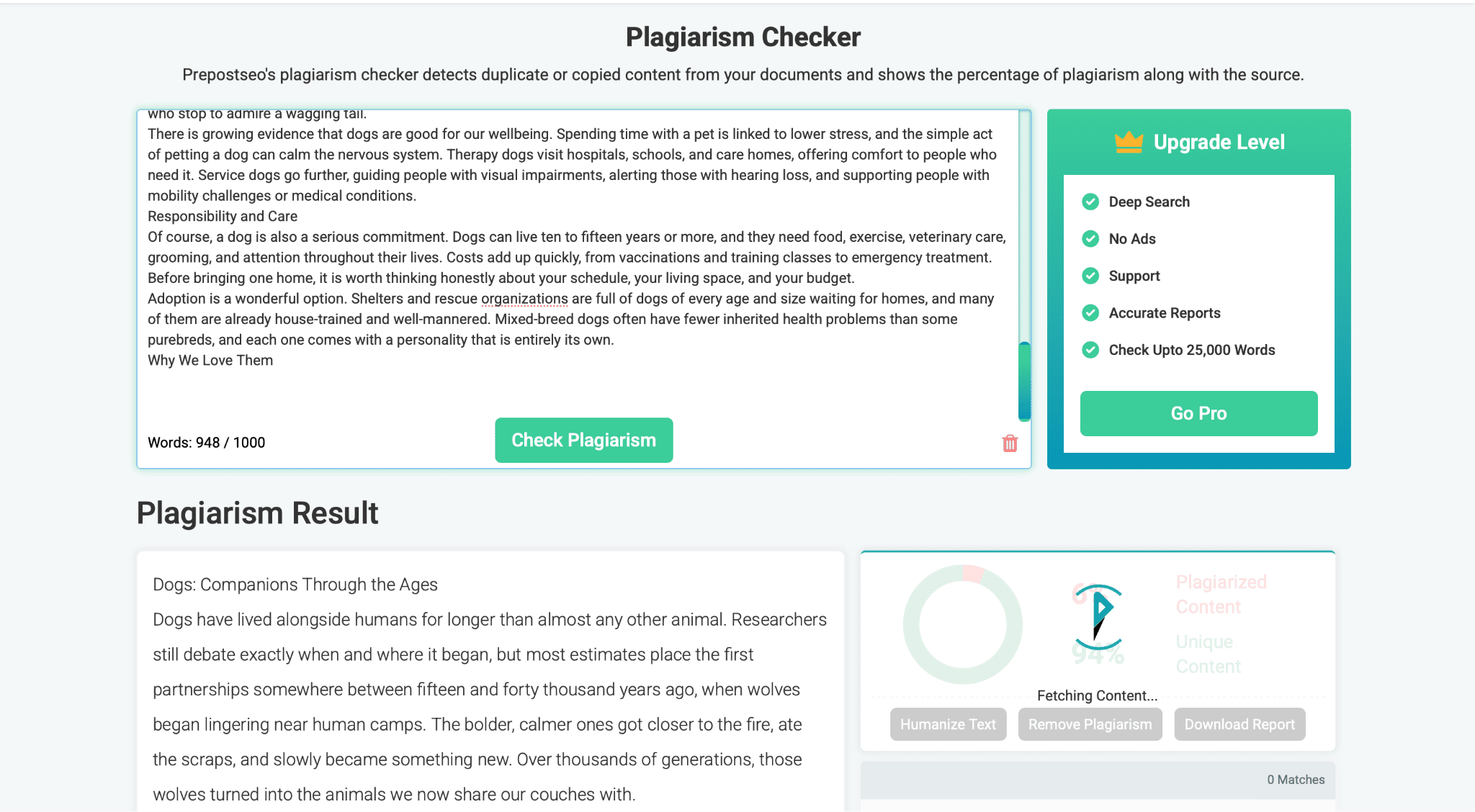
12. PrePostSEO — Best Free Tool Bundle
PrePostSEO isn’t really a single plagiarism checker so much as a toolbox of 150+ free utilities, with plagiarism detection as one of its most-used features. It’s a solid pick if you’d rather have one login for a bunch of free writing and SEO tools than juggle five bookmarked sites. If you want a more purpose-built companion for the actual writing side of things, it’s worth browsing AI writing tools that complement plagiarism checks alongside whatever checker you settle on.
Key features:
- 300 words free per scan (500 with a free account).
- Color-coded underlining distinguishes verbatim from paraphrased matches.
- “Exclude Quotes” option on premium plans, so properly cited text isn’t miscounted.
👍 Pros: Genuinely useful free tier. Correctly detected fully plagiarized test content. Exclude Quotes is a rare and welcome feature.
👎 Cons: Word limits are described inconsistently across its pricing pages, making it hard to know exactly what you’re buying. Only 300 words are checked as unregistered.
💰 Pricing: From $6.75/month (billed annually) for the Basic tier.
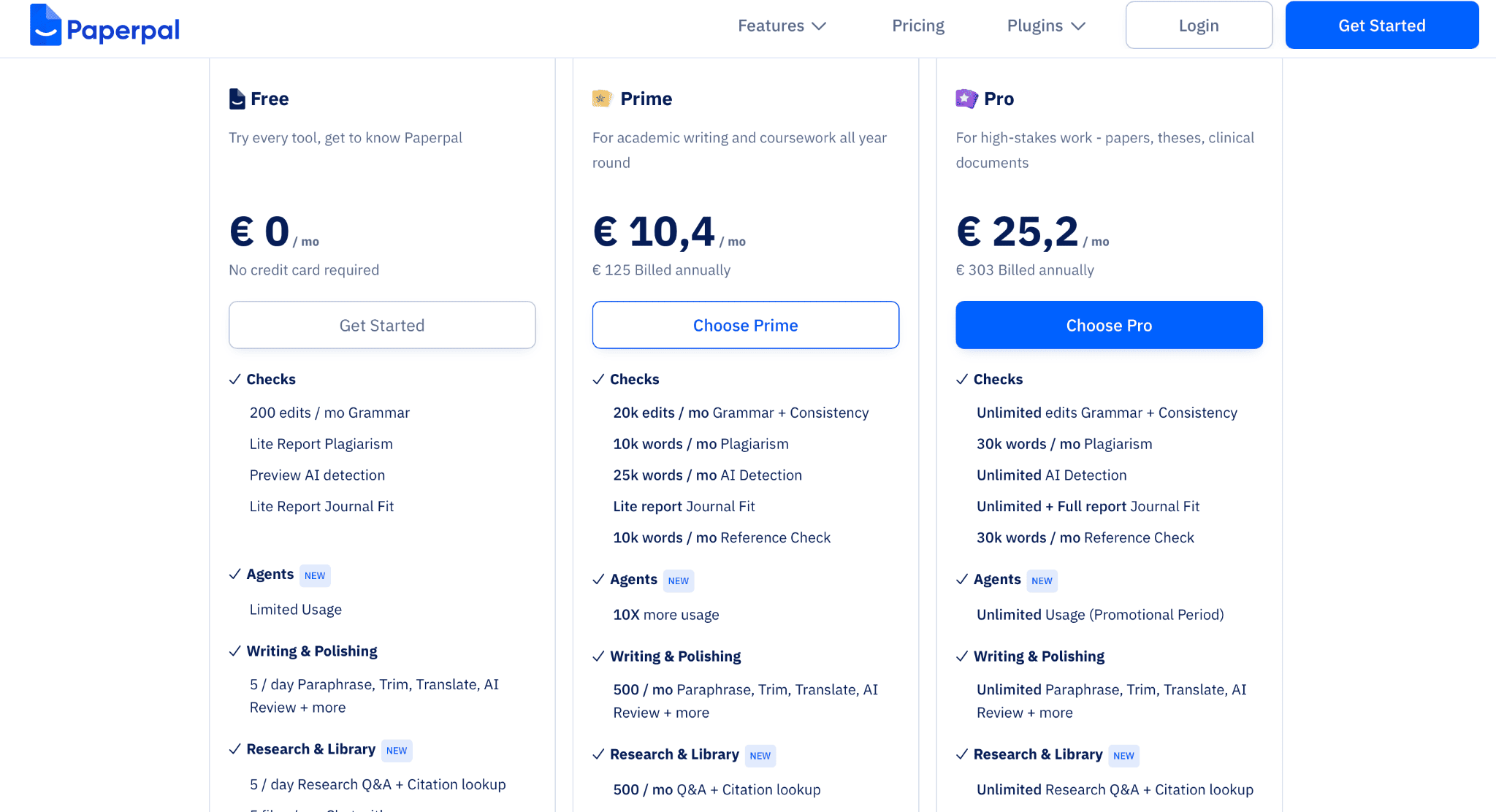
13. Paperpal — Best for Research Manuscripts
Paperpal is aimed squarely at researchers preparing a manuscript for submission, a narrower task than general web plagiarism checking. It backs that up with a genuinely large database: over 99 billion web pages and 200 million published academic articles.
Key features:
- Free tier covering up to 7,000 words per month.
- Large academic and general web database.
- Positioned to align with what journals actually expect at submission.
👍 Pros: Rare combination of a generous free tier and research-grade database coverage.
Cons: Less useful outside an academic/research context. Some claims (like database size) come from the company itself rather than from independent testing. Only sign up.
💰 Pricing: Free fore lite report checks; plans start at $7.20/mo (billed annually).
14. PlagScan — Best for GDPR-Conscious Institutions
PlagScan rounds out this list as the go-to for European institutions specifically. It has customizable similarity settings and built-in GDPR compliance for handling submitted documents. Recently, it has become available for individual use.
Key features:
- Adjustable similarity detection settings.
- GDPR-compliant document handling.
- Transparent, detailed similarity reports.
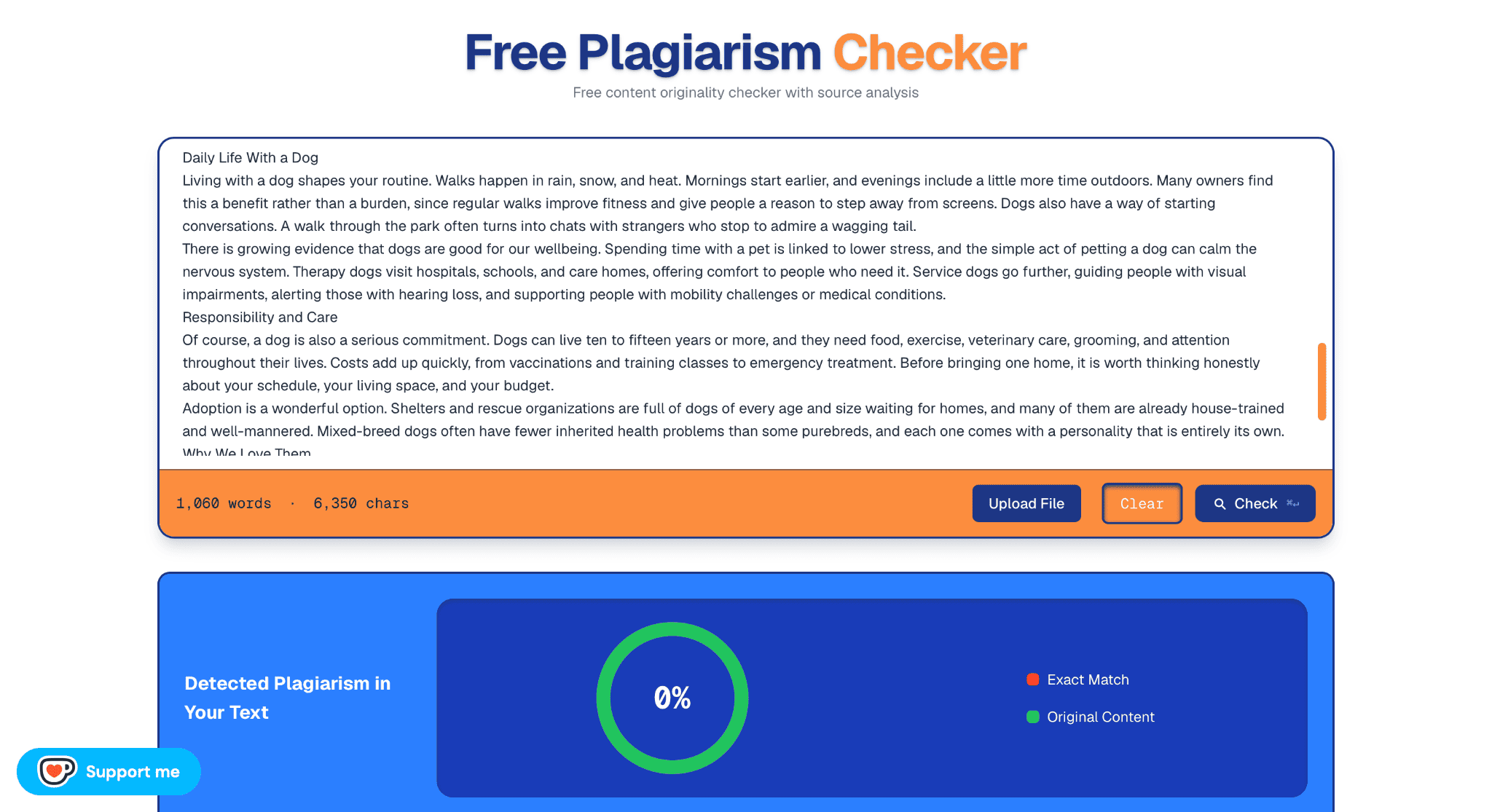
👍 Pros: Big database. Highlights exact matches, paraphrased text, and quotations side-by-side for quick revision.
👎 Cons: Measures text similarity rather than definitive plagiarism. Limited in file formats.
💰 Pricing: Plans start at $5.99 per month for individual usage.
Best Plagiarism Checker by Use Case
- Best for students on a budget: Quetext or GPTZero, both have free tiers generous enough for real assignments, not just teaser scans.
- Best for freelance writers and content teams: GetSolved, since you get plagiarism, AI detection, and citation checks in one place instead of three subscriptions.
- Best for academic researchers submitting to journals: iThenticate or Paperpal, given their depth of academic database coverage.
- Best if you just need one paper checked once: Scribbr, despite the per-document price, because the report quality justifies a single purchase.
- Best if budget is the only constraint: DupliChecker or GPTZero, with the clear caveat that you should treat it as a first pass, not a final answer.
📌 Expert tip: Run anything high-stakes through two tools, not one. Reedsy’s 2026 testing found that even the best-performing checkers reliably caught direct copying but consistently missed subtle paraphrasing. A second opinion catches what the first tool’s blind spots let through.
Final Verdict: What’s the Best Plagiarism Checker?
There isn’t a single plagiarism checker that wins every category, but GetSolved is my top recommendation for most writers. It handles the full workflow in one place — letting you check your text for possible plagiarism, catch AI phrasing, fix citations, and verify facts without jumping between apps.
If raw detection accuracy is your sole priority, Copyleaks leads, according to independent data. Students on a budget should start with Quetext, while academic researchers submitting to journals should lean on iThenticate or Paperpal.
Whatever tool you choose, treat the similarity score as a starting point, not an absolute verdict. Always read the flagged matches yourself before making changes!
FAQ
Is there a truly free plagiarism checker that’s actually accurate?
Quetext and GPTZero both offer free tiers that go beyond a teaser scan. GPTZero’s free plan covers 10,000 words per month, and Quetext gives you 500 words before and after signing up. Neither will match the depth of a paid plagiarism detector’s database, but both are solid for a first check.
What’s the difference between a plagiarism checker and an AI detector?
A plagiarism checker looks for text that matches or closely resembles existing published content, using AI in some cases to catch paraphrased overlap, not just exact matches. If you are asking how AI-generated content can be identified, such a tool looks for patterns typical of machine-generated writing, regardless of whether that writing copies anything. A document can be 100% “original” by plagiarism standards and still get flagged by an AI detector, or vice versa. The tools answer whether the text was copied and whether it’s human-written or AI-generated, two separate checks.
Why did my properly cited work get flagged as plagiarized?
Most plagiarism checkers count text similarity, not intent, which is how you can commit plagiarism accidentally even when nothing was copied on purpose. Direct quotes, common phrases, industry-standard terminology, and even correctly cited passages get marked as plagiarism and can inflate a plagiarism score, covering several forms of plagiarism that have nothing to do with intent to deceive.