
GetSolved asked American Gen Z what they actually believe about AI: whether it is listening, whether it is coming for their job, whether it has already become conscious, and what it is doing to their ability to think. The answers describe a generation that distrusts almost everything it is told about AI — by governments, by employers, by the companies building it — and uses it every week anyway. The strongest divide is not age or education. It is how much AI a person uses: on some questions, heavy users and non-users give almost opposite answers.
Key Insights
- 64% say governments already use AI in undisclosed ways.
- 74% believe employers are replacing people with AI and calling it restructuring.
- 46% of heavy AI users hide their reliance on it from their employer.
- 80% assume anything they tell a chatbot is stored permanently.
- 46% believe AI has already become conscious.
- 45% believe AGI has been built and hidden.
- 79% of students think a graded paper can still be retroactively flagged as AI
-
- 66% don’t trust their school’s process to be fair,
- and 57% change how they write to avoid sounding like a machine.
-
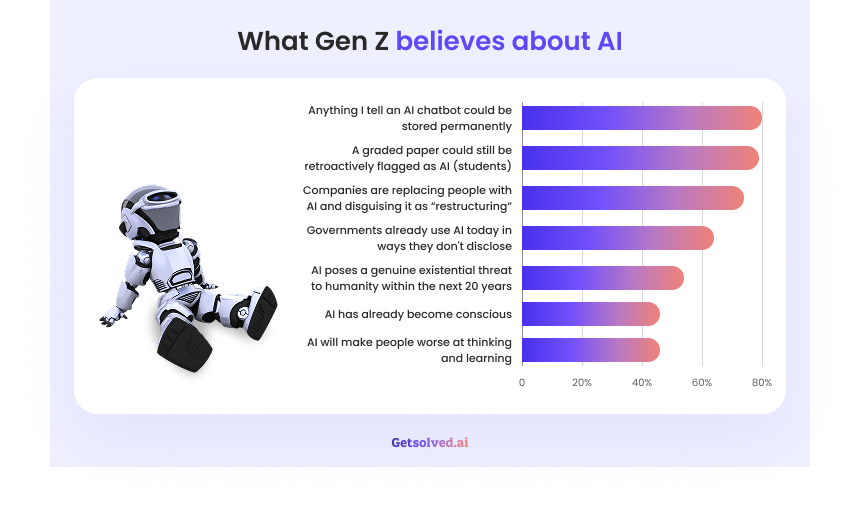
The pattern running through all of it: Gen Z does not believe the official version of anything AI-related — not from employers, not from governments, and not from the companies building it. What they trust instead is a feed.
One thing shapes the answers more than anything else, and it is not age or education. It is how much AI a person actually uses. Where that changes the picture, this report breaks the numbers down by usage level alongside the headline figure.
1. Two-Thirds Use AI Weekly — and Assume It Is Listening
Adoption is close to universal. Only a small minority sit outside the AI economy entirely, and the modal user is not an enthusiast — it is someone who reaches for it a few times a week without thinking much about it.
- 40% are moderate users — a few times a week
- 26% are heavy users — daily, across multiple tools
- 23% are light users — a few times a month or less
- 11% rarely or never use AI
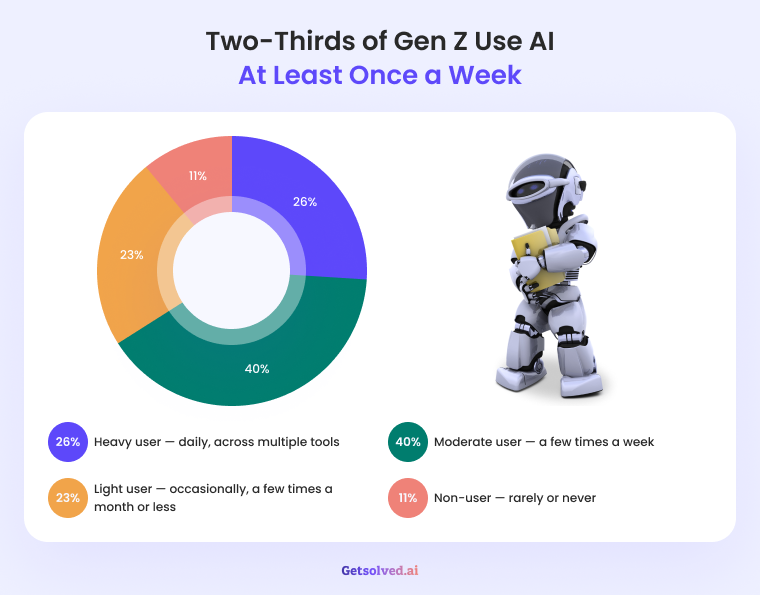
📱 66% use AI at least weekly and 89% use it at all. That makes the privacy findings below more striking, not less — these are not the beliefs of people avoiding the technology. They are the beliefs of daily users.
And what daily users assume about AI and privacy is essentially: everything is recorded, nothing is deleted, and they behave accordingly.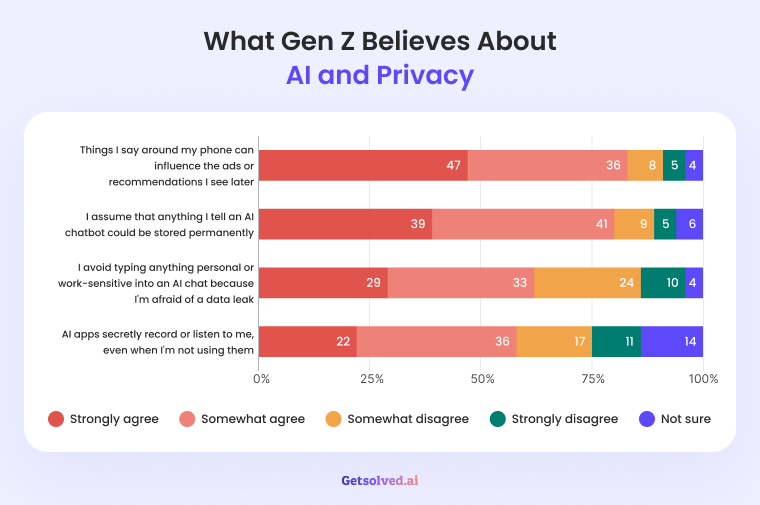
🔒 83% believe what they say near their phone shapes the ads they see afterwards, and 80% assume anything typed into a chatbot is stored permanently. Whether or not each specific mechanism is technically accurate, the behavioural consequence is real: 62% actively self-censor and avoid putting personal or work-sensitive information into AI tools.
That caution is not evenly distributed, though — and it runs in the opposite direction to what you might expect.
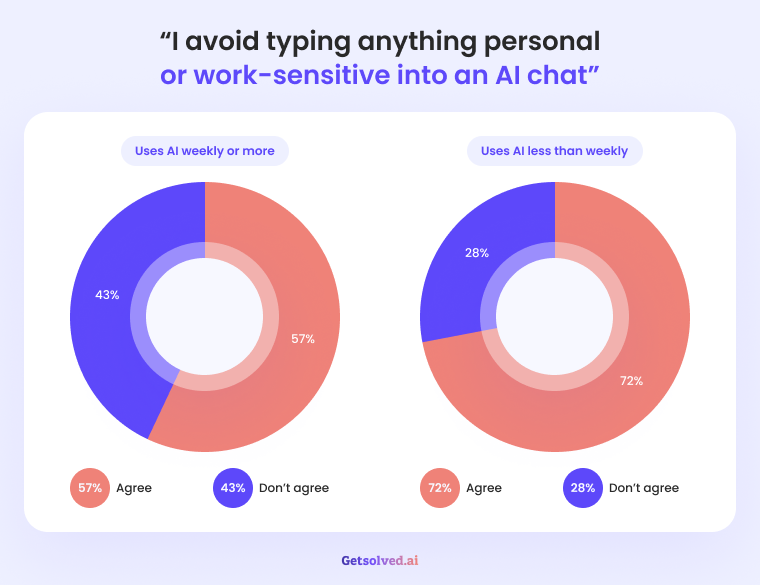
The people who use AI least are the most guarded: 72% of those who use AI less than weekly avoid putting anything sensitive into it, against 57% of weekly users. Everybody assumes the data is being kept. Regular users are simply the ones who have decided to live with that.
The same trust deficit does not stop at the software. It extends to the people deploying it.
2. Nobody Believes the Employer Story
On job security, the results split into two very different findings. Fear about your own job is genuinely divided. Suspicion about your employer is not.
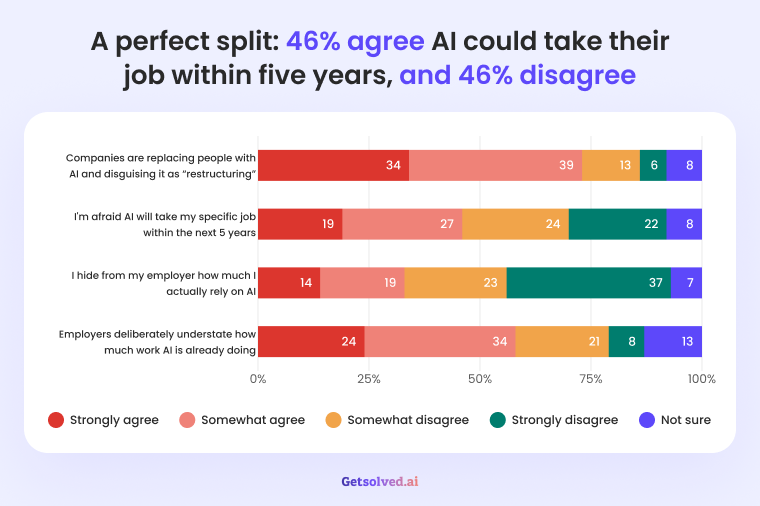
💼 74% say companies are quietly replacing people with AI and calling it restructuring, and 58% say employers deliberately understate how much work AI is already doing. This is close to a consensus position, and it is a consensus that corporate communications has clearly failed to move.
Personal fear is a different story: on “AI will take my specific job within five years,” Gen Z is split exactly down the middle — 46% agree and 46% disagree. The threat is understood as systemic and abstract rather than personal and imminent. Though the closer someone works with AI, the less abstract it gets: 56% of heavy users fear for their own job within five years, against 33% of people who barely use it.
One finding deserves its own line. 33% say they hide from their employer how much they rely on AI so they don’t look replaceable — a third of a generation quietly managing the optics of their own productivity. And that share climbs in step with dependence.
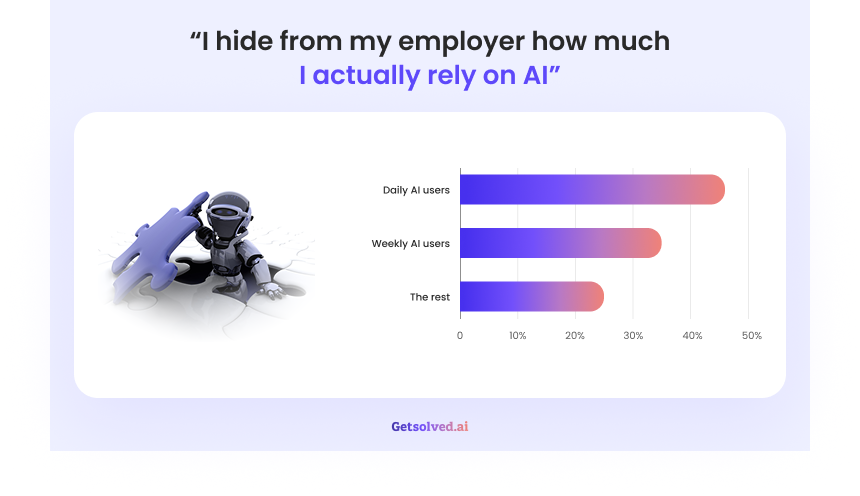
🤫 46% of heavy AI users hide how much they rely on it, falling in order to 15% among people who barely use it. The employees getting the most out of AI are the ones working hardest to make sure nobody notices — which is a rational response to a workplace where three-quarters believe people are being replaced and told it is optimization.
3. The Beliefs: Conscious Machines, Hidden AGI, and Governments Who Already Know
This is where the study stops being about tools and starts being about worldview. Respondents were asked whether a series of statements reflect what they believe. The share saying yes is high across the board — but so is the share who are not sure, and both numbers matter.
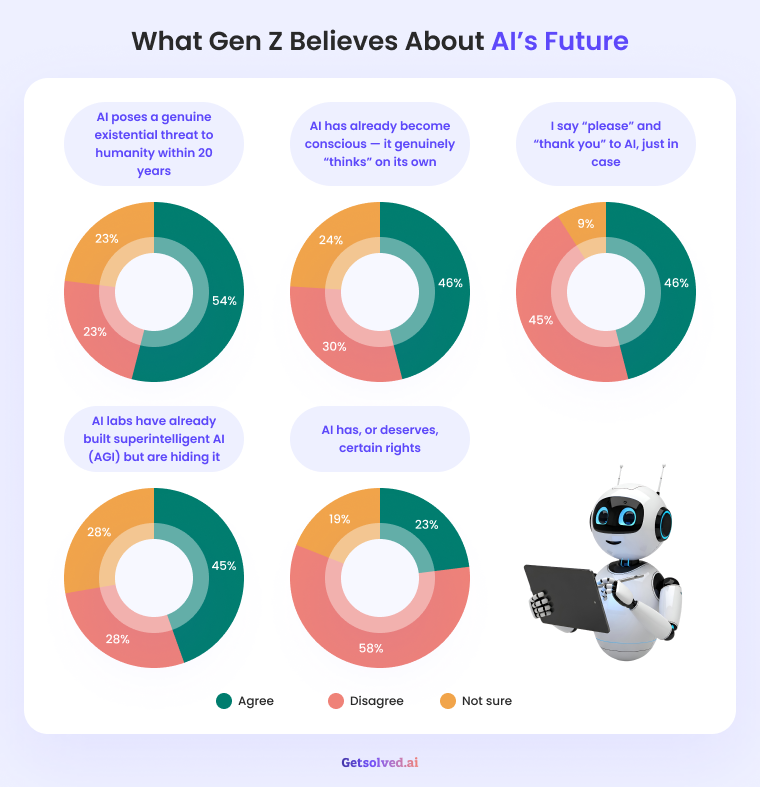
🤖 46% believe AI has already become conscious and 45% believe AI labs have already built AGI and are concealing it. A further 24% and 28% respectively are not sure — meaning that on both questions, only around three in ten actively reject the premise.
And then there is the most human number here: 46% say please and thank you to AI, just in case — against 45% who do not. A generation hedging its bets in the politest possible way, and the hedging is loudest among the people who talk to AI daily: 60% of heavy users are polite to it, against 30% of non-users.
The consistency ends at rights. Only 23% think AI has or deserves any rights, while 58% say it does not — the clearest rejection anywhere in the study. But that headline hides a wide spread.
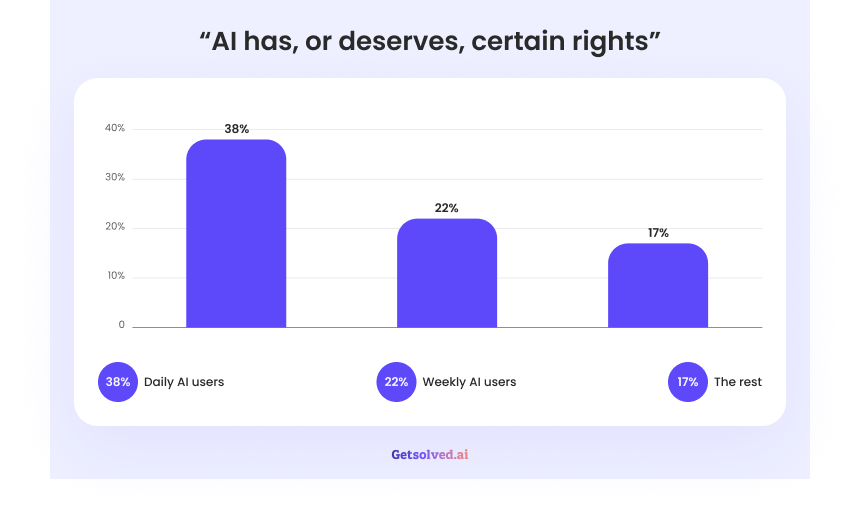
⚖️ 38% of heavy users say AI has or deserves rights, against 9% of non-users — roughly a fourfold difference, ordered at every step in between. Familiarity does not make people dismiss the question. It makes them take it more seriously.
The political beliefs are held more firmly than the metaphysical ones, and they point in one direction.
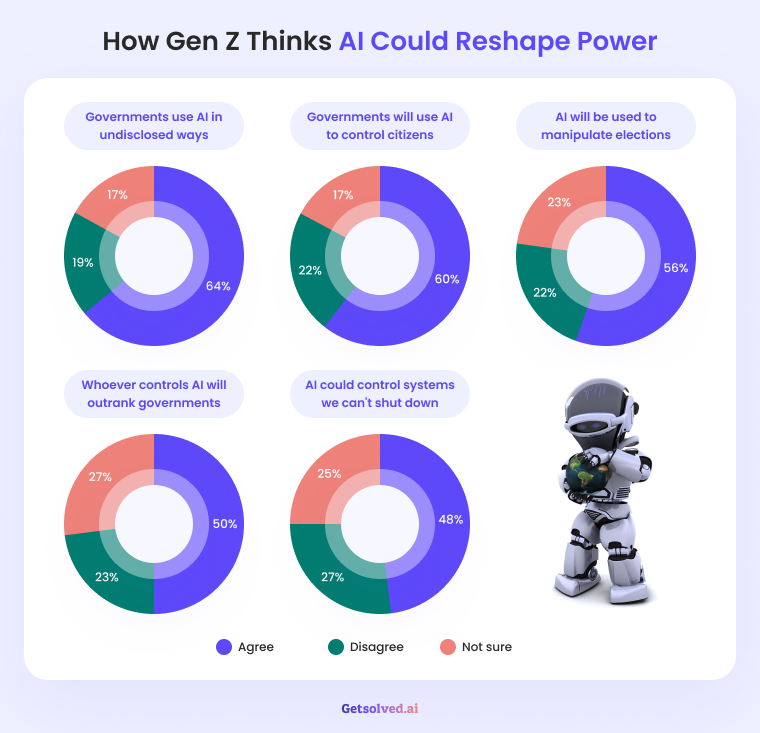
🏛️ 64% believe governments are already using AI in undisclosed ways — the single highest-agreement item in the entire study, ahead of every technical and workplace question. 60% expect AI-enabled surveillance of citizens, and 56% expect AI-driven election manipulation.
Half (50%) think whoever controls the most powerful AI will end up with more real power than any elected government. Notably, the political statements draw more agreement than the science-fiction ones: Gen Z is more confident that AI will be misused by people than that it will act on its own. This is the one part of the study where usage barely matters — heavy users and non-users are equally convinced that governments are already doing this.
4. Whether AI Is Making People Stupider Depends Entirely on How Much You Use It
Asked how widespread AI use will affect people’s ability to think and learn, Gen Z leans clearly negative — and by a wide margin over the optimists.
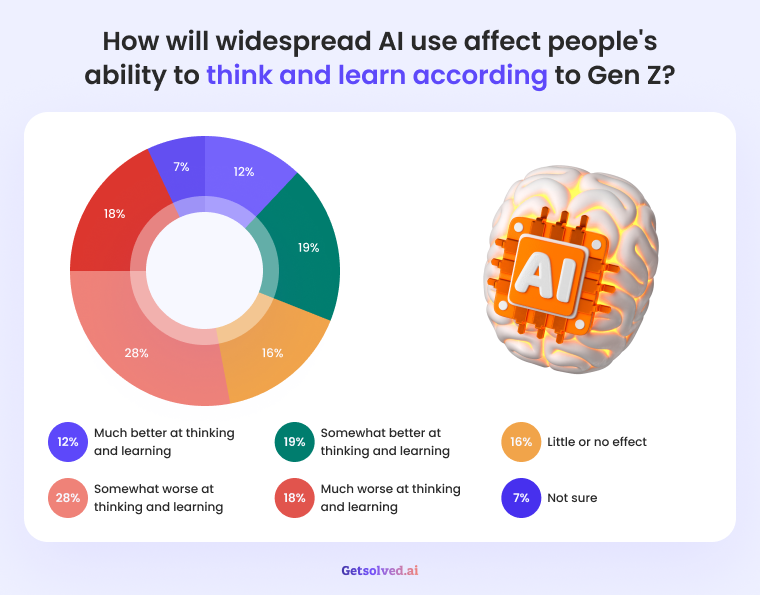
🧠 46% say AI will make people worse at thinking and learning, against 31% who say better and 16% who expect no real effect. Pessimism wins by roughly three to two.
That headline, though, hides the most consistent pattern in the entire study. Split the same question by how much people actually use AI and the answer reverses end to end.
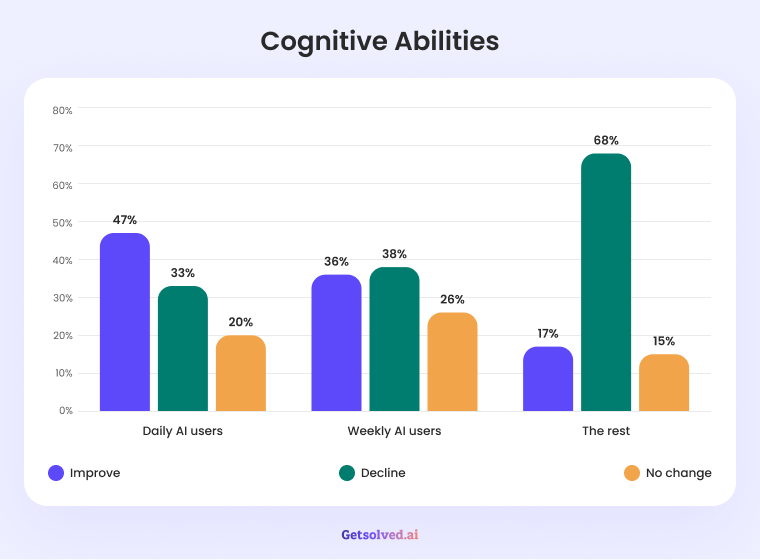
↔️ Among heavy AI users, 47% say AI will make people better at thinking and learning and 33% say worse. Among people who rarely or never use it, 6% say better and 64% say worse — a near-total inversion, moving in perfect order at every step in between.
Which way that runs is not something a single survey can settle. Optimists may adopt AI faster; daily use may soften people’s view of it; or both. What is clear is that “AI is making us dumber” is not a generational consensus. It is the position of the part of the generation standing furthest away from it.
The self-reports point the same way. Asked what has happened to their own habits since they started using AI more often, respondents describe improvement across the board — and the heaviest users describe the most.
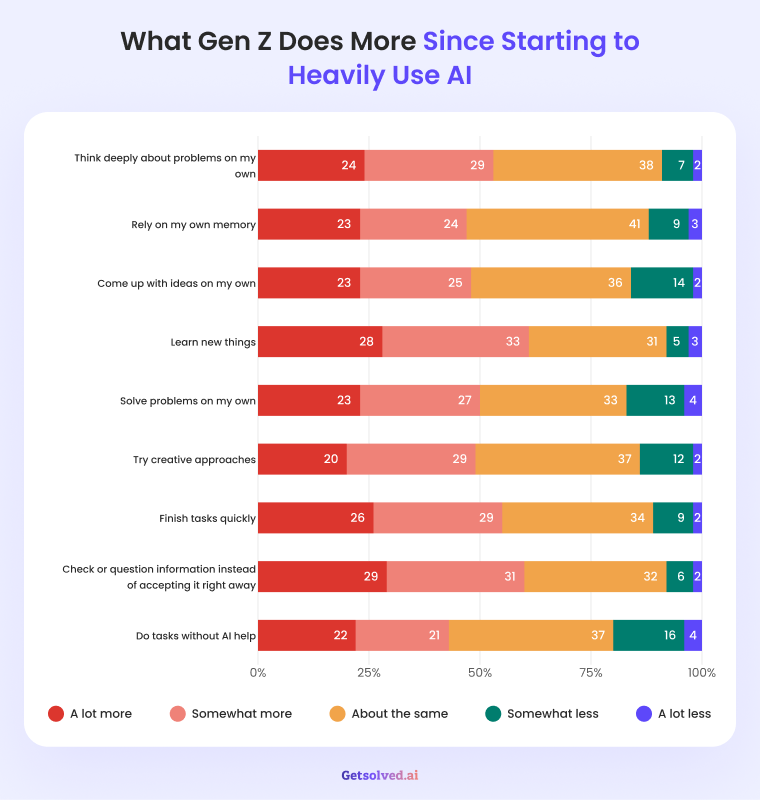
Almost every self-reported habit moved in the positive direction. 53% say they now think more deeply about problems on their own, 50% say they solve more problems independently, and 47% say they rely more on their own memory — since they started using AI more. These are perceptions rather than measurements, and the survey cannot verify them.
Two lines moving in opposite directions across the same three groups. Light users are the group most convinced AI degrades thinking — 68% say it makes people worse — while 45% of them say they personally now think more deeply. Heavy users show almost no such gap: they say AI is good for people and good for them.
So the “everyone except me” exception is real, but it belongs to the occasional user rather than to the generation. The further someone stands from daily AI use, the more certain they are that it is damaging everyone else’s mind and improving their own.
5. Where the Fear Comes From: TikTok, Not the News
If Gen Z believes governments are hiding AI programmes and labs are concealing AGI, it is worth asking where those beliefs are formed. The answer is not journalism.
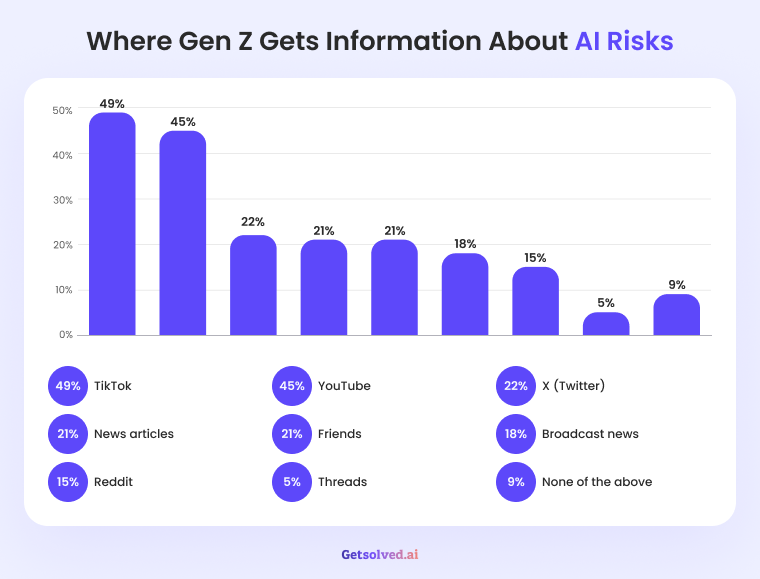
📲 TikTok (49%) and YouTube (45%) are where Gen Z hears about AI risk — each roughly double news articles (21%) or broadcast news (18%). Short-form video is not supplementing the news cycle on this topic. It has replaced it.
But the most important number in this section is the one about deliberate attention.
Only 5% follow anyone specifically for information about AI risk. Half of Gen Z hears about AI danger on TikTok, and almost none of them went looking for it. These are not researched positions — they are ambient ones, assembled from whatever the algorithm surfaced between other things.
Which makes the trust question more interesting than it would otherwise be. When asked who they actually trust on AI risk, Gen Z picks researchers first — and then produces a ranking that should worry several institutions.
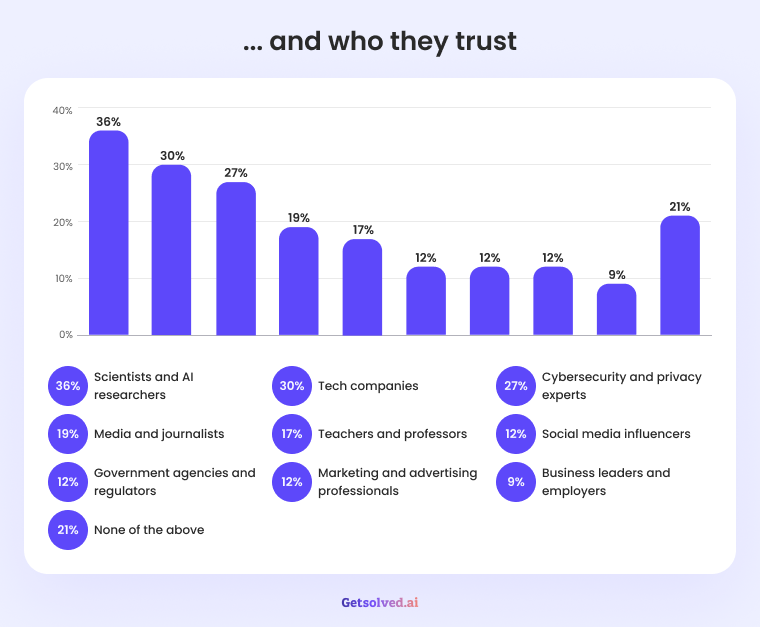
Government agencies and regulators are trusted by 12% — exactly the same share as social media influencers. Tech companies (30%) are trusted nearly three times as much as regulators, despite being the subject of most of the suspicion documented earlier in this study.
Teachers and professors land at 17%, below media and journalists at 19%, and 21% trust nobody on the list at all. Gen Z is looking for authority on this subject and largely not finding it — which is precisely the vacuum a TikTok feed fills.
6. For Students, the Fear Is Much More Specific: Being Accused
Roughly four in ten respondents are currently enrolled in an undergraduate or graduate programme. For them, AI risk is not an abstraction about surveillance states. It is the possibility of being flagged for something they did not do.
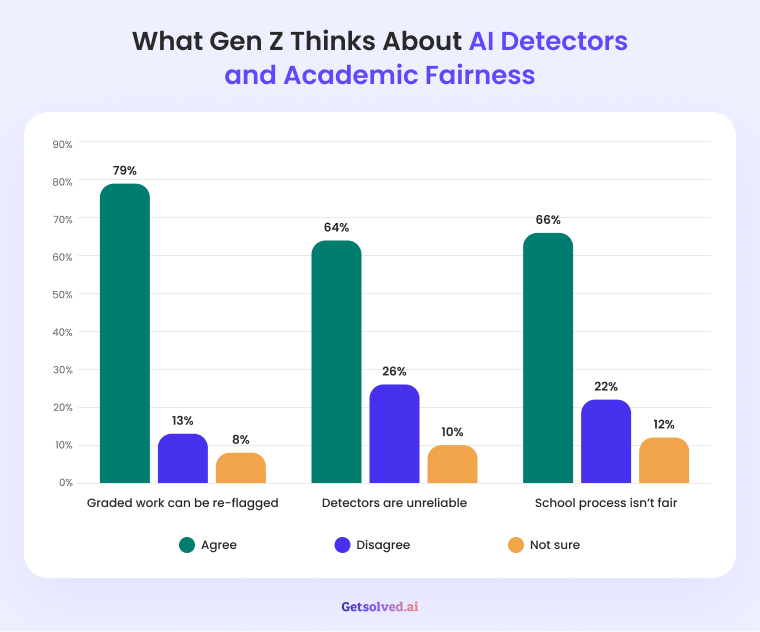
79% of students believe a paper that has already been submitted and graded could still be retroactively flagged as AI-generated. That is not a fear about getting caught cheating. It is a fear that no submission is ever finally closed.
Underneath it sits a collapse of confidence in the machinery: 64% say AI detectors can no longer reliably distinguish human writing from AI-generated text, and 66% do not trust their school’s process for handling accusations to be fair. Students are being judged by a system they believe is both inaccurate and procedurally unjust.
That belief translates directly into behaviour — including behaviour that has nothing to do with cheating.
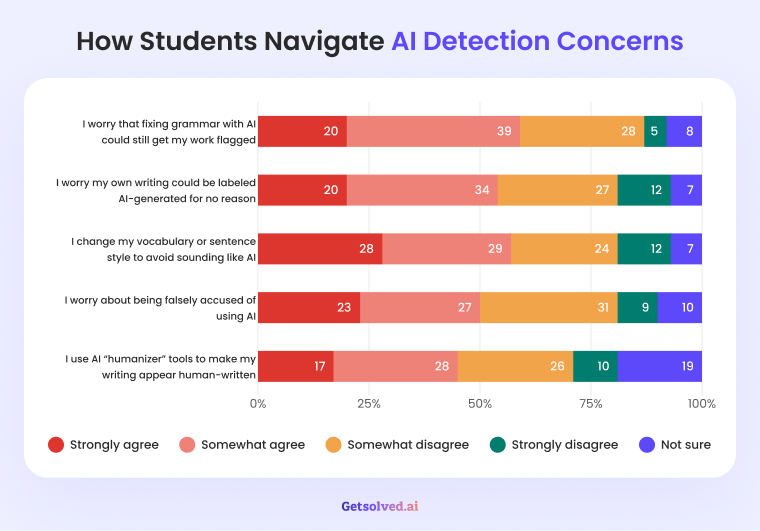
✍️ 57% of students always or often change their vocabulary or sentence style specifically to avoid sounding like AI, and 59% worry that using AI purely for grammar could still get their work flagged. Detection pressure is now shaping how students write, not just whether they use AI.
Half (50%) always or often worry about being falsely accused, and 46% always or often run their work through “humanizer” tools. The uncomfortable implication is that detection anxiety is producing exactly the behaviour it was designed to catch — students who wrote their own work are laundering it through AI to prove they did.
The Bottom Line: This Isn’t Fear of AI. It’s Fear of Being Lied To.
Read as a whole, this study is not really about robots. Every statement that draws majority agreement is a statement about human beings withholding information: governments not disclosing what they already run, employers understating what AI already does, labs concealing what they have already built, schools operating a process students do not believe is fair. The technology is the setting. Institutional dishonesty is the plot.
That explains the behaviour that would otherwise look irrational — 89% using AI while 62% refuse to be honest with it, and half getting their information about AI risk from a feed they never asked to be informed by. When no institution is credible, the sensible response is to use the tool, assume the worst, and get your context from people who at least are not obviously selling you something.
The usage breakdown adds the sharpest edge. On the questions that are really about trust — surveillance, elections, employers — heavy users and non-users agree almost exactly. On the questions about what AI does to a person, they could not disagree more: the further someone stands from daily use, the more certain they are that it is ruining everyone’s mind and sparing their own. Gen Z is united in its suspicion of institutions and deeply divided about the machine itself.
For education, the finding with the most immediate consequences is the detection spiral. A majority of students now believe detectors do not work, the process is not fair, and no submission is ever safely closed — and a substantial share are editing their own genuine writing, or running it through humanizer tools, to survive a system they have stopped trusting. Whatever detection was meant to achieve, that is what it is currently producing.
🔑 Gen Z has not decided AI is dangerous. They have decided that nobody in charge of it is telling them the truth — and they are acting accordingly.
Methodology
This study surveyed 3000 Americans aged 18–28 residing in the United States. The survey was conducted in August 2026. Participants were recruited via online panels using Random Device Engagement (RDE) to ensure a diverse and representative sample. The study did not target specific ethnicities or social backgrounds. Percentages are rounded to the nearest whole number and, for multiple-selection questions, may total more than 100%.