
There are a lot of AI writing helpers around these days, and yes, it’s tempting to just let one of them write your fiction for you. Of course, leaning on them too much can weaken a story and strip away the writer’s voice. Used thoughtfully, though, they can be a real help when you’re working out ideas, and they can even push your creativity a little further. The key is finding one that fits the way you already write.
To find the most useful options, I tested several AI tools for story writing, from the familiar names you see in pretty much every review to lesser-known ones I’d only seen discussed on Reddit. Then I narrowed the list down to 9: some are general-purpose writing tools, some focus on fiction, and others are popular chatbots that turn out to be quite good at storytelling too.
This list should help you find a tool that suits your needs, your budget and the way you approach writing. What I was looking for, in the end, is something that supports your originality and makes your work stronger without pushing your voice out of the picture.
Quick Takeaways
- Best for drafting fiction prose: Sudowrite. Fiction-tuned models and a Story Bible for continuity, from $10/month on annual billing.
- Best for long novels and series: Novelcrafter. The strongest story bible around, from $8/month.
- Best all-in-one for story ideas and polishing: GetSolved. Its AI story generator, humanizer, grammar checker and AI detector come together on one plan.
How I Chose The Best 9 Tools
My testing process was quite simple: I basically tried to write a story with every tool on this list, starting from my own idea and characters.
I couldn’t test them all the same way, though. They’re very different, from one-prompt generators and story-bible workspaces to chatbots and platforms with a paragraph rewriter for polishing, so I used each one the way it’s meant to be used. Also, the story couldn’t always be the same, as some tools were created for specific genres.
Overall, I looked mostly at:
- Story memory
- Prose quality
- Price
- Free access
- Control over my voice
This way, I believe I managed to find what the strengths and weaknesses were for each analyzed option.
The Best Tools Compared
Before going into detail about these 9 AI writing tools for fiction, here’s a table that will allow you to see for yourself the main features of each one and focus only on those that interest you.
However, it’s important to clarify that these options do more than just write fiction: they often have a wide range of other functions. Some are mainstream platforms capable of performing hundreds of different actions, while others include additional tools, ranging from a text expander to an AI detector.
The sole criterion by which I analyzed and compared them, however, is how they can be used by fiction writers.
| # | Tool | Best for | Starting price (USD) | Free option | Story memory |
|---|---|---|---|---|---|
| 1 | Sudowrite | Drafting fiction prose | $10/mo (annual) | Free trial, no card | Story Bible |
| 2 | Novelcrafter | Long novels and series | $8/mo + your AI provider | 21-day free trial | Codex |
| 3 | GetSolved | Story ideas and polishing drafts | $7.99/mo (annual) | $2 seven-day pass | Per-session prompt |
| 4 | Claude | Natural prose and whole-manuscript feedback | $17/mo (annual) | Free plan | Projects knowledge base |
| 5 | NovelAI | Genre and dark fiction | $10/mo | Trial | Lorebook, Memory, Author’s Note |
| 6 | DreamGen | Roleplay and interactive fiction | $7.83/mo | Free tier | Scenario Codex |
| 7 | Squibler | Fast premise-to-draft | $15.83/mo (annual) | 1,000 AI credits/month | Elements |
| 8 | ChatGPT | Brainstorming and outlining | $20/mo | Free plan | Projects and memory |
| 9 | ProWritingAid | Self-editing a finished draft | $10/mo (annual) | 500 words per report | Manuscript Analysis |
It’s worth noting that none of these are 100% free AI writing tools, but they all offer some sort of free trial. This will allow you to try the ones you’re most intrigued by and, if you’re not satisfied, eventually move on to the next one.
1. Sudowrite: Best for drafting fiction prose
Sudowrite takes the top spot simply because it’s the only tool I tested that’s built entirely around novel writing. It covers the whole process in one place, and it felt like it was made by people who actually write novels.
Sudowrite’s core is the Story Bible, where you store your characters, settings, plot points and worldbuilding. The platform reads from it every time it generates text, so its suggestions know who your characters are and what’s already happened. From there you work inside the editor with a handful of focused commands:
- Brainstorm: plot ideas, names, twists and new characters, for when you’re stuck
- Write: continues the scene from wherever your cursor is
- Expand: takes a bare-bones outline or beat and turns it into a fuller rough scene
- Describe: adds smells, sounds and textures to a paragraph that reads flat
- Rewrite: reworks a passage, for example when the pacing is wrong or you’re telling instead of showing
Sudowrite has its own story-tuned models, Muse and Ballad, plus 30+ mainstream models you can switch between. Plans start at $10/month on annual billing, and the free trial doesn’t ask for a card.
Start a free Sudowrite trial now
2. Novelcrafter: Best for long novels and series
Novelcrafter is, first of all, a novel-writing workspace, to which the use of any AI can be connected. In this way, it is perfect especially for longer and more complex projects.
The heart of it is the Codex, the most powerful story bible I tested. Here, you can add characters, locations, objects, and lore. Novelcrafter automatically spots those names in your manuscript and links them.
For sure, it asks more of you than Sudowrite. In my test, I had to set up an OpenRouter key and pay that provider separately on top of the subscription, and it took a few sessions before the Codex and beats workflow clicked. Once it did, though, it was just great. And an awesome thing is that there’s a 21-day free trial with every feature unlocked and no card required.
Try Novelcrafter free for 21 days
3. GetSolved: Best for quick story drafts and polishing AI-assisted fiction
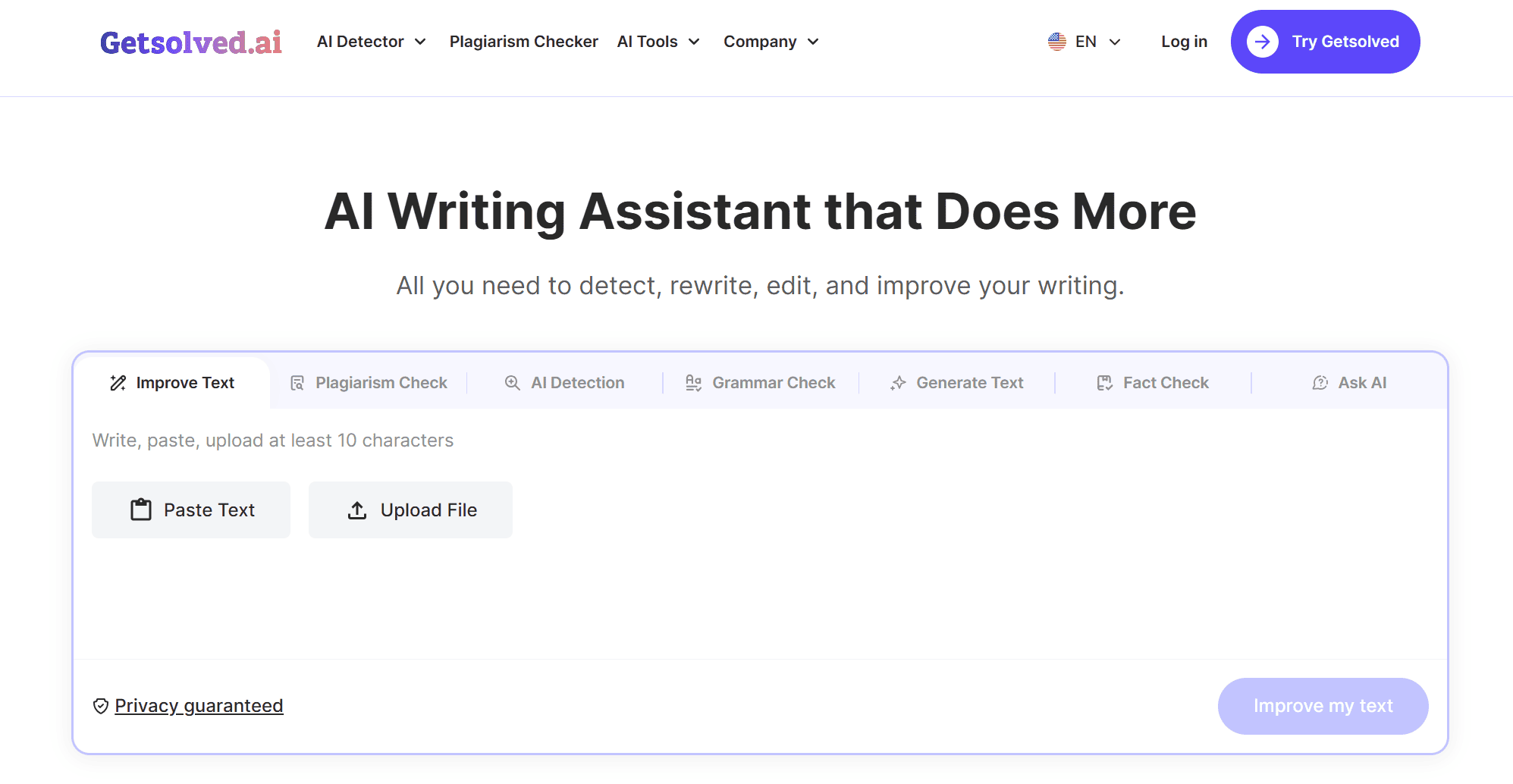
I was already familiar with some of GetSolved’s tools. I’d used both the fact checker and the AI detector before and had been pretty happy with them. What I didn’t know was that it also has an AI story generator, so I was curious to see whether it could hold its own among fiction tools and how it could be used alongside the platform’s other features.
The story generator is simple to use: you type in an idea, choose a genre and a tone, and a fully story draft comes back in seconds. However, the real advantage of GetSolved is that you can then use the AI Writing Assistant in order to check grammar, generate more text, and run AI detection and plagiarism checks.
What I like the most is that it still leaves you a lot of creative freedom. It gives you something to react to and build on, but the decisions stay yours, and you never get lazy.
The story generator and editing tools are on the paid plans, but you can try everything with a $2 seven-day pass before committing to $7.99/month on annual billing.
4. Claude: Best for natural prose and whole-manuscript feedback
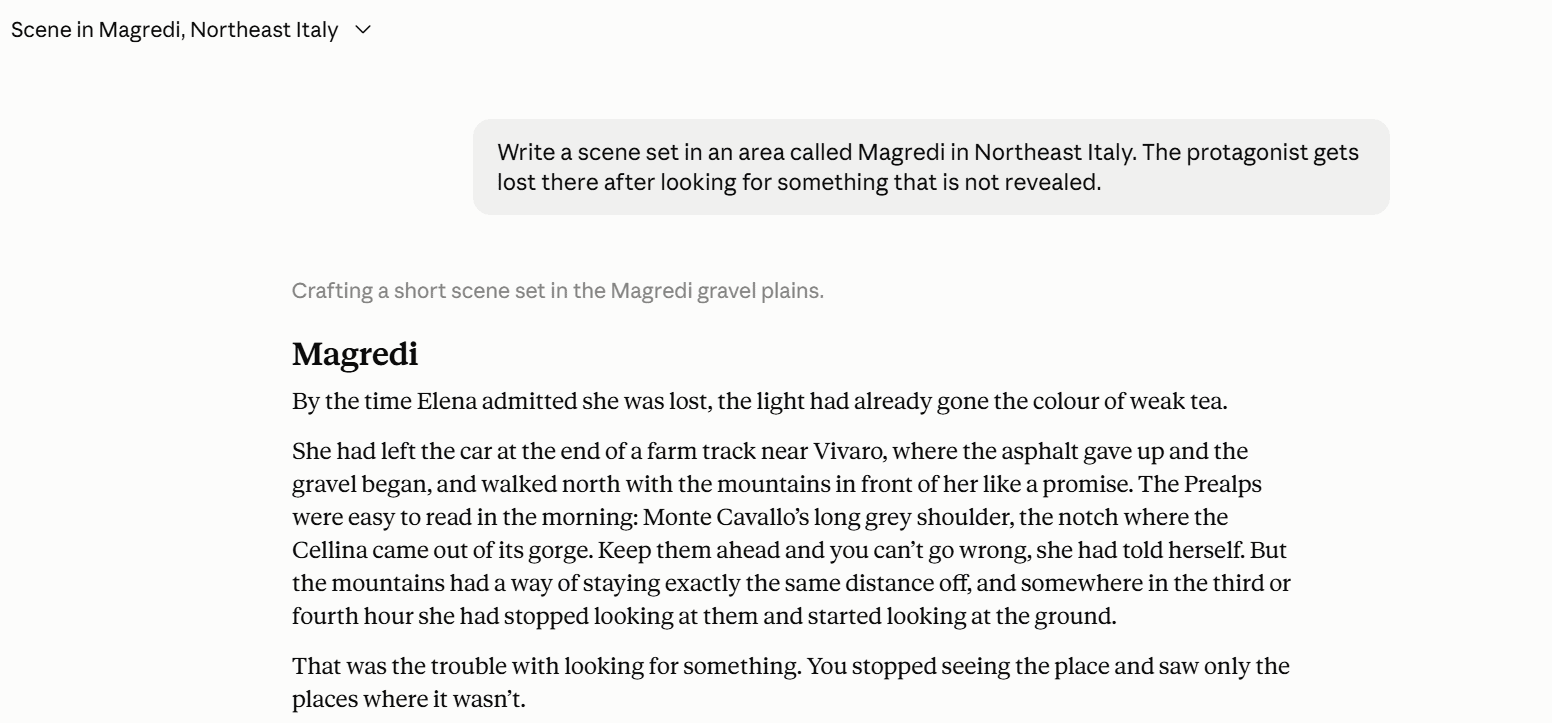
I expected a general-purpose chatbot to make this list, but Claude exceeded my expectations. I asked it to write a short scene about a character getting lost in an arid, mysterious landscape in Europe; the setting felt incredibly realistic, as did the protagonist’s thoughts.
The best part, however, was the feedback. I asked it to be honest about some chapters I had already written, and it managed to identify several areas for improvement, both in terms of structure and pacing.
My advice here is to use the “Projects” feature. I created one for my book and uploaded my story bible, my outline, and the chapter I had already finished. From that point on, I provided my instructions, and every new chat within that project was already familiar with the story.
However, be aware that there is no actual manuscript structure or book export function, so you will need to do your writing elsewhere. Also, it restricts explicit content, and you risk getting banned if you attempt to include it.
5. NovelAI: Best for genre and dark fiction
My story has one scene I was almost sure most tools would refuse to write, so I saved it for NovelAI, which has a reputation for not censoring mature themes. It wrote the scene without any problem. If your thing is horror, grimdark fantasy, or explicit romance, that’s reason enough to give it a try. And since your stories are encrypted, you don’t have to worry too much about privacy.
Working with it feels a bit different from the other tools. You don’t ask for a chapter; you write a few lines, let NovelAI continue, and keep going back and forth. To keep it on track, there are three places to put information:
- Memory: the big-picture facts the AI should never forget
- Author’s Note: where the story should go in the next few paragraphs
- Lorebook: characters and places, which load automatically whenever their name appears in the text
This made it really easy to try out different directions for the same scene. On the other hand, it struggled to keep the overall arc of the book consistent, so it’s better for single scenes than for planning a whole novel.
Paid plans range from $10 to $25 per month.
6. DreamGen: Best for roleplay and interactive fiction
With DreamGen, I was able to set up my plot, setting, writing style, and several characters, then directed the story scene by scene. It’s uncensored for verified adults, so it sits alongside NovelAI for mature fiction.
What stood out in my testing:
- The Scenario Codex, which defines your world and cast up front
- Steering controls to nudge the story where you want it
- Separate Roleplay and Story modes, so you can switch from chat to prose
Keep in mind, though, that the Starter plan’s window is only 5,000 tokens, and in longer sessions the story started to lose earlier details. For serious projects, the Advanced (15,000) or Pro (30,000) plan is a better fit.
7. Squibler: Best for going from premise to first draft fast
Squibler gave me the fastest “whole book” experience of any tool I tried. I pasted in my premise, and it built a chapter-and-scene outline, then started drafting thousands of words almost immediately. Pretty impressive!
Overall, it’s a fantastic way to beat the blank page, but treat what it gives you as a zero draft. Some of my generated scenes circled back over the same beats, and the characters it created didn’t appear in Elements automatically, so expect to cut, reorganize, and rewrite.
The free plan gives you 1,000 AI credits a month, which was enough for me to judge it properly. Paid plans let you generate a full 200-300-page manuscript.
8. ChatGPT: Best for outlines
ChatGPT was the first option I tried, and I suspect I’m not the only one. After all, it’s the first chatbot most of us started using, and many still use it every single day.
It’s worth noting right away that it isn’t particularly useful for writing entire scenes; rather, it’s great for creating outlines. In my case, it suggested 5 different plot twists and three possible structures. Naturally, not everything was worth keeping, but I needed just one of each after all.
The main issue is that it’s bad at providing feedback. Without further prompting, it treats you as if you were Dostoevsky himself. If you ask it to be more critical, it finds fault with absolutely everything.
9. ProWritingAid: Best for self-editing a finished draft
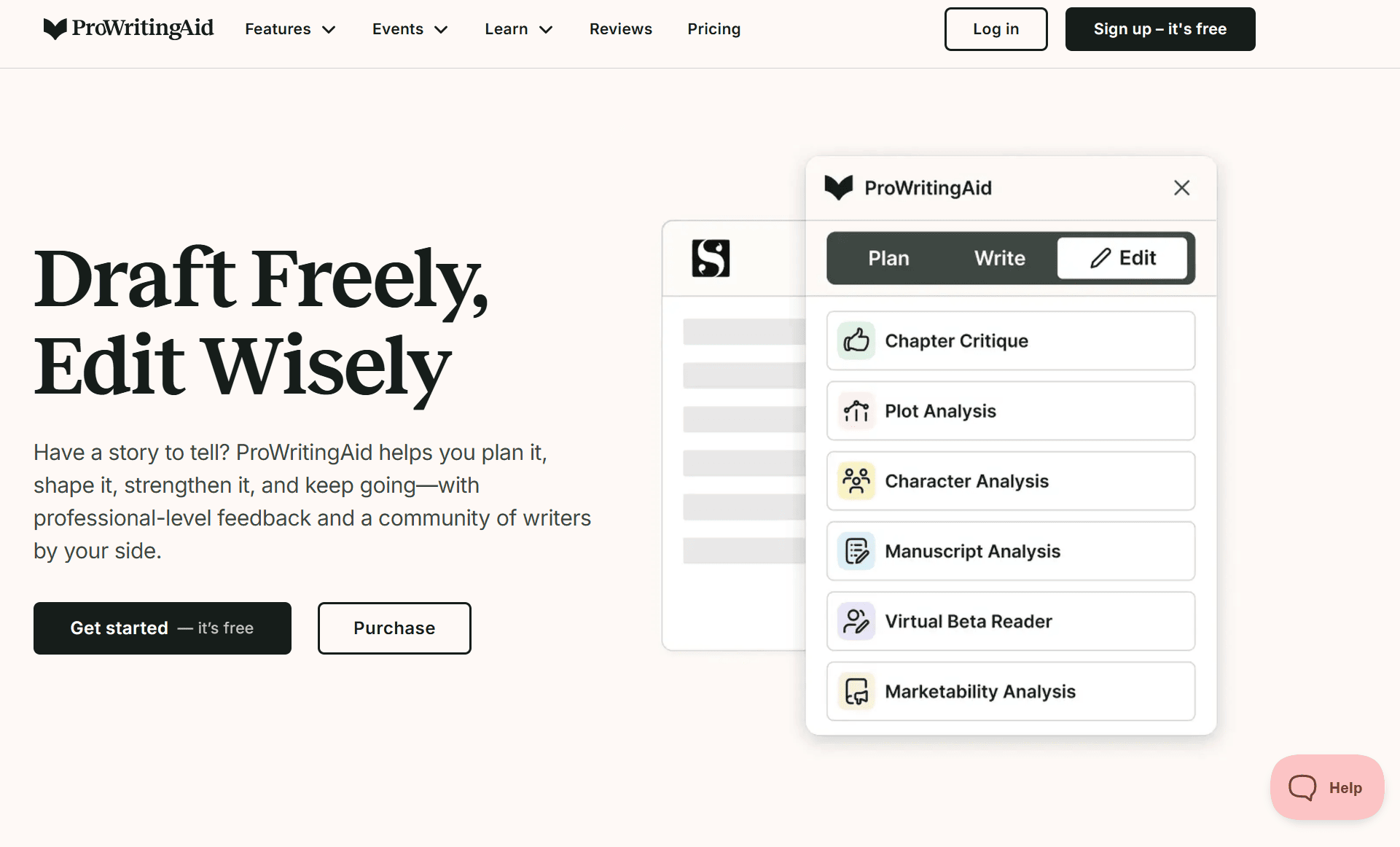
ProWritingAid doesn’t write your story but rather helps you fix the one you’ve already written yourself. That means I used it only once I had already drafted some chapters myself or with the help of other tools in this list. It had 25+ reports built for fiction, such as pacing, dialogue tags, sensory detail, echoes, sentence variety, and overused words.
The feature that surprised me most, though, was Chapter Critique. I ran it on one of my chapters, and it came back with comments on tension, point of view, and character motivation. That felt closer to an early beta read than a grammar check.
How to Choose The Best Tool for You
It’s hard to say which of these AI writing tools for fiction is the best. After all, every writer works differently. Some of us need help getting words on the page, some need a way to keep a sprawling world consistent, and others just want a second pair of eyes once the draft is done. After testing these 9 tools, the right choice comes down to where you are in your process and what kind of story you’re telling.
If I were to recommend just one, it would be Sudowrite. It’s the only tool I tested that’s built entirely around fiction, with story-tuned models and a Story Bible that keeps your characters and plot consistent from scene to scene. However, GetSolved’s AI Writing Assistant is also a truly useful option, especially if you want to keep full control of your creativity.