
These days, AI detection tools have become an important part of the writing workflow. Before submitting a paper, one should always check the AI score of their text to avoid receiving unpleasant emails from professors or bosses claiming the work is not theirs. Because of that, we are sure lots of you have asked at least once: how does a piece of software even make that call? How do AI detection tools work?
🎯 To put it shortly, AI detectors don’t read for meaning the way a person does. They run statistical checks on how predictable, varied, and structured a piece of writing is, then convert that into a score.
Today we want to explain what’s actually happening under the hood. Let’s discuss why your work may be flagged as AI, why the results aren’t as clean as a single percentage makes them look, and how reliable those detection results are.
How AI Detectors Work: The Core Signals Explained
To begin with, let’s understand what an AI detector is. An AI detector is software that estimates the likelihood that a piece of text was generated by a language model rather than a person. It doesn’t compare your writing to the original source the way a plagiarism checker does. Instead, it studies the text itself: word choice, sentence rhythm, structural patterns.
For example, length matters here more than most people expect. A three-sentence paragraph gives a detector almost nothing to work with, while a full essay hands it hundreds of data points. So, it helps to check text length before analysis, since a detector’s confidence tends to increase with word count and drops sharply below a few hundred words.
But sentence length is not the main signal the detector uses to identify AI-generated text. There is much more behind it.
Perplexity: Why Predictable Text Raises Flags
One of the main features the models are analyzing is perplexity. Language models generate text by predicting the most statistically likely next word, over and over. Perplexity measures how surprising or unlikely a sequence of words is to a model doing that same kind of prediction.
Low perplexity means the wording followed an obvious, well-worn path. High perplexity means the text took a less predictable route: an odd word choice, an unusual turn of phrase, a sentence that doesn’t quite go where you’d expect. Human writing tends to run higher on this scale simply because people are inconsistent in ways a probability model isn’t trained to reproduce.
That’s also the root of the false-positive problem. Someone writing in short, plain, grammatically correct sentences can land in the same low-perplexity range as AI output, even when no AI was involved anywhere in the process.
Burstiness: The Rhythm a Detector Listens for
One of the common signs of AI-generated content is burstiness. It measures how much sentence length and structure vary across a document. Human writing tends to be uneven: a short punchy sentence, then a longer one that wanders, then something clipped again. Earlier AI models, by contrast, tended to produce sentences that landed in a narrower, more consistent length range, paragraph after paragraph.
Newer models have gotten noticeably better at varying their own rhythm. It is a big part of why detection has gotten harder over the past couple of years, not easier. A model trained specifically to avoid that “too even” cadence can slip past a burstiness check that would have easily caught an earlier version of the same tool.
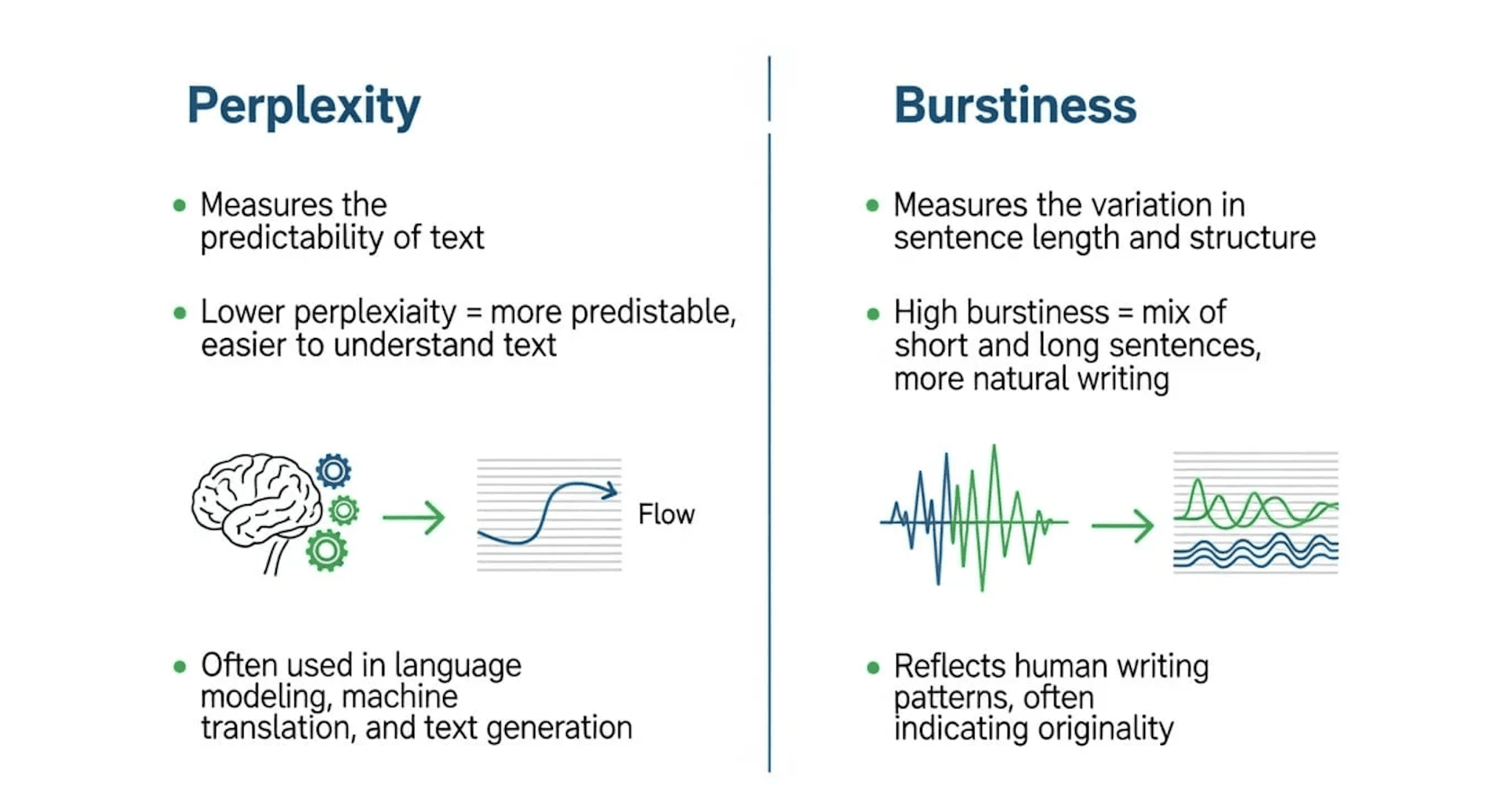
Comparison of Perplexity and Burstiness taken from Intellectual Lead.
Classifiers: The Model Doing the Actual Judging of AI Content
Next is a classifier, which AI detection uses to determine whether your text is AI-generated. It’s a machine learning model trained on large sets of text that are already labeled (some written by a human, some generated by AI), so it learns which combinations of features tend to appear in each group.
Vocabulary richness, sentence complexity, repetition patterns, and even punctuation habits all feed into that judgment. You can get a rough feel for a few of those yourself by running a passage through a tool that lets you analyze the readability of a passage. Just compare the sentence-length and word-complexity numbers against something you know was AI-written. When new text comes in, the classifier scores it against everything it learned during training and outputs a probability. And remember one thing: this distinction matters more than it sounds like it should. A 91% score means the writing statistically resembles the AI-labeled examples the model was trained on, not that AI involvement has been proven.
Other Signals: Stylometry and Watermarking in AI Detection Work
A couple of other methods show up less often but are worth knowing about.
Stylometric analysis examines an author’s habitual patterns: favorite transition words, typical sentence openers, and how often they repeat a phrase. It’s more useful for confirming whether two texts share an author than for flagging AI on its own.
AI detectors’ watermarks work differently. Some AI models can be built to subtly nudge their word choices in ways that a detector trained to look for them can pick up on, even though a human reader would never notice. It’s a promising idea in theory, but it only works if the model in question actually applies a watermark. By the way, even light paraphrasing tends to scramble the signal beyond recognition.
Some tools also check metadata like file properties, edit history, and timestamps. A Google Doc’s revision history, for instance, can show whether a piece of text was typed gradually over an hour or pasted in as one block, which tells you something a perplexity score never could. That kind of evidence sits outside the writing itself, so it isn’t affected by how predictable or varied the sentences happen to be.
How Reliable Are AI Content Detectors?
After all, the main question is whether such tools are reliable.
Let’s start with the fact that OpenAI shut down its own AI-writing classifier in 2023, less than a year after launching it, after acknowledging that the tool’s accuracy simply wasn’t good enough to stand behind. That incident alone tells us a lot: if the company that built ChatGPT admits its own detector couldn’t be trusted, it’s a direct signal of how difficult AI detection really is.
Academic benchmarks like RAID compare human and AI-assisted text to test detectors and report accuracy scores that often look strong on paper. Real-world testing tells a messier story because actual writing rarely resembles a clean benchmark sample. Text gets edited, mixed with quotes, written by someone whose second language is not English, or run through a paraphrasing tool before anyone checks it. A benchmark measures a controlled scenario; a classroom, a newsroom, or a hiring pipeline is anything but controlled, and that gap shows up in the results people actually experience.
Why Does Human Writing Get Flagged as AI Text Too?
False positives aren’t rare edge cases — they’re a predictable side effect of how these tools work. Stanford’s peer-reviewed study on non-native English writers found detectors wrongly flagging a majority of genuinely human essays as AI-generated. Largely, it happens because simpler vocabulary and more uniform sentence structure produce the same statistical fingerprint that the models associate with machine writing.
Formally structured, carefully edited writing runs into the same issue, regardless of who wrote it or why. Clear topic sentences, consistent transitions, and grammatically tight prose are good writing by any normal standard and are also exactly the kind of writing that reads as more predictable to a perplexity check.
How Different AI Checkers Put This Into Practice
The underlying methods are similar across the category. Still, the implementation of AI checkers varies enough to change the results you get. Some AI detectors focus on identifying AI-generated patterns, while others can be confusing.
GPTZero’s Approach
GPTZero is considered one of the more advanced AI tools available today. Its detection model uses machine learning to analyze perplexity and burstiness. Then it layers sentence-level highlighting and an ESL-focused adjustment on top of those original two signals over time. That combination helps it identify patterns indicative of AI generation in known AI outputs from models like ChatGPT, while accounting for how human writing tends to differ in rhythm from AI-generated text.
We’ve covered how GPTZero applies AI detection in more depth, including where its real-world accuracy tends to diverge from its benchmark numbers. By the way, a gap that shows up across most tools that use machine learning models to judge human and AI text, rather than directly checking authorship.
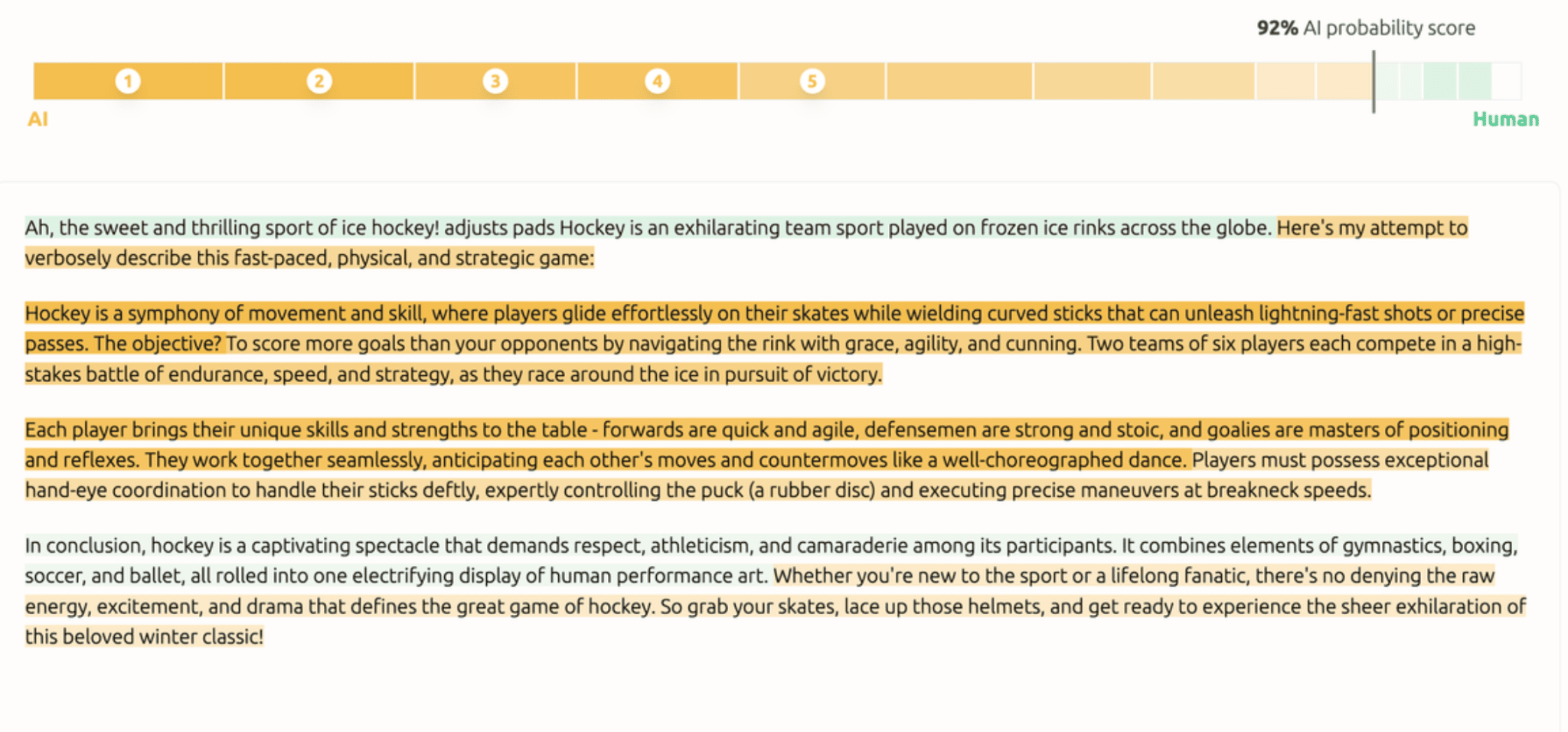
Sentence-level analysis / Image taken from GPTZero
Grammarly’s Approach
Grammarly folds detection into the same panel as its plagiarism checker, scoring documents in sections rather than returning a single clean percentage for the whole piece. We ran our own tests on how Grammarly approaches AI detection and found it flagged a meaningful share of text we knew was entirely human-written — a useful reminder that implementation differences translate directly into different real-world risks.
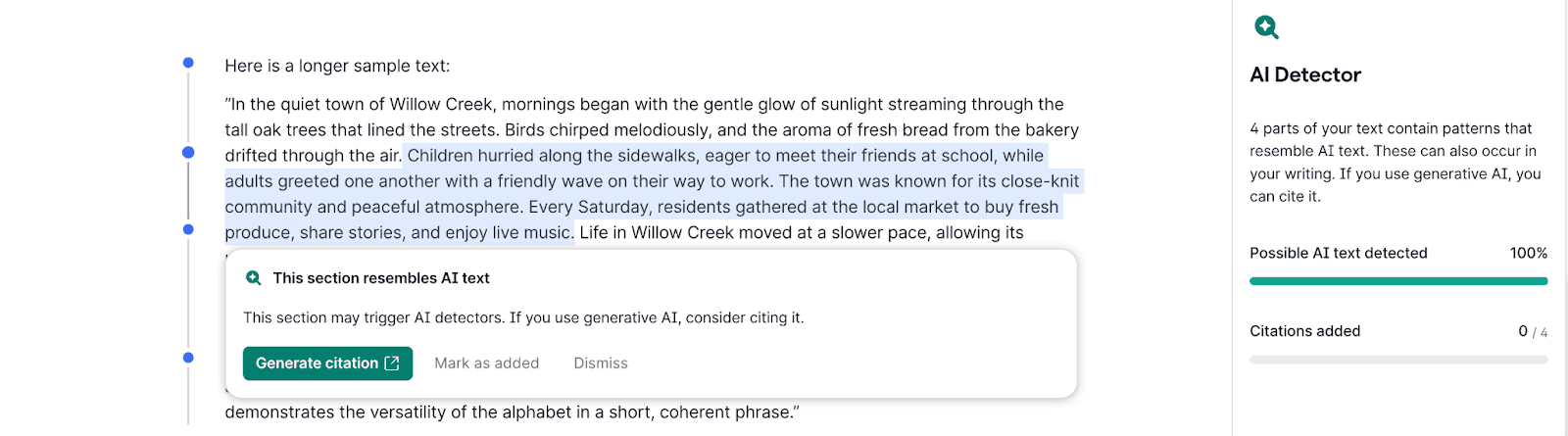
Text Analysis by Grammarly/ Image taken from Grammarly
GetSolved’s Approach
GetSolved runs the same core perplexity- and pattern-based checks as the tools above, checking against output from ChatGPT, GPT-5, Claude, and Gemini. It pairs the overall score with sentence-level flags that name the specific linguistic cue behind each one. You can revise a flagged passage and rescan it in the same session to see whether the edit actually moved the score.
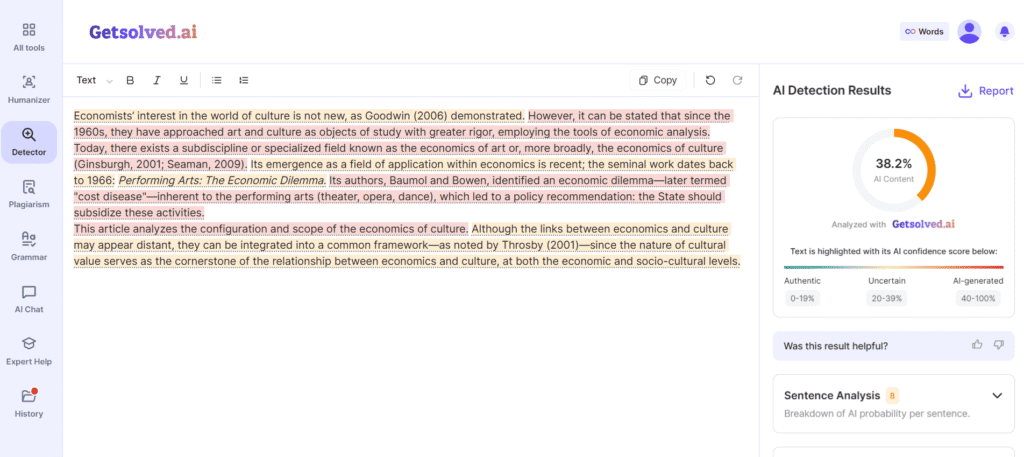
Text Analysis by GetSolved / Images taken from GetSolved
Best Practices for Using AI or Why Use AI Detectors Responsibly
None of this means these tools are useless or that detectors can lead to unfair marks. However, it means they’re one input, not a verdict. AI detectors can be useful, as a high score is a reason to look more closely at your writing patterns. We also recommend cross-checking a flagged result with a second tool, reviewing the specific sentences that triggered the flag, and asking the writer directly about their process. It will catch more genuine problems, such as identifying patterns indicative of AI, than trusting any single score in isolation.
Of course, you can try AI detection on your own text and analyze the actual flagged sections on your own. You can analyze why your text was written by an AI based on the detector’s mark and perhaps understand what can be changed in your writing style. This is a much more responsible use of AI, rather than just trusting a machine tool.
AI detectors matter a lot in modern writing, but human touch and analysis will always matter more.
FAQ
Do AI content detectors work?
They work as probability estimates, not as proof. They can point out writing that statistically resembles known AI patterns. They can’t confirm authorship the way a fingerprint or a signature can. Both false positives and false negatives happen regularly.
Can AI detectors be fooled?
Yes, fairly easily in many cases. Light paraphrasing changes vocabulary without changing sentence rhythm much, which limits how well AI detectors analyze your text. Heavier rewriting, such as genuinely varying sentence length and structure, reduces detection scores substantially across most tests.
Why did my own writing get flagged as AI?
It can happen because your writing is unusually predictable or evenly structured by the detector’s standards. AI detectors analyze writing patterns, so formal, well-edited writing or text from non-native English speakers, whose sentence patterns statistically resemble those that low-perplexity detectors can associate with AI.
Are some AI detectors more accurate than others?
Accuracy varies by tool, by how the text was generated, and by how heavily it’s been edited. Benchmark scores are a reasonable starting point for comparison, but they consistently overstate a detector’s performance on messy, real-world writing.