
There’s a kind of tired that’s hard to explain. You used AI to handle most of the day’s tasks — emails drafted, reports summarized, research pulled. Nothing was technically difficult. But by evening, your focus is gone and your mind feels slow and spent.
Researchers now have a name for this: AI brain fry — cognitive fatigue that comes not from hard work, but from constantly monitoring, verifying, and correcting what AI produces. And recent data on Gen Z workplace AI use suggests it’s more common than most workplaces recognize.
5 Key Findings
- 75% of Gen Z AI users say AI has made them more productive — but the symptom data tells a more complicated story
- 36% experience mental fog or difficulty focusing on a near-daily basis linked to AI-heavy work
- 52% have avoided using AI specifically because they found it too mentally draining to oversee
- 40% need a full evening of rest to recover after an AI-heavy workday
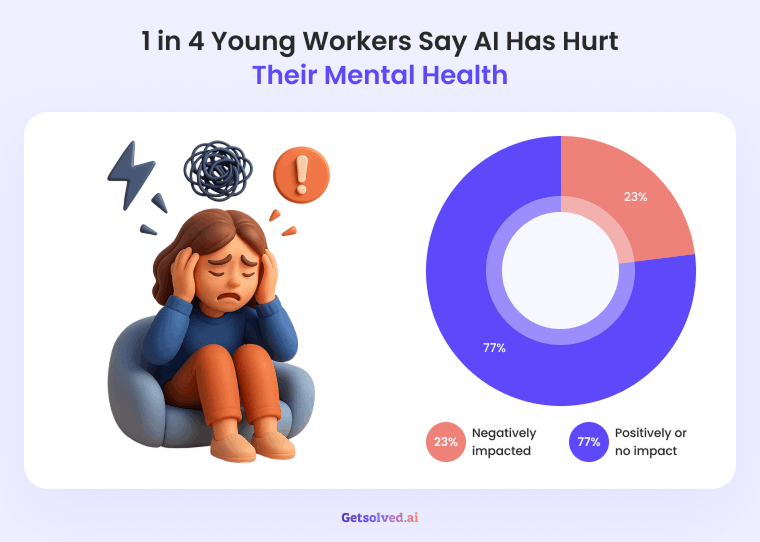
- 23% say AI at work has negatively affected their mental health
The Productivity Side: AI Is Working
Start with the good news: AI is genuinely making people more productive — and the data on Gen Z workplace AI use backs it up.
In a survey of 3,000 Gen Z professionals aged 18 to 28 who use AI daily, 75% said AI had made them more productive at work. Of those, 24% described the improvement as significant — a real shift in how much they accomplish, not just a marginal gain. Another 51% report being slightly more productive.
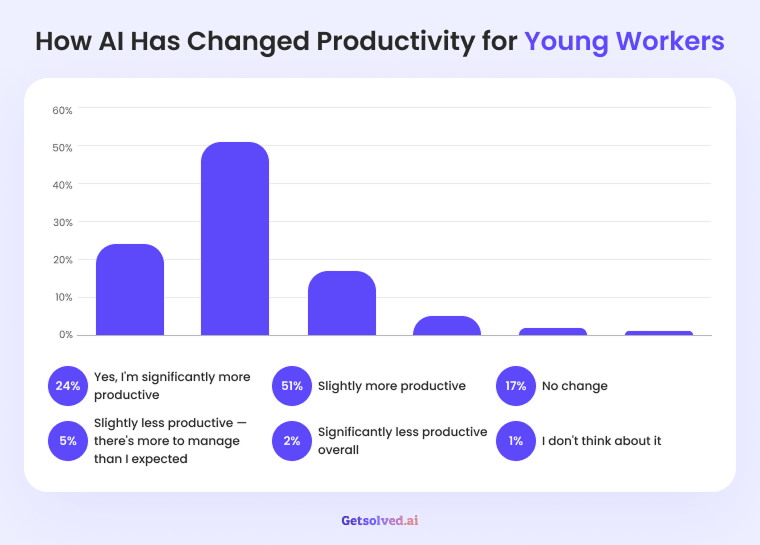
A further 66% say AI has made their work life easier overall — and for most, the change is tangible, not just theoretical. Less time staring at a blank page. Fewer hours lost to formatting, summarizing, and sorting through messy notes. Tasks that used to take an afternoon now take twenty minutes.
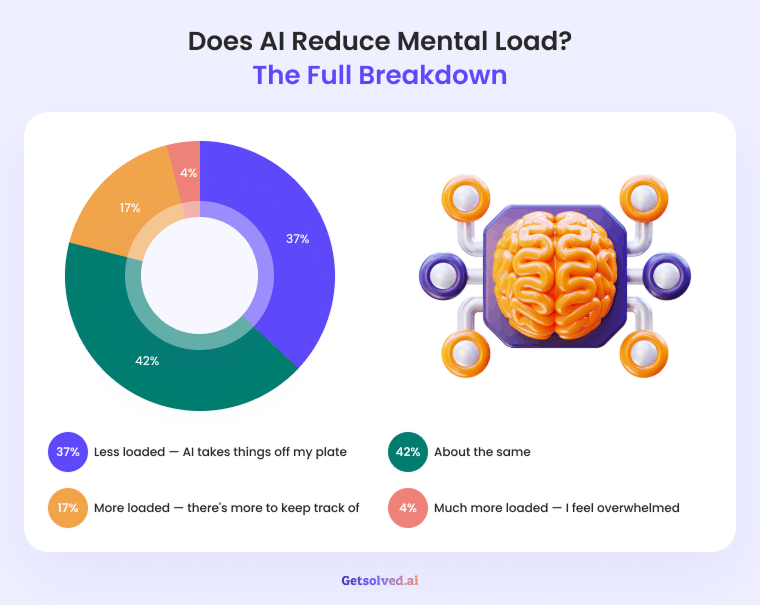
For the 37% who report a lower mental load, the benefits are practical: less time lost to formatting, summarizing, and routine admin.
But the picture isn’t uniform. How AI affects mental load varies significantly depending on the person and the role.
60% of Gen Z workers say AI helps them work faster and with less effort. And 49% use AI regularly to develop workplace skills.
The productivity case for AI is real. The question is what comes with it.
The Skills Benefit: What AI Helps People Get Better At
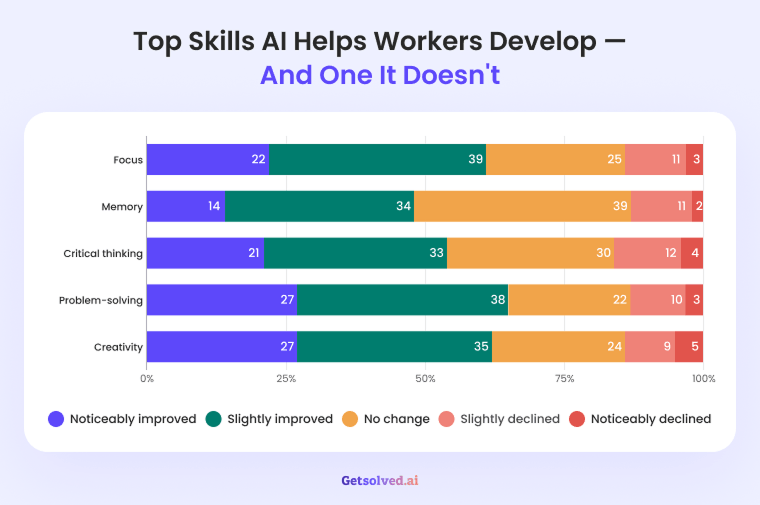
For many workers, AI isn’t making them less capable — it’s helping them improve the skills that matter most. Reported gains from the same survey:
- 65% – Problem-solving
- 62% – Creativity
- 61% – Focus
- 54% – Critical thinking
The one outlier is memory — only 48% reported improvement there, the lowest of all skills measured. When AI summarizes, stores, and retrieves information for you, it’s easy to stop retaining knowledge yourself. The long-term implications of that shift are still being studied.
The Other Side: What the Symptom Data Shows
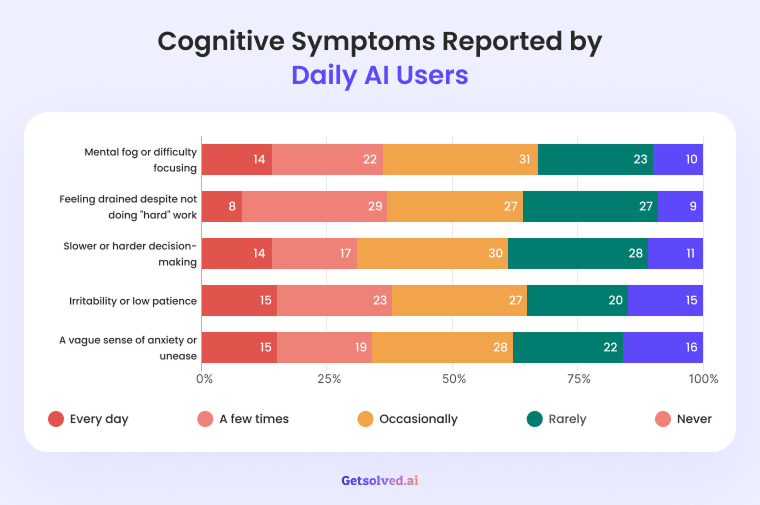
Here’s where the numbers get more complicated.
When the same workers were asked about the cognitive and emotional effects of AI-heavy work, the picture looked different from the productivity headlines:
- 36% deal with mental fog or trouble focusing almost every day
- 37% feel worn out even when the work itself wasn’t hard
- 34% regularly feel irritable or less patient
- 34% experience a vague, undefined sense of anxiety
The cumulative effect goes beyond daily discomfort. AI directly hurts the mental health of every fourth user.
Researchers describe this pattern as “AI brain fry” — cognitive fatigue from constantly monitoring, verifying, and managing AI outputs. Reported symptoms include a buzzing mental sensation, difficulty making decisions, and headaches after extended AI oversight sessions.
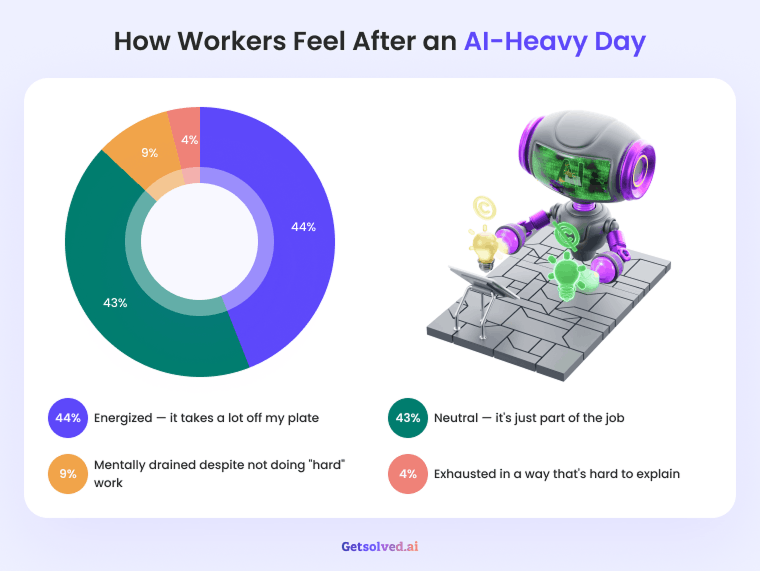
Interestingly, 87% of young workers say they feel neutral or energized after AI-heavy days — even as they report these same symptoms. Researchers suggest this reflects normalization: when fatigue becomes routine, it stops registering as a problem. That doesn’t mean it isn’t one.
The Recovery Gap
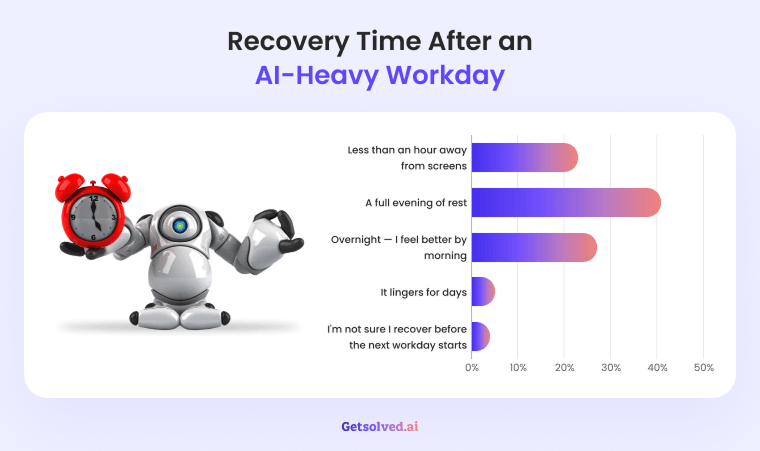
After an AI-intensive workday, how long does it take to feel like yourself again?
- 41% say they need a full evening of rest to recover
- 27% feel better by morning
- 5% say the fatigue lingers for days
- 4% aren’t sure they’ll recover before the next workday starts
That means roughly one in ten young professionals carries ongoing, unresolved fatigue from one workday into the next.
If a tool helps you finish work 20% faster but leaves you 30% more drained the next day, the net gain isn’t clear. Recent research shows that mental fatigue and cognitive strain have now surpassed workload volume as the leading predictors of burnout.
The Oversight Problem
Anyone who has asked AI to draft something, then spent longer checking it than writing it themselves, will recognize this finding: 52% of young professionals have avoided using AI because they found it too mentally tiring to supervise. Of those, 20% avoid it regularly.
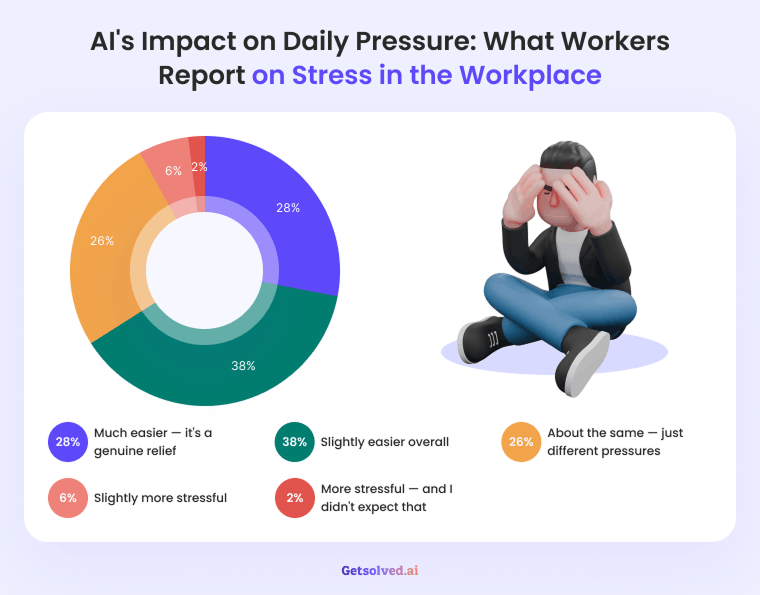
This isn’t skepticism about AI. This is the generation most comfortable with these tools making a practical calculation: the effort to monitor and correct the output isn’t always worth the time saved.
The two most cited reasons:
- 25% say AI giving wrong information has made their jobs harder
- 12% cite the need to fact-check everything constantly as the main issue — not that AI is occasionally wrong, but that it could be wrong at any time, which means every result needs careful review.
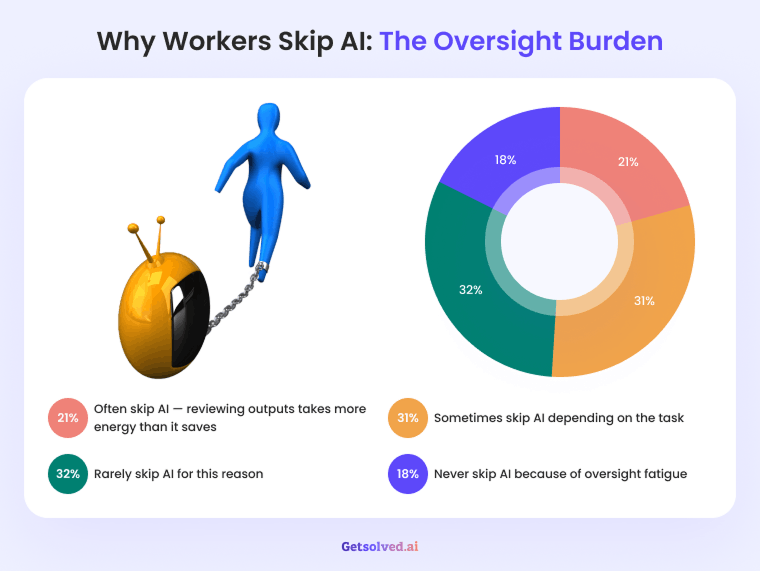
If AI completes a task 40% faster, but the output requires twice as much review as work you’d have done yourself, the time savings disappears — along with some of your trust in the results.
What Employers Aren’t Addressing
Companies are moving quickly to adopt AI. Most are moving slowly to support the people using it.
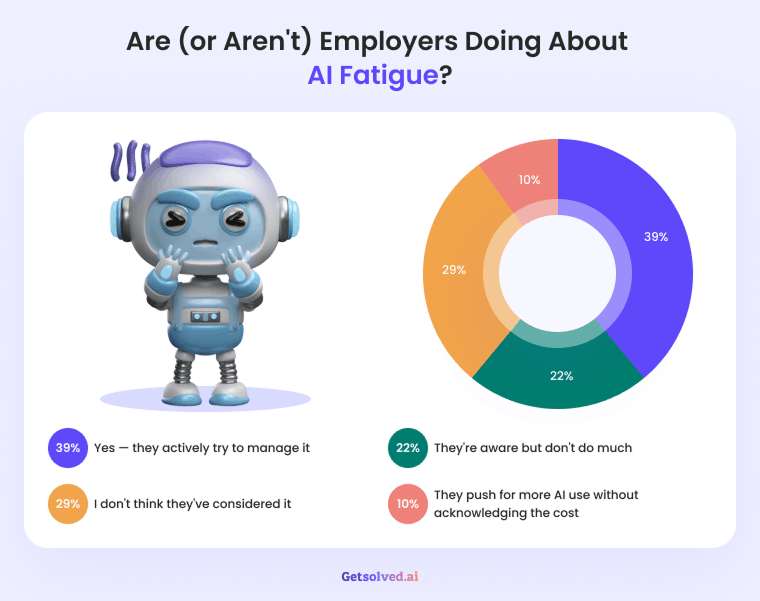
When asked whether their employer actively addresses the mental load from AI work:
- 51%said their employer does not address it
- 29%said the issue simply hasn’t been considered
- 10%said their employer is pushing for more AI use without acknowledging the cost
Only 39% work somewhere that genuinely tries to manage the cognitive impact of AI adoption. Separately, 41% of young workers feel anxious about AI at work, pointing to a widening gap between exposure and support.
What This Means
AI is improving productivity — that’s not in question. But the gains come with a cognitive cost that most workplaces haven’t started measuring, let alone managing.
Mental fog, fatigue, and the effort of constant AI oversight are real. For professionals dealing with them daily, tools that make work cleaner, clearer, and easier to verify aren’t a luxury. They’re part of making AI use sustainable.
Methodology
This study surveyed 3000 Americans aged 18–28 residing in the United States. The survey was conducted in August 2026. Participants were recruited via online panels using Random Device Engagement (RDE) to ensure a diverse and representative sample. The study did not target specific ethnicities or social backgrounds. Percentages are rounded to the nearest whole number and, for multiple-selection questions, may total more than 100%.